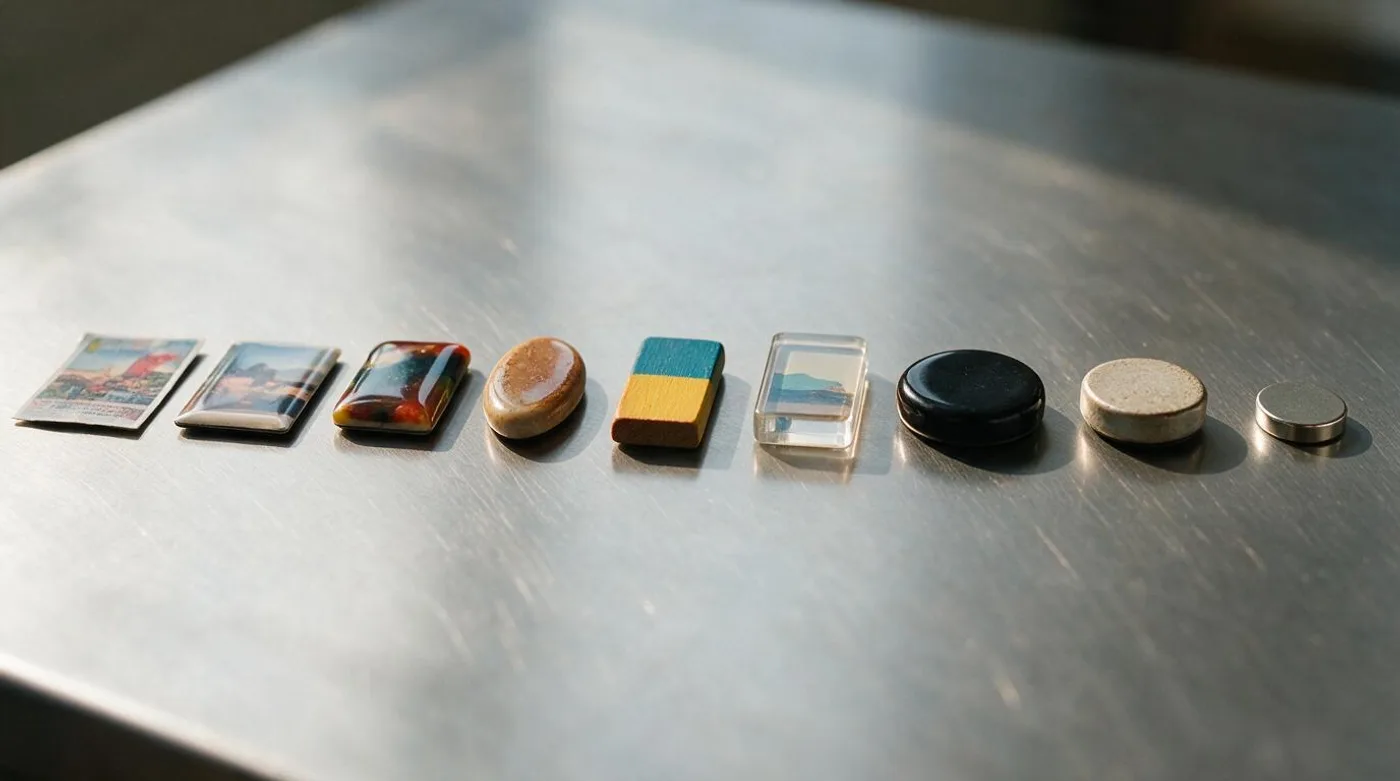
Types of fridge magnet
Tip a kitchen drawer of magnets onto the table and you can sort most of them without reading a single label. The floppy ones bend and weigh nothing. The ones with a picture behind a hard clear window have a steel rim you can catch with a thumbnail. Anything cold and heavy is cast resin or glazed ceramic. Anything that leaps across the table to join another magnet is neodymium, and you now have a small problem to solve with a fingernail.
Four backs cover nearly every magnet sold for a fridge door, and the back is the part that decides whether the thing works. The front is decoration.
What the back tells you
A flexible sheet is ferrite powder mixed into vinyl, rolled to 0.5 or 0.75 mm and cut to shape. The whole back is the magnet, and it is a weak one: about 300 Gauss at the surface, 60 g of pull for a 50 x 50 mm square in 0.5 mm, 110 g for the same square in 0.75 mm.
A crimped steel shell hides a flat ferrite magnet behind the print. That is the pressed photo magnet, roughly 4 mm thick front to back and usually 57 mm round or 64 mm square. No seller we cover publishes what it holds, and we have not measured one, but a solid ferrite disc has several times the magnetic material of the same footprint in sheet, so it holds several times as much.
A separate ferrite disc glued to the back is what souvenirs, wooden cutouts and resin castings use. A 20 x 3 mm C8 disc holds 500 g on a bare plate. A 25 x 5 mm disc holds 1,100 g. Anything smaller than 20 mm holds less, and manufacturers rarely print the disc size on the box.
Bare neodymium is the fourth back, and it is a different order of magnitude. A 10 x 2 mm N42 disc holds 1,400 g. A 20 x 3 mm holds 3,500 g, roughly seven times a ferrite disc of exactly the same size.
Every figure above comes off a flat bare steel plate. A painted fridge door keeps 60 to 80 percent of it, so multiply by about 0.7 before you decide anything. The magnet strength chart has the full list.
The ten types side by side
| Type | Body | Back | Hold on bare plate |
|---|---|---|---|
| Photo | Print under mylar in a steel shell, or print on vinyl | Ferrite slug in the shell, or the sheet itself | Pressed figure not published, 60 to 110 g for 50 mm of sheet |
| Souvenir | Resin dome, cast polyresin, enamelled steel, wood, tin | Ferrite disc, often 20 mm or smaller | 500 g for a 20 x 3 mm disc, less as the disc shrinks |
| Decorative and art | Gallery print, ceramic tile, glass cabochon, resin | Sheet pad or ferrite disc | 60 to 110 g on sheet, 500 g on a 20 x 3 mm disc |
| Neodymium | Nickel plated metal, sometimes a plastic cap | The magnet is the whole object | 1,400 g at 10 x 2 mm, 3,500 g at 20 x 3 mm |
| Flexible rubber | Printed or plain vinyl, die cut | The same vinyl | 60 g at 0.5 mm, 110 g at 0.75 mm per 50 mm square |
| Promotional and business | Printed card stock or direct print | Flexible sheet, usually 0.5 mm | Under 60 g, since a business card is smaller than 50 mm square |
| Letters, numbers, kids | Foam, molded plastic, wood | A small patch of sheet in a recess | A fraction of 60 g, scaled down by the patch area |
| Whiteboard and office | Clips, hooks, plain discs, plastic housings | Ferrite disc or neodymium | 500 g for a 20 x 3 mm ferrite, 6,000 g for a 16 mm neodymium pot hook |
| 3D resin | Cast and hand painted relief | Ferrite disc set into the casting | 500 g for a 20 x 3 mm disc, less through a recess |
| Wood and acrylic | Laser cut ply, engraved acrylic | Disc in a drilled pocket, or sheet glued flat | 500 g on a disc, 60 to 110 g on sheet |
Thickness, and why it costs you pull
Thickness in this table means two different things. In a flexible sheet it is the magnet itself, and going from 0.5 to 0.75 mm takes the hold from 60 g to 110 g. In everything else it is packaging sitting between the magnet and the steel.
That distance is expensive. Paint on a door already adds 0.1 to 0.2 mm, and every tenth of a millimeter costs a small disc roughly 10 percent of its pull. A resin casting with its disc sunk 1 mm into a well is fighting a gap several times worse than the paint, which is why a heavy souvenir with a proper looking disc on the back still creeps down the door overnight.
What each family is actually for
Sheet magnets hold paper, and not much paper. At 60 g a business card magnet manages a takeaway menu and gives up on a school newsletter. Buy them for the print, not the grip.
Ferrite disc backs sit in the middle. A 20 x 3 mm disc holds 500 g on a plate and about 350 g once the paint is in the way, which covers a stack of drawings, a wall calendar, or a magnet heavy enough to have some weight of its own. Pressed photo magnets run on ferrite too, held in a steel shell, and they hold several times what a printed sheet of the same size does. Nobody publishes the figure, so that is as precise as this gets.
Neodymium is what you buy when the magnet has a job. A 16 mm pot with a hook takes 6,000 g on a plate and will hang a bag of shopping off the door, though it will also pinch a finger hard enough to draw blood and should stay away from small children entirely.
Souvenir, decorative and 3D resin magnets are in a different business. They hold themselves up and nothing else, and most of the complaints about them are really complaints about an undersized disc.
Check the door before you buy any of them
None of this matters if the door is not magnetic. Austenitic stainless, grade 304, has a face-centered cubic structure stabilized by nickel and holds no magnetic domain at all, so a 6,000 g pot hook and a business card magnet perform identically on it, which is to say they fall off. Ferritic stainless, grade 430, is magnetic. Side panels on most models are painted mild steel and work even when the door does not, so a fridge that rejects everything still has two good walls. There is more on that in why magnets do not stick to stainless.
Usable door width runs 40 to 60 cm on most models, which is eight 57 mm rounds across a 50 cm door if you leave a little air between them. Work out how many you want before you order, because minimum order quantities vary from one magnet to twenty-five, and read what to look for on a listing that does not state its thickness in millimeters.
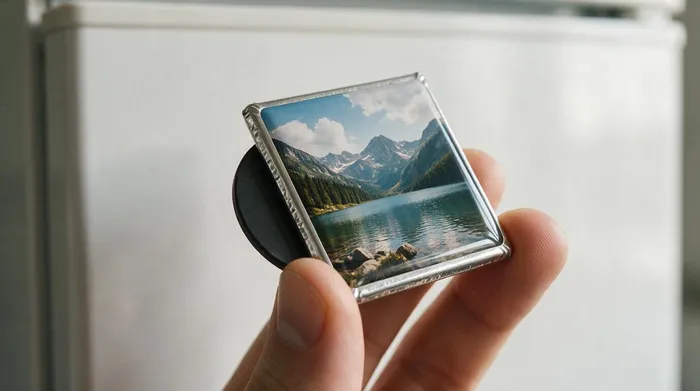
Photo fridge magnets: sheet and pressed construction
Compare the layers, edges, and backing of photo fridge magnets. A construction guide for reading specifications and checking a sample.

Souvenir and travel fridge magnets
How souvenir magnets are built, why so many slide down the door, what a good back looks like, and how to buy and store a collection.
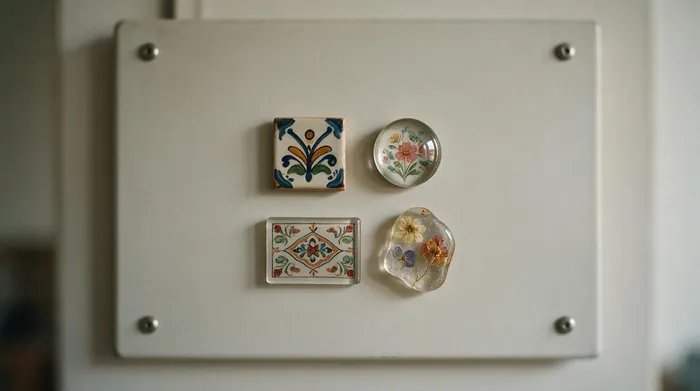
Decorative and art fridge magnets
Gallery prints, ceramic tiles, glass cabochons and pressed flowers. What each backing holds, how to mount a heavy one, and what fades.
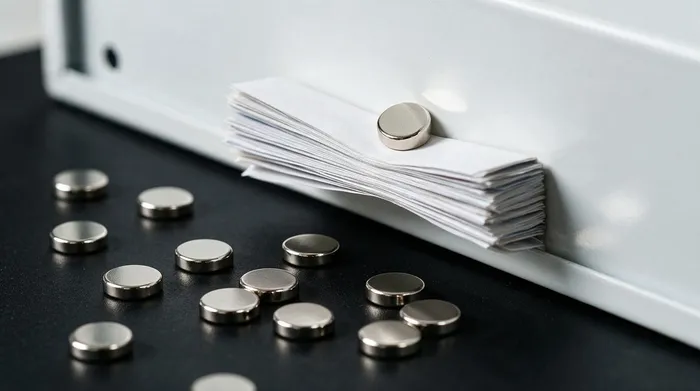
Neodymium fridge magnets
What N42 means, what each disc size holds, why they chip, the 80 C ceiling, and the safety rules that matter around children.
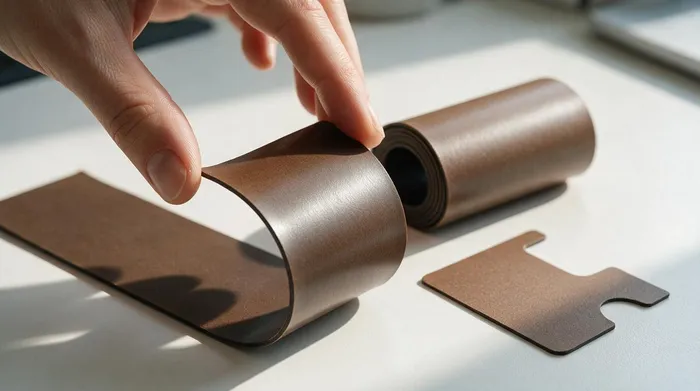
Flexible rubber and vinyl magnets
Ferrite powder in vinyl, 0.5 and 0.75 mm thick, holding 60 to 110 g at 50 by 50 mm. What sheet magnet is good at and where it slides.
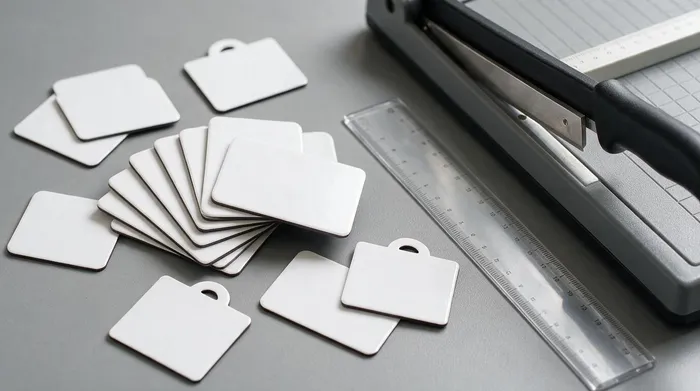
Promotional and business magnets
The pizza calendar, the estate agent card, the trade show handout. Sizes, sheet thickness, order quantities, print methods and proofing.
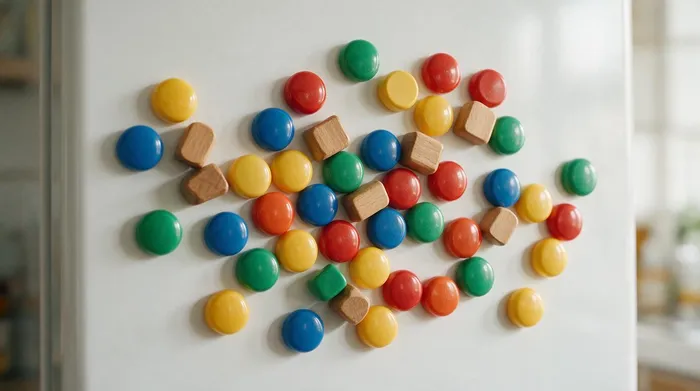
Letter and number magnets for kids
Foam letters, molded plastic sets, wooden alphabets and poetry tiles. What backs each one, what it holds, and how to handle the small-magnet risk.

Whiteboard and office magnets
Button, clip and hook magnets on a fridge door. What each holds, how to size one to a paper stack, and what to do when the door is not magnetic.

Cast resin and 3D novelty magnets
Food replicas, animals and dome-topped designs in cast resin. How they are made, what weight the disc on the back can take, and why domes go yellow.
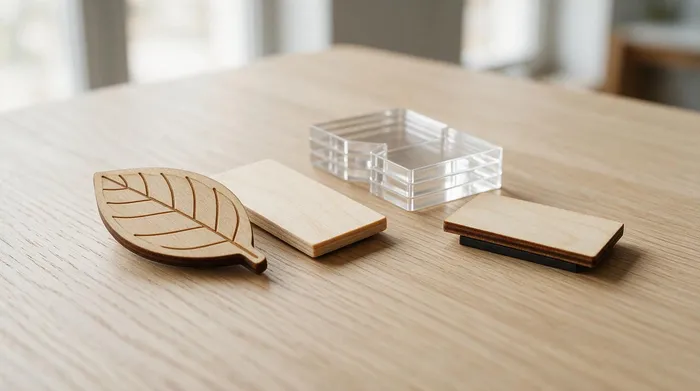
Wood and acrylic fridge magnets
Laser-cut plywood, engraved hardwood and printed acrylic. Adhesive choice, wood movement in a kitchen, and what a flat back does to the hold.