Neodymium fridge magnets
Neodymium fridge magnets are sintered NdFeB, usually grade N42. A 12 by 3 mm N42 disc holds about 2,500 g on bare steel, roughly seven times a ferrite disc the same size. They chip when dropped, stop working above about 80 C, and belong away from children.
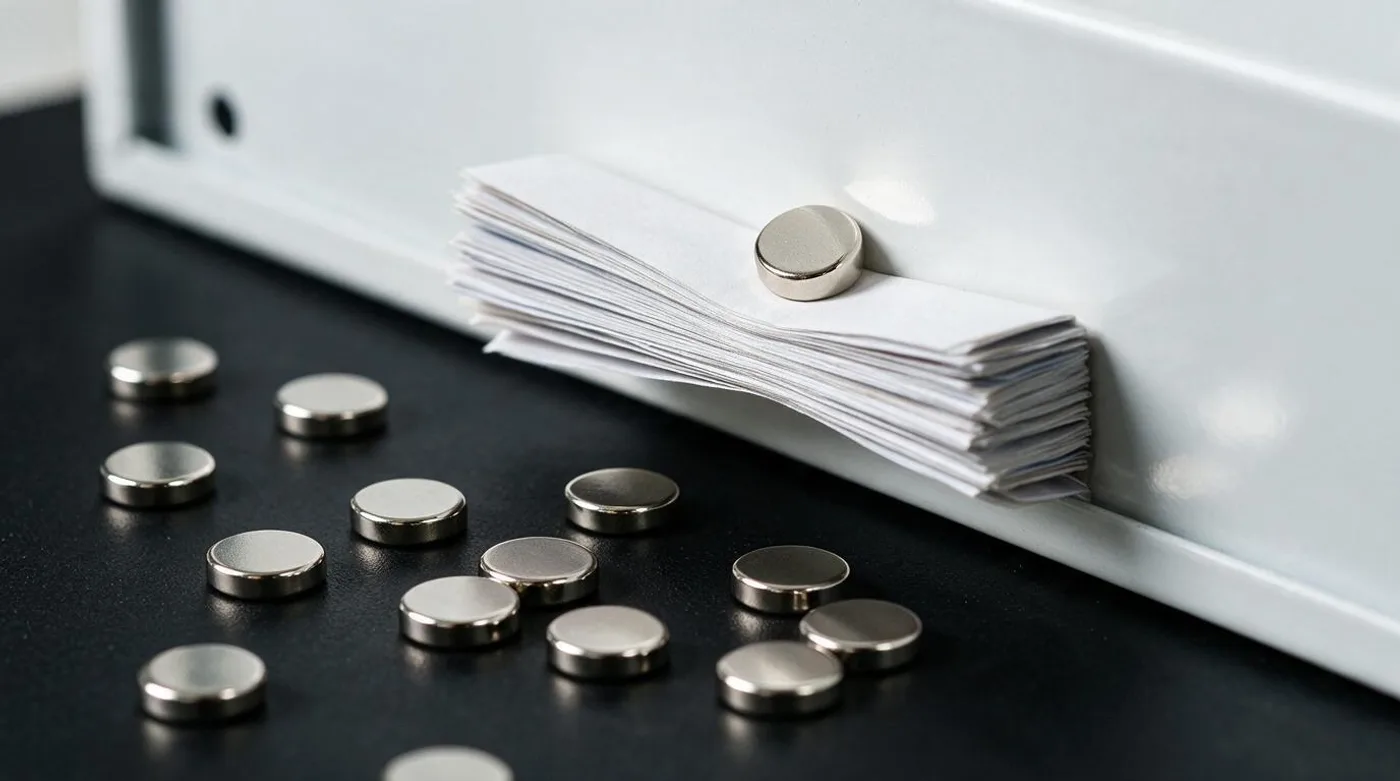
Two and a half kilograms, from a disc the size of a shirt button. That is the figure that sends people down this particular hole. A 12 by 3 mm neodymium disc holds about 2,500 g on flat bare steel and weighs under three grams itself. Nothing else you can stick on a fridge door does that, and the souvenir ferrite on the freezer, currently losing an argument with a takeaway menu, is not close.
Neodymium magnets are sintered NdFeB, an alloy of neodymium, iron and boron pressed and fired into a solid block, then cut, plated and magnetized. The material came out of the motor and hard-disk industries and arrived on fridge doors as a side effect. Almost every magnet sold as strong for a kitchen is one of these: a small plated disc, sometimes a cube, sometimes a steel pot with a hook screwed into the back.
What the grade number means
The N in N42 marks the neodymium family. The number is the maximum energy product in MGOe, mega-gauss-oersteds, which describes how much magnetic energy the material stores in a given volume. Higher grade, more energy in the same block, more pull from the same footprint. The scale in common use runs from about N35 at the cheap end to N52 at the top, and N42 is the grade most sellers list because it sits where price and performance stop arguing.
| Grade | Energy product | Where you see it |
|---|---|---|
| N35 | 35 MGOe | Budget craft discs, unbranded multipacks |
| N42 | 42 MGOe | The default for named fridge and hobby magnets |
| N52 | 52 MGOe | Sold at a premium, often as tiny cubes and spheres |
Every pull figure on this site is for N42, because that is the grade with published data behind it. Sellers rarely publish pull force per grade for the other two, so we do not print a number for them. If a listing says N52 and quotes a holding weight, ask what size the sample was and what surface it was measured on. The grade by itself tells you nothing about what a magnet will hold: a large N35 block out-pulls a small N52 one without effort.
One more thing about grade letters. A suffix such as N42H or N42SH marks a high-temperature version, not a stronger one. Those cost more and hold the same or slightly less at room temperature. On a fridge door you will never need one.
What each disc size holds
These are pull force figures on a flat bare steel plate, which is the standard way pull force gets quoted and the reason catalogue numbers always feel optimistic in a real kitchen.
| N42 magnet | Size | Holds on bare steel | Rough figure on a painted door |
|---|---|---|---|
| Disc | 6 x 2 mm | 700 g | about 490 g |
| Disc | 10 x 2 mm | 1,400 g | about 980 g |
| Disc | 12 x 3 mm | 2,500 g | about 1,750 g |
| Disc | 20 x 3 mm | 3,500 g | about 2,450 g |
| Cube | 10 mm | 4,800 g | about 3,360 g |
| Pot with hook | 16 mm | 6,000 g | about 4,200 g |
The right-hand column is the plate figure multiplied by 0.7. A painted or coated door keeps 60 to 80 percent of the plate number, because paint adds 0.1 to 0.2 mm of gap between the magnet and the steel underneath, and every tenth of a millimeter of gap costs a small disc roughly 10 percent of its pull. Curvature and texture add more gap on top of that. A magnet that holds 2,500 g in a catalogue and 1,750 g on your door has not been mis-sold. It was measured properly and then put somewhere real. The arithmetic behind that is set out in magnet strength explained.
Compare the 10 by 2 mm and 12 by 3 mm rows to see how thickness pays. Two millimeters of extra diameter and one of extra thickness takes 1,400 g to 2,500 g. For small discs, doubling the thickness adds 40 to 70 percent, and it does that without claiming any more room on the door. Thickness is the cheapest strength you can buy.
Why a 12 mm disc replaces a much bigger ferrite one
Size for size, neodymium holds about seven times what ceramic ferrite holds. At 20 by 3 mm the N42 disc holds 3,500 g and a C8 ferrite disc of exactly those dimensions holds 500 g. Anything a ferrite magnet does, a much smaller neodymium magnet also does.
Run it against the largest ferrite figure we publish. A C8 ferrite disc at 25 by 5 mm holds 1,100 g. The 12 by 3 mm N42 disc holds 2,500 g, more than twice as much, from a face covering under a quarter of the area and a body with a fraction of the volume. That is the swap people make when they replace a drawer of chunky black craft discs with a bag of little silver ones. Same holding job, in something that stops looking like a magnet from two meters away.
We do not publish a pull figure for a 40 mm ferrite disc and we are not going to guess one. The direction is clear enough from the two numbers above, and if you are choosing between the materials for a particular job, neodymium against ferrite covers price and brittleness as well as pull.
Surface field is a different measurement and a reliable source of confusion. A 12 mm N42 disc reads about 4,000 Gauss at its face. Gauss describes the field at a single point. It does not predict holding weight, which depends on how much flux the magnet pushes into the steel across the whole contact area. A large weak magnet and a small strong one can read similar Gauss and hold wildly different weights. Buy on pull force.
Nickel plating and why the edges chip
Sintered NdFeB corrodes. Left bare in kitchen air it goes dull, then powdery, so nearly every disc on sale is plated, usually nickel over copper over nickel. That stack is where the mirror finish comes from. It is also only a few microns thick, hard, and brittle.
The core underneath is brittle too. Sintered means pressed powder fired into a solid, and a solid made that way behaves more like a ceramic tile than like metal. Drop a 12 mm disc on a tile floor and it can take a chip out of the rim. Let two of them snap together across a few centimeters and they arrive hard enough to spall a flake off each face, which is the more common way people wreck them. Once the plating is broken the exposed core takes up moisture and rusts, and the rust marks whatever the magnet is sitting on.
Two habits prevent most of it. Slide magnets apart sideways rather than pulling them straight off each other, and never let one fly across a gap to meet another. If a magnet is going to live on a fridge door with wet hands and splashes around it, look over the plating now and then for a bare gray patch.
Heat, and the loss you will never notice
An N42 magnet has a maximum working temperature of about 80 C. Below that, heat costs it nothing permanent. Above it the material starts losing alignment and does not recover on cooling, so the magnet comes down from the heat weaker than it went up. Ferrite is far more tolerant, with a working ceiling around 250 C, which is one of the few arguments left in ferrite's favor.
Eighty degrees sounds comfortably high until you think about where magnets end up. The top of a fridge under a south-facing window. The side panel next to an oven vent. The steel hood over a gas hob. None of those is guaranteed to stay under 80 C in a hot kitchen in summer. Anything on the appliance itself is fine, anything near the cooker is a gamble, and magnets in heat goes through the cases.
The other kind of loss is close to academic. At room temperature an N42 magnet gives up roughly 1 percent of its strength per decade. A disc holding 2,500 g today holds a shade under that in ten years, which no door will ever notice. Neodymium magnets fail because someone dropped them, cooked them, or broke the plating. They do not wear out.
Pot magnets and hooks on the side of the fridge
A pot magnet is a neodymium disc set into a steel cup. The cup catches flux that would otherwise loop out of the back of the magnet and drives all of it through the open face, which roughly doubles the pull from the same disc. The cup also shields the brittle core and gives the maker somewhere to fit a threaded stud or a hook.
A 16 mm pot with a hook holds 6,000 g on bare steel, about 4,200 g on a painted panel. That is the strongest item on our figures list, and it is the one worth knowing about, because the side of a fridge is often the best unused hanging space in a small kitchen. Side panels on most models are painted mild steel and stay magnetic even when the door is austenitic stainless and holds nothing at all, a situation covered in why magnets do not stick to stainless.
Two of those hooks will carry a cast iron pan, a bag of tools, or a coiled apron with room over. Load them in shear, hanging straight down, and cut the estimate below 0.7 if the panel is textured, because a hook that creeps takes the pan with it.
Swallowed magnets are a surgical emergency
This section matters more than any pull figure on the page.
The US Consumer Product Safety Commission's guidance on magnets is blunt. If a child swallows more than one small high-powered magnet, or swallows one along with another piece of metal, the pieces can find each other through separate loops of intestine and clamp shut on the tissue between them. The bowel wall gets pinched between two magnets that are still pulling. It dies, perforates, and leaks. Children have needed surgery and bowel resection, and there are reported deaths. Early symptoms look like an ordinary stomach bug, which is what makes the whole thing so dangerous.
The CPSC's advice is to keep small high-powered magnets away from all children and teens. Teens as well as toddlers, because loose spheres and discs get used to fake a tongue or nose piercing and get swallowed that way. If there is a small child in the house and you still want strong magnets on the door, put them out of reach and keep count, or use something that cannot go in a mouth at all. A pressed photo magnet at 57 mm across holds plenty for a door and fits nowhere it should not.
Adults get hurt differently. Two 20 by 3 mm discs closing on a fingertip carry 3,500 g of pull between them and they arrive fast, because the force climbs steeply over the last few millimeters. That is enough to raise a blood blister, and enough to split the web between thumb and finger. Bigger magnets crack against each other and throw chips of plating. Keep them apart with card or foam in the drawer, and pick up two large ones one at a time.
Implanted pacemakers and defibrillators have a stated minimum distance from strong magnets, set by the device maker rather than by us, so ask the clinic and not a magnet seller. Bank cards with a magnetic stripe do get wiped by contact with a neodymium disc, which magnets and credit cards goes into. Phones, laptops and the fridge's own control board sit behind plastic and steel far enough away that the field from a door magnet has already fallen to nothing.
Frequently asked
What does N42 actually mean?
N is the neodymium family and 42 is the maximum energy product in MGOe, a number for how much magnetic energy the material stores per unit of volume. A 12 by 3 mm N42 disc holds about 2,500 g on bare steel.
How strong is neodymium compared with ferrite?
About seven times, size for size. At 20 by 3 mm an N42 disc holds 3,500 g and a C8 ferrite disc of the same dimensions holds 500 g.
Will a neodymium magnet lose strength sitting on a fridge?
Very slowly. Room temperature costs an N42 magnet roughly 1 percent of its strength per decade. Heat is the real limit, and above about 80 C the loss stops being reversible.
Are neodymium magnets safe for children?
No. The US Consumer Product Safety Commission advises keeping small high-powered magnets away from all children and teens, because two swallowed magnets can pull together through the wall of the gut. That is a surgical emergency.
Why did my magnet lose a flake of its coating?
The nickel plating is thin and hard and the sintered core underneath is brittle. A drop onto a tile floor, or two magnets slamming together, chips the edge, and the bare spot then rusts.