Whiteboard and office magnets
Office magnets hold paper rather than decorate. A plain ferrite button of 20 by 3 mm holds 500 g on bare steel and about 350 g on a painted door, which is far more paper than its clip jaw can grip. Hooks are rated in pull, not in the shear a hanging bag applies.
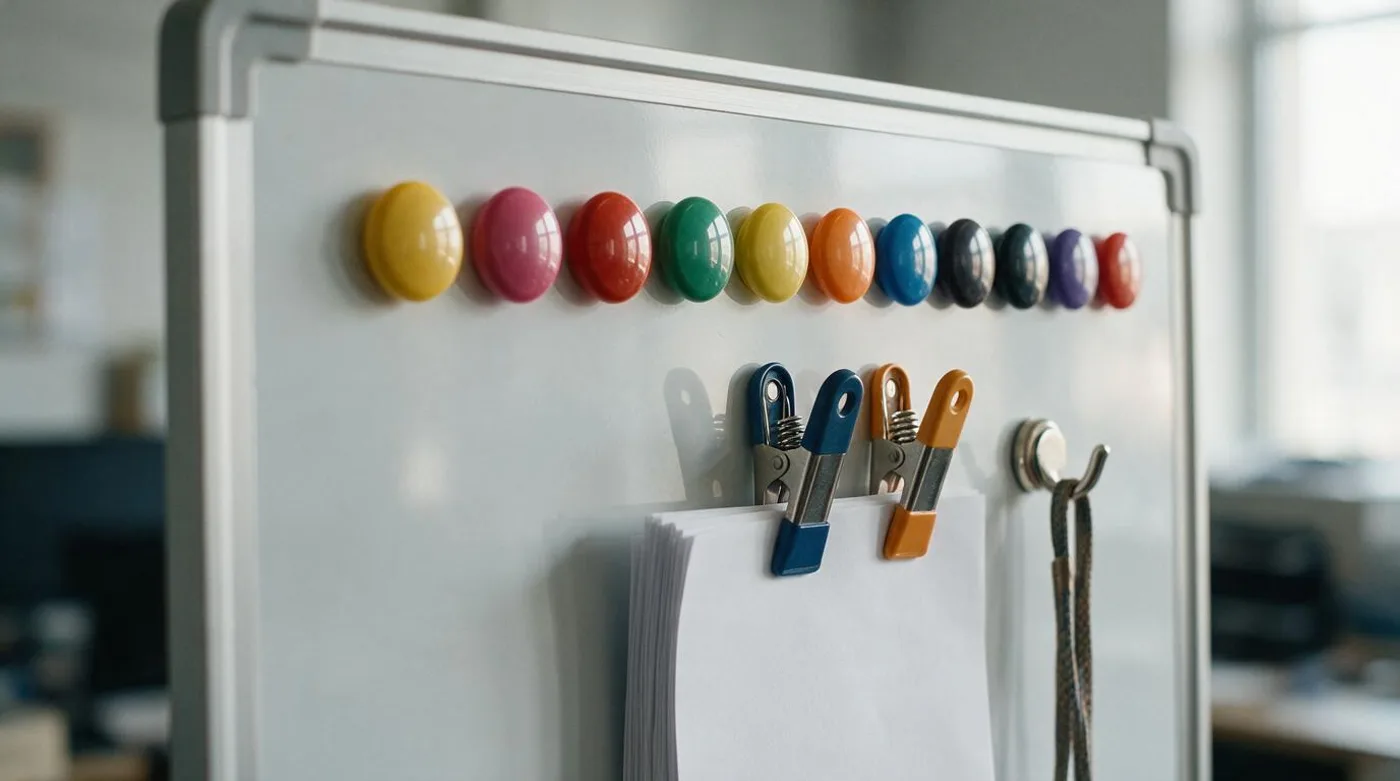
How much paper can one button magnet hold
This is the question people ask in the shop, and the honest answer is that the magnet is almost never the limit.
A plain ferrite button of 20 by 3 mm holds 500 g against a bare steel plate. On a painted fridge door, keeping 60 to 80 percent of the plate figure, that comes down to about 350 g. A4 paper at 80 gsm weighs 4.99 g a sheet, which falls straight out of the definition of gsm: 80 grams per square meter, and an A4 sheet is 0.0624 of a square meter. So the button is nominally good for something like seventy sheets, which is a stack thick enough that no magnetic clip on the market will close on it.
The number that fails first is a different one. Paper hanging below a magnet does two things at once. It pulls down, which the magnet resists in friction rather than in pull force, and it leans out from the door, which levers the top edge of the magnet away from the steel. Peel a magnet off a fridge and you feel this directly: sliding it sideways is easy, tipping it off an edge is easy, and pulling it straight out is very hard. Pull force is the number everyone publishes and the one your paper stack is least interested in. K&J Magnetics explains the measurement itself well, and magnet strength explained covers what the figure does and does not tell you.
So read a published pull force as a ceiling. A magnet rated 500 g will not hold 500 g of hanging paper, and nobody publishes the shear figure, because it depends on the finish of your door.
Clips, hooks, and what they hold
| Type | Magnet inside | Pull on bare steel | On a painted door | Limited by |
|---|---|---|---|---|
| Colored button, 20 mm | ferrite disc 20 x 3 mm | 500 g | about 350 g | nothing, at normal loads |
| Heavy button, 25 mm | ferrite disc 25 x 5 mm | 1,100 g | about 770 g | nothing, at normal loads |
| Small clip magnet | ferrite disc 20 x 3 mm | 500 g | about 350 g | jaw opening, 4 to 6 mm |
| Bulldog-clip hybrid | ferrite disc 25 x 5 mm | 1,100 g | about 770 g | lever arm of a thick stack |
| Neodymium clip | N42 disc 10 x 2 mm | 1,400 g | about 980 g | jaw opening |
| Hook magnet, small | N42 disc 12 x 3 mm | 2,500 g | about 1,750 g | shear, not published |
| Pot magnet with hook, 16 mm | neodymium pot | 6,000 g | about 4,200 g | shear, not published |
The last column is the one to read. Two magnets in that table are limited by their own strength and the rest are limited by their hardware or by the direction of the load, which is why paying for a stronger magnet inside a clip usually buys nothing.
Pot magnets deserve a note of their own, because their listed figures look absurd next to a plain disc. A 16 mm pot with a hook holds 6,000 g on a plate while a 20 mm ferrite disc holds 500 g. The pot is not twelve times the magnet. It is a neodymium slug inside a steel cup, and the cup returns the field around the back so that almost all of it crosses the working face. Put that same pot on a textured, painted door and it gives back a large share of the advantage, since concentrated fields are exactly the ones that suffer most from an air gap. Each tenth of a millimeter of gap costs a small magnet roughly 10 percent of its pull, and paint alone is 0.1 to 0.2 mm.
Matching a magnet to the stack
Work from the thickness of the paper, not from its weight.
A clip magnet with a 4 mm jaw takes about forty sheets of 80 gsm paper. That is 200 g of paper, well inside the 350 g a 20 by 3 mm ferrite disc gives you on a painted door, so a small clip almost never needs a neodymium upgrade. What it needs is a jaw that opens far enough and a spring that keeps its tension after a year.
Bulldog-clip hybrids are the ones that come off the door, because the clip body stands 20 to 30 mm proud and the stack hangs below it. All that mass sits well away from the steel, and the resulting torque works on the top edge of the magnet like a lever. If a hybrid clip keeps falling, the fix is a wider magnet rather than a stronger one, since a 25 mm disc resists tipping better than a 20 mm disc of the same pull would, simply by putting its edge further from the pivot.
For anything that hangs, such as a hook holding a tote bag or a set of keys, budget generously. Take the pull figure, cut it to 70 percent for a painted door, and then treat what remains as an upper bound you should stay well under, because the load is in shear and no maker publishes shear. A 12 by 3 mm N42 disc at 2,500 g on a plate and about 1,750 g on the door is not a 1,750 g hook. The strongest fridge magnet works through the same reasoning with the biggest magnets people actually buy.
One more thing that separates a good office magnet from a bad one at the same strength. The face that touches the door should be flat and hard, either bare plated steel or a molded plastic shell with no proud rim. Rubber-coated magnets grip better in shear and give up some pull to the thickness of the coating, which is a trade worth making for a clip and a bad one for a hook.
When the door will not take a magnet
Roughly half the stainless fridge doors sold hold nothing at all. Austenitic stainless of grade 304, the common one, has a face-centered cubic structure stabilized by nickel and carries no magnetic domain, so a magnet slides off it like it would off glass. Ferritic stainless of grade 430 is magnetic and looks identical on a showroom floor. Why magnets don't stick to stainless has the full explanation.
Before buying anything, try the side panel. Most models use painted mild steel down the sides even when the door is 304, and a side panel is flat, which makes it a better magnetic surface than the door was going to be.
If that fails, you are buying a surface rather than a magnet. A steel magnetic board hung on the wall next to the fridge gives you flat, thinly coated steel, and every magnet in the table above performs closer to its plate figure on one. Self-adhesive steel strip does the same job in a narrower space and sticks to the side of a cabinet. What does not work is magnetic paint, which contains iron powder at a fraction of the density of sheet steel and holds so little that a 20 by 3 mm ferrite disc drops off under its own weight on a vertical wall. Magnetic receptive vinyl sheeting is the same idea with the same disappointment attached.
Note: usable door width on most models is 40 to 60 cm, so a magnetic board wider than that will not read as an extension of the fridge. Match the width and it does.
What separates a whiteboard magnet from a fridge magnet
The magnet inside can be the same ferrite disc. The surface it was designed for is not.
A whiteboard is a sheet of thin steel with a smooth coating a few hundredths of a millimeter thick, hung flat. A fridge door is thicker steel with a heavier paint layer, usually curved gently across its width, and often given a texture to hide fingerprints. Move a magnet from the board to the door and it loses on every count: more gap from the paint, more gap again from the texture, and a curve that means a wide flat magnet touches at two points instead of across its face.
That is why office magnets bought for a board disappoint on a fridge, and why the fix is a smaller, thicker magnet rather than a bigger one. A 25 by 5 mm ferrite disc at 1,100 g concentrates its contact patch into an area that can sit flat on a curved door. A large flat sheet magnet of the same nominal strength cannot.
Whiteboard magnets also assume they will be moved several times a day, which shapes the hardware. The plastic shell is domed to be picked up with fingertips, the colors are coded for meaning, and the magnet is deliberately weak enough to slide with one finger. On a fridge those design choices work against you, because the thing you want from a fridge magnet is that it stays where you put it while the door swings and slams. For a note that lives on the door for a month, a plain disc with no shell at all beats every colored button in the drawer, and office magnet ideas has more arrangements that survive daily use.
Frequently asked
How many sheets of paper can a fridge magnet hold?
A 20 by 3 mm ferrite button holds about 350 g on a painted door, and A4 at 80 gsm weighs 4.99 g a sheet, so the magnet is not the limit at any sane stack. What fails first is the grip of the clip jaw, and the stack leaning out and peeling the magnet off at its top edge.
Is a whiteboard magnet the same as a fridge magnet?
The magnet inside can be identical. The mounting surface is not. A whiteboard is flat, thin, smoothly coated steel, while a fridge door is curved, textured, and painted more thickly, so the same button holds less on the fridge.
What can I hang a bag from on my fridge?
A neodymium pot magnet with a hook, 16 mm across, is listed at 6,000 g of pull on bare steel. Pull is measured straight out from the surface, and a hanging bag loads the magnet in shear instead, which is lower and is not published, so leave a wide margin.
My fridge door is not magnetic. What are my options?
Check the side panel first, since most models use painted mild steel there even when the door is austenitic 304 stainless. Failing that, a steel magnetic board or a self-adhesive steel strip gives you a surface, and both hold better than a door because they are flat and thinly coated.