Souvenir and travel fridge magnets
Most souvenir magnets are a resin dome, a cast polyresin relief, enamelled steel, wood, or tin, with a ferrite disc glued to the back. A 20 by 3 mm ferrite disc holds 500 g on bare steel and about 350 g on a painted door. Smaller discs slide.
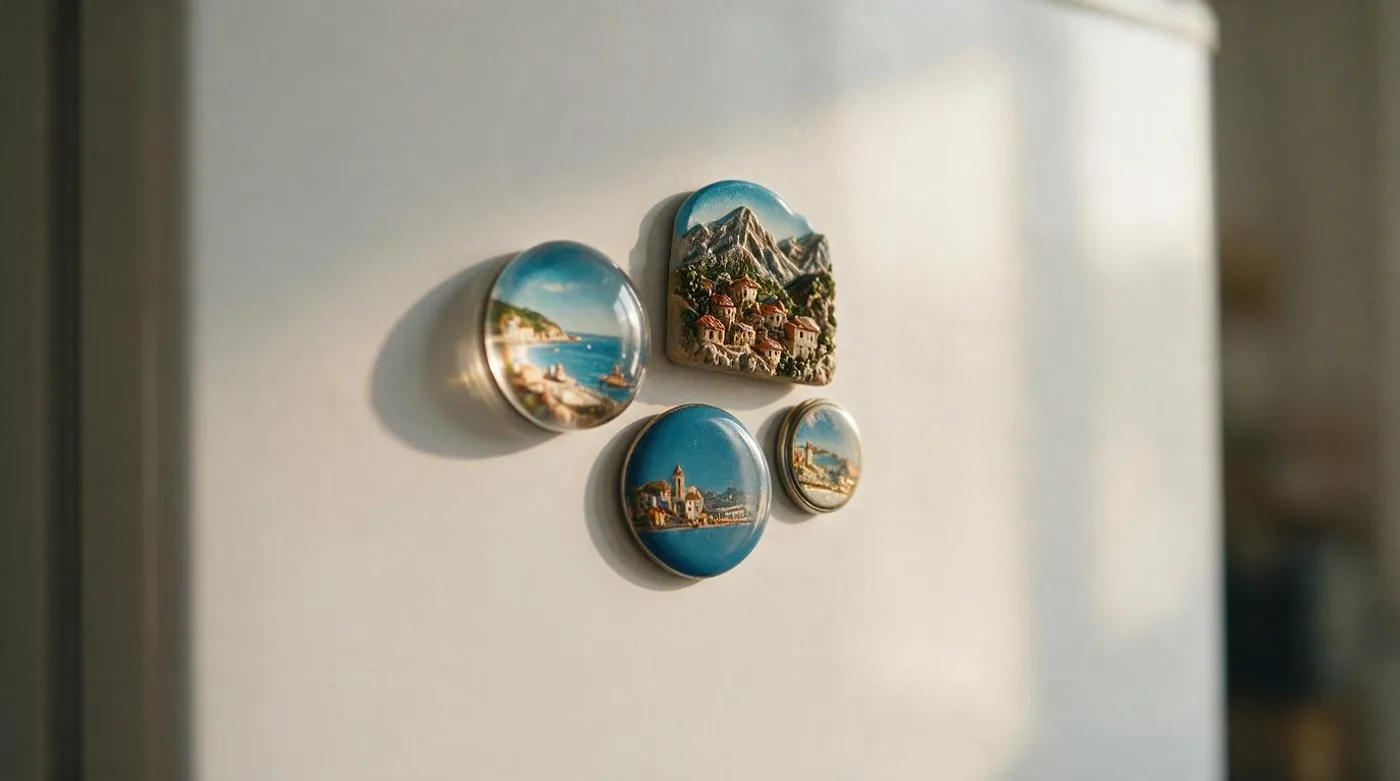
You get home, put the magnet from the trip on the fridge, and in the morning it has walked six inches down the door and parked itself on the handle trim. Nothing is broken. The magnet was built to be sold at an airport, and the part nobody looks at is the part that had to work.
How they are built
Five constructions cover most of what is sold at a tourist counter, and you can identify all of them by weight and by running a thumbnail over the front.
| Construction | Front | Feel | Usual back | What that back gives |
|---|---|---|---|---|
| Resin dome | Printed card under a clear epoxy dome | Light, warm, slightly springy | Small ferrite disc glued to the card | Depends entirely on disc size, often well under 500 g |
| Cast polyresin | Molded and hand painted relief | Heavy, cold, dense | Ferrite disc set into a molded well | 500 g at best, less through the recess |
| Enamelled or printed steel | Flat printed plate | Thin, rigid, cool | Ferrite disc, or a sheet pad on the plate | 500 g on a disc, 60 to 110 g on sheet |
| Wood | Printed or laser engraved ply | Light, dry, matte | Disc in a drilled pocket, or sheet glued flat | 500 g on a 20 x 3 mm disc, less on sheet |
| Tin or pressed metal | Stamped and lithographed tin | Very light, hollow, tinny | Sheet pad, occasionally a disc | 60 to 110 g on sheet at 50 mm square |
The disc in the right-hand column is almost always ceramic ferrite, grade C8: dark gray, cheap, brittle, and happy to about 250 C, which is more heat than a kitchen will ever offer it. A 20 x 3 mm C8 disc holds 500 g on a flat bare steel plate. Go up to 25 x 5 mm and it holds 1,100 g, which no souvenir maker has ever fitted to anything.
Why so many of them slide
Three things stack up against a souvenir magnet, and the manufacturer controls all three.
The first is disc size. A 20 mm disc is the standard souvenir and craft size, and it gives 500 g on a plate. Suppliers routinely fit something smaller because a smaller disc costs less and hides better, and the listing never says which one you are getting. Nobody publishes disc dimensions on a souvenir magnet. We have not found an exception.
The second is gap. Paint on a fridge door already costs you 0.1 to 0.2 mm, and every tenth of a millimeter takes roughly 10 percent off a small disc. Now sink that disc into a molded well in a polyresin casting so the rim of the casting touches the door first, and you have added a millimeter or more of air. A disc that would have given 500 g gives a fraction of it, and the fault is a molding decision rather than a bad magnet.
The third is the door itself. Textured and dimpled fridge doors add gap the same way paint does, and the curve at the edge of a door means a wide flat casting only ever touches at two points. That is why the same magnet holds on a friend's smooth white fridge and crawls down your brushed one.
There is a fourth thing that is not the manufacturer's fault. Pull force is measured straight off the steel, at ninety degrees. Sliding is a different problem, resisted by friction between the magnet and the paint, and friction gives out long before the pull figure does. A magnet that survives being tugged straight off can still fail to stay put, which is the whole of the complaint. Magnet strength explained goes into how the two differ.
What a good back looks like
Turn the magnet over in the shop. You are looking for a gray ferrite disc close to 20 mm across, glued flat, sitting flush with the surrounding material or slightly proud of it. Proud is better than flush, and flush is much better than recessed. On a casting wider than about 60 mm you want two discs rather than one, spread towards the ends, because a single central disc lets a long body pivot away from the door at both edges.
Glue is worth a look too. A thick bead of hot melt under the disc is another tenth of a millimeter or two of gap, and hot melt under a heavy casting in a warm kitchen creeps. A thin, even glue line is the sign that somebody cared.
The back that never works is a small disc at the bottom of a deep molded well, which is exactly what you find on most of the heavier cast pieces on the counter.
Weight against holding force
A 20 x 3 mm ferrite disc gives about 350 g on a painted door once you take the 0.7 multiplier off the plate figure. That is the whole budget, and the magnet spends part of it on itself before it holds anything.
Polyresin is dense. A palm-sized cast relief is a substantial object, and when the magnet's own weight starts to approach a few hundred grams, the sliding margin disappears. The magnet does not fall off. It creeps, a few millimeters a day, which is more annoying than falling off because it takes a week to notice.
Resin domes and tin plates have the opposite problem and the opposite advantage. They weigh almost nothing, so even a small disc or a sheet pad at 60 g holds them, and they stay where you put them for years. The lightest souvenir magnets are usually the most reliable ones, which is not what the pricing at the counter suggests.
Displaying and storing a collection
A fridge door gives you 40 to 60 cm of usable width on most models, and a collection outgrows that faster than anyone expects. Fifty magnets at 55 mm across need around 0.15 square meters of door, which is most of a standard fridge front with no room for a shopping list.
The usual next step is a steel sheet on a wall, or a painted steel board, which also solves the stainless problem if your fridge turned out to be grade 304 and never held anything to begin with. Side panels on most fridges are painted mild steel and work even when the door does not, so a collection can migrate around the corner. There are more arrangements in travel collections.
For storage, lay them flat in a shallow box with card between the layers. Ferrite is brittle and chips at the edge, resin domes scratch, and two magnets that snap together face to face can crack a thin casting when you pull them apart. Do not put a souvenir collection in a bag with anything neodymium in it, unless you want to spend an evening prising a 10 mm cube out of a plaster gondola. How to store magnets covers the rest.
Buying there or ordering later
The one real advantage of buying while traveling is that you can turn the thing over. You can see the disc, feel the weight, and put back the heavy casting with a 12 mm disc rattling in a well. Online you get a photograph of the front and a size in centimeters, and disc dimensions appear in roughly none of the listings.
Ordering later has the obvious problem that a souvenir bought from a warehouse two months after the trip is a fridge decoration with a place name on it. If that is fine, buy on weight: a light printed piece will hold, and a heavy cast one is a coin toss.
Prices are not published in any form we can quote here. Souvenir magnets are sold at counters that do not publish price lists, and the only per-magnet prices we hold are for printed sheet magnets from two USA sellers, which is a different product entirely. Anything you read putting a firm number on a souvenir magnet made it up.
Identical castings and honest fakes
Walk into enough tourist shops and you will meet the same magnet in different cities. The mold is generic, the painting is done in bulk, and only the printed panel or the place name changes. That is normal in the trade rather than a scam, but it is worth knowing that the cathedral in your hand may be a mold shared across four countries.
Two tells. Look at the seam where the mold halves met, usually along the top edge, and look at whether the place name is part of the casting or a printed sticker sunk under the varnish. A name that is molded in belongs to that mold; a name printed on a panel can be swapped for the next town along. Neither says anything about the magnet on the back, which is still the only part that determines whether the thing stays on your door.
If you want the picture rather than the object, a pressed photo magnet of something you saw yourself outholds any printed sheet several times over and costs less than most airport castings.
Frequently asked
Why does my souvenir magnet slide down the door?
Almost always an undersized or recessed ferrite disc. A 20 x 3 mm disc gives 500 g on a bare plate and about 350 g on a painted door, and anything smaller gives less. A disc sunk into a well in the casting loses roughly 10 percent of its pull for every tenth of a millimeter of extra gap.
What should the back of a good souvenir magnet look like?
A ferrite disc close to 20 mm across, glued flat and sitting proud of or flush with the surrounding body, so the magnet touches the door. Two discs are better than one on a wide casting. A dull gray disc recessed 1 mm inside a rim is the shape that fails.
Are heavy cast souvenir magnets worth buying?
Only if the back matches the weight. Polyresin castings are dense, and a magnet whose own weight approaches the roughly 350 g a 20 x 3 mm disc gives on a painted door will creep down over a few days, because resistance to sliding is much lower than straight pull.
How should I store a souvenir collection I am not displaying?
Flat, in a shallow box, with paper or card between layers. Ceramic ferrite is brittle and chips, resin domes scratch each other, and magnets stacked face to face pull hard enough to crack a thin casting when you separate them.