Why magnets do not stick to stainless steel
Most stainless fridge doors are austenitic 304, whose face-centered cubic structure, stabilized by nickel, holds no magnetic domain, so magnets slide off. Ferritic 430 doors are magnetic. Test the door with a magnet, then try the side panel, which is usually painted mild steel and holds.
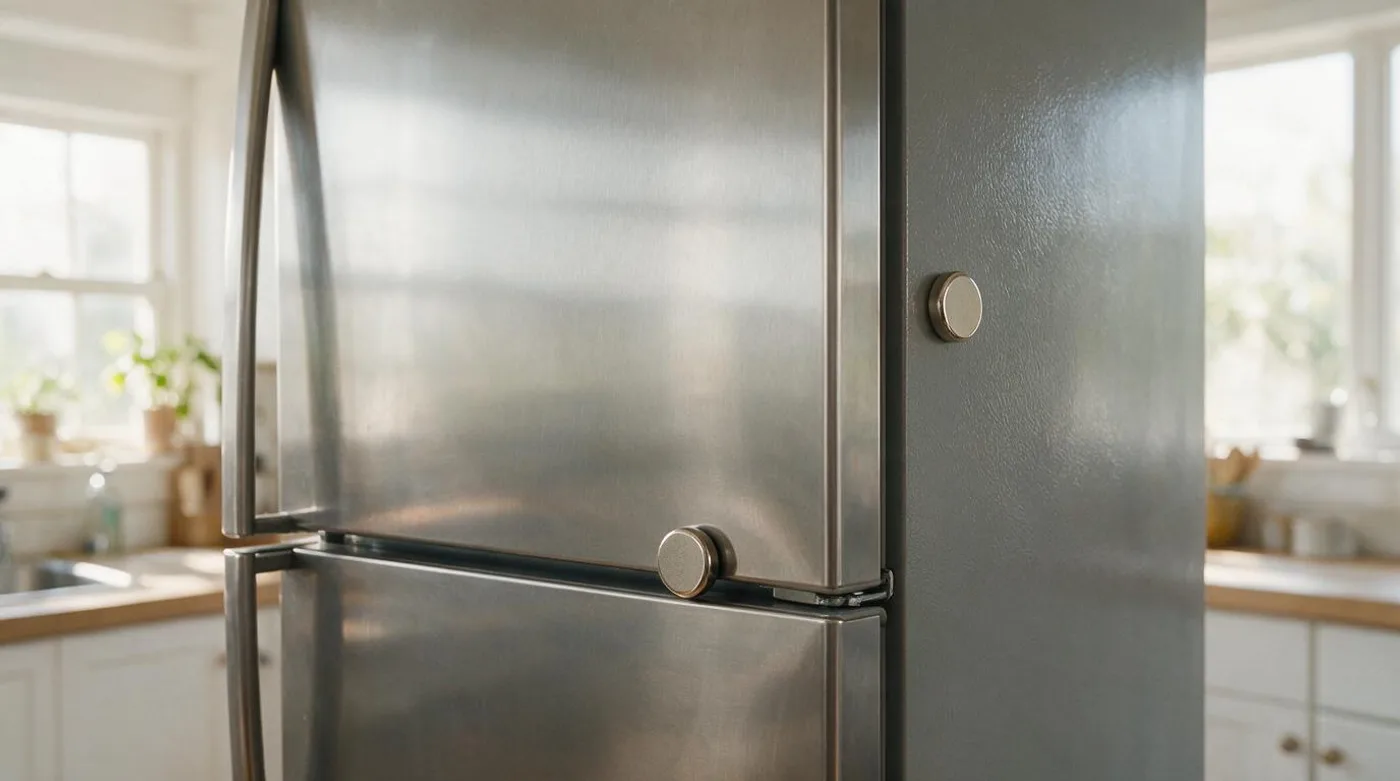
Press a magnet against the front of a new stainless fridge and it falls on the floor. Walk round to the side of the same fridge, press the same magnet against the painted panel, and it holds well enough to carry a school letter. One appliance, two answers, and no fault in either the magnet or the fridge.
Both surfaces are steel. Steel is famously magnetic. The catch is that "stainless steel" names a family of alloys rather than one material, and the family splits down the middle on this question.
Two grades that look identical and behave nothing alike
Austenitic stainless, of which 304 is the common grade, is not magnetic. Ferritic stainless, of which 430 is the common grade, is. Many stainless fridge doors use 304 and some use 430, which is why your neighbor's fridge holds a magnet and yours refuses.
Brushing, polishing and fingerprint-resistant coatings make the two indistinguishable by eye. Weight does not separate them either. The only practical test is a magnet.
| 304, austenitic | 430, ferritic | |
|---|---|---|
| Crystal structure | Face-centered cubic | Body-centered cubic |
| Nickel | A main alloying addition, and what stabilises the structure | Essentially none |
| Magnetic domains | None to align, so no attraction | Present, so the steel attracts |
| Holds a fridge magnet | No | Yes |
| Found on | Many stainless fridge doors, sinks, cookware | Some fridge doors, trim, some cookware |
| What a 20 x 3 mm ferrite disc does | Slides off | Grabs |
What the crystal structure has to do with it
Iron atoms in ordinary steel sit in a body-centered cubic lattice at room temperature. That arrangement lets neighboring atoms couple their magnetic moments, so the metal forms magnetic domains: small regions all pointing the same way. Bring a magnet close and those domains swing into line with its field, the steel becomes a temporary magnet itself, and the two attract. That is the whole trick behind every fridge magnet, and how fridge magnets work covers the door side of it.
Add enough nickel and the lattice rearranges into a face-centered cubic packing that stays stable all the way down to room temperature. In that arrangement the atomic moments no longer couple, so no domains form, so there is nothing for an approaching magnet to align. 304 is not weakly magnetic. It has no domain structure to work with at all, which is why the result is so binary in the hand.
One caveat worth knowing. Heavy cold working of austenitic steel can convert part of it to a magnetic phase, which is why a pressed corner or a deep-drawn 304 sink sometimes tugs faintly at a magnet while the flat panel next to it does nothing. On a fridge door that effect is too small to hold anything, so treat a faint tug as a no.
The ten second door test
Take a small disc magnet, not a printed sheet magnet. A 0.5 mm flexible sheet holds 60 g at 50 x 50 mm on bare steel, so it can fail on a magnetic door simply because the door is painted or textured, and then you have learned nothing. A ferrite disc rated 500 g or a 10 x 2 mm N42 disc rated 1,400 g gives an unambiguous answer.
Touch the magnet flat to the middle of the door, not to an edge. Then repeat on the top of the cabinet, on the side panel, on the handle, and on the freezer drawer front if it is a separate panel. Doors, handles and trim are often different alloys on the same appliance, and it is common to find the freezer front magnetic and the fridge door not.
If the magnet drops off the front but holds on the side, the door skin is austenitic and there is nothing to be done to the door itself. If it holds everywhere, you have a 430 door and the only thing standing between the magnet and full pull is the finish: paint or a coating adds 0.1 to 0.2 mm of gap, and each tenth of a millimeter costs a small disc roughly 10 percent of its pull.
Why the side panel usually works
Manufacturers pay for stainless on the surfaces people see. Side panels on most models are painted mild steel, because a fridge in a fitted kitchen has its sides buried between cabinets and nobody is looking. That painted mild steel is fully magnetic.
The side is genuinely usable. Usable door width on most models runs 40 to 60 cm, and a fridge side panel is deeper than that, so you gain display area rather than losing it. What you lose is visibility, and if the fridge is boxed in on both sides the point is moot. Check the top of the cabinet too, which is often painted steel as well and takes a row of magnets nicely if you can reach it.
What the manufacturers do not tell you
We would like to hand you a list of which brands and which door styles use 430 and which use 304. That list does not exist, and we are not going to invent one. Appliance specifications describe the finish in marketing terms, and the alloy grade behind the finish is rarely stated anywhere in the documentation. The same brand can use different grades in different ranges, and a range can change without the description changing at all. Retail listings that promise a magnetic door are quoting the retailer, not the metallurgy.
Two things you can do instead. Ask the showroom to let you touch a magnet to the display model, which nobody minds and which settles it on the spot. Or read owner reviews for the exact model number, where somebody has usually complained about magnets already. If you are buying and the door matters to you, treat it as a feature to confirm rather than a feature to assume, in the same way you would confirm which way the door hinges.
A fingerprint-resistant coating is a separate variable on top of the alloy. Those coatings are thin films, and if the steel underneath is 430 the magnet still holds, just with slightly more gap between the magnet and the metal. If the steel is 304, no coating changes anything.
Steel boards, strips and what each one gives up
A magnetic board is the honest fix. Hang or lean a sheet of mild steel, an enamelled steel whiteboard, or a purpose-made magnetic board, and magnets behave exactly as they would on a painted fridge door. Thickness matters: manufacturer pull figures assume a thick, flat, bare steel plate, and thin sheet saturates under a strong magnet, so a 20 x 3 mm N42 disc rated 3,500 g on a plate will hold noticeably less on a thin decorative panel. Ferrite discs and pressed photo magnets are far less fussy, because a ferrite disc at 500 g does not come close to saturating even thin steel. Our whiteboard and office magnets page goes into which magnets suit an enamelled surface.
Adhesive steel strip is the compact version. A strip of thin galvanised steel with foam tape on the back gives you a magnetic line above the worktop or on the side of a cupboard. Two warnings. The strip is thin, so it has the same saturation limit as a thin board, and the tape is the actual attachment: pulled off a cold painted surface it can take paint with it, which is the same failure described on do magnets damage fridges. Put strips on cabinet sides rather than on the fridge itself, and warm the tape before removing it.
Magnetic primer paint, and its honest limits
Magnetic primer is iron powder suspended in paint. Rolled onto a wall or a panel in several coats, it gives a surface that magnets stick to. It works, in the sense that a magnet will stay put on a wall that would otherwise hold nothing.
It also gives up a great deal. Iron powder in a binder is a much poorer flux path than solid steel, the film is a fraction of a millimeter where a door skin is closer to a millimeter, and the primer wants a decorative topcoat over it, which adds gap directly between the magnet and the iron. Every 0.1 mm of that gap costs a small disc about 10 percent of its pull, and the paint is thicker than that. Pull force on magnetic primer is not published by anyone we would trust to quote, and we have not measured it, so the only claim we will make is a shape rather than a number: expect it to hold a sheet of paper under a light magnet and expect it to disappoint a pressed photo magnet.
Two further options get overlooked. Over-the-door hooks and rails need no magnetism at all and carry more weight than any magnet on this site. And the flat side of a metal cooker hood, a dishwasher front, a filing cabinet, or a radiator is often painted mild steel, so the display surface you wanted may already exist in the same room. Test those the same way you tested the door, with the same disc, flat against the middle of the panel.
Frequently asked
Is all stainless steel non-magnetic?
No. Austenitic grades such as 304 are not magnetic. Ferritic grades such as 430 are, and some fridge doors use 430 precisely so magnets work. Both look identical once brushed.
How do I test my fridge door?
Hold a small disc magnet flat against the front. A 20 x 3 mm ferrite disc rated at 500 g either grabs or does nothing, with no middle ground. Then try the side panel, the top, and the door handle separately.
Why does the side of my fridge hold magnets when the front does not?
Side panels on most models are painted mild steel, which is magnetic, while only the visible front gets a stainless skin. The paint costs you 0.1 to 0.2 mm of gap, so a small disc keeps roughly 60 to 80 percent of its rated pull there.
Does magnetic paint work on a stainless fridge?
Partly. Magnetic primer is iron powder in paint and it is far weaker than sheet steel, and the topcoat over it adds gap on top of that. Actual pull force on primer is not published and we have not measured it.
Which fridge brands use magnetic stainless?
Not published. Manufacturers list the finish, not the alloy grade, and the same brand can use different grades across its range. Testing the door you own takes ten seconds and beats any list.