Flexible rubber and vinyl magnets
Flexible rubber magnets are ferrite powder in a vinyl binder, rolled to 0.5 or 0.75 mm and printed on directly. At 50 by 50 mm a 0.5 mm sheet holds 60 g and a 0.75 mm sheet holds 110 g. Surface field is about 300 Gauss, so they suit paper-weight jobs only.
The plumber's calendar magnet has been creeping down the fridge door since it went up, and now it is level with the handle. Nobody moved it. It is a 0.5 mm flexible sheet on a door with a fine brushed texture, and it is losing a very slow argument with gravity. That failure, and the reason it happens, is most of what there is to know about rubber magnets.
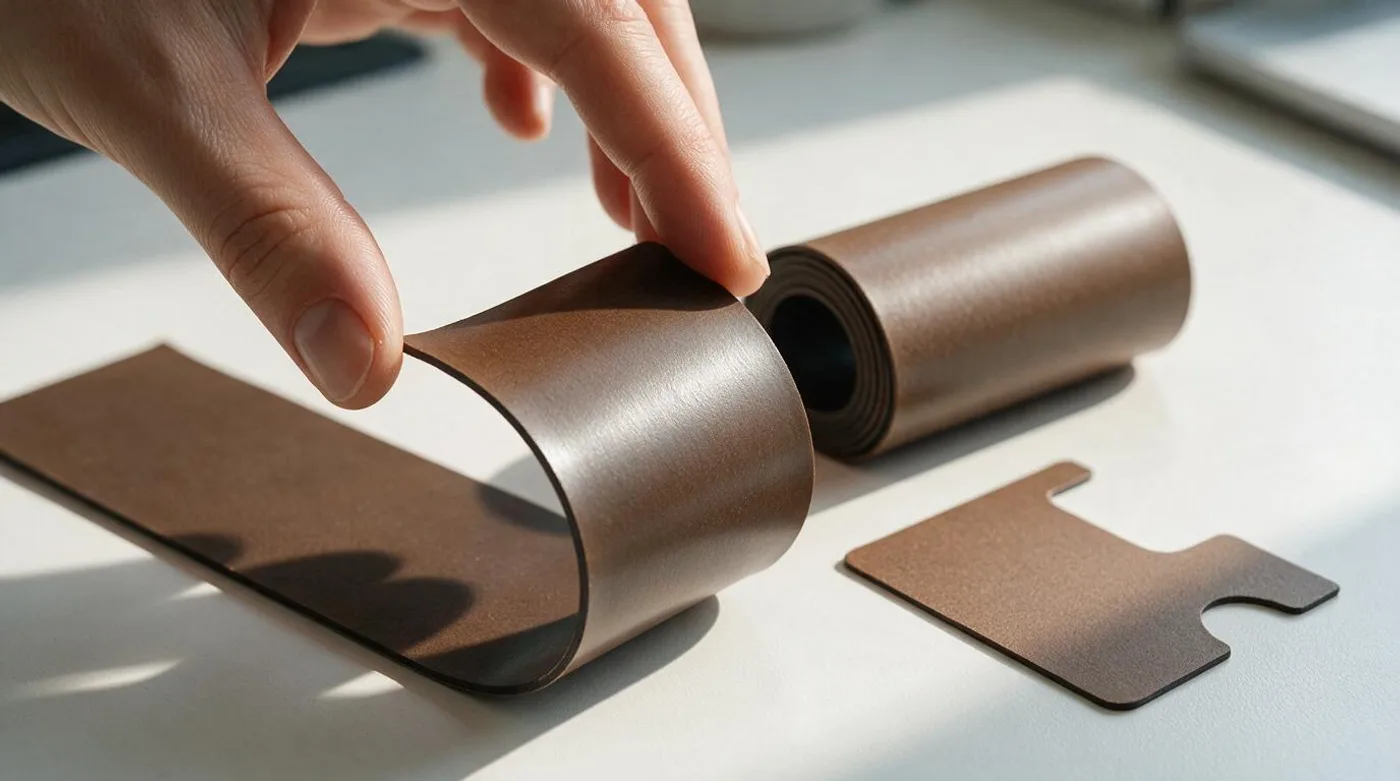
Flexible magnet is the material that almost every giveaway magnet in your kitchen is made of. Cut a fridge magnet with scissors and it was flexible sheet. Bend it and it stays bent for a second and then flattens out again. It costs almost nothing per square meter, takes ink beautifully, and holds about as much as a strong paperclip.
Ferrite powder held in a vinyl binder
The recipe is strontium or barium ferrite powder, the same hard ceramic magnetic material used in a black craft disc, mixed into a plastic binder that is usually vinyl or a synthetic rubber. The mix comes out of an extruder or a calender as a continuous sheet, gets rolled to thickness, and passes over a magnetizing head on the way out.
Two consequences follow from that recipe, and they explain nearly everything about how the stuff behaves.
The first is that the magnetic material is diluted. A solid ferrite disc is all ferrite. A flexible sheet is ferrite particles suspended in something that is not magnetic at all, so a given volume of sheet contains far less magnet than the same volume of ceramic. The binder is the price you pay for a material that will go round a roller and through a guillotine.
The second is the way it gets magnetized. The head lays down narrow parallel stripes of alternating polarity across one face of the sheet, so north and south alternate every couple of millimeters, and only on that side. The field from each stripe arcs over to its neighbors and closes within a millimeter or two of the surface. That is deliberate. Fine stripes give a strong grip at very short range from a thin, weak material. It is also why a magnetic sheet sticks on one side and not the other, and why two offcuts either lock together with a click or slide off each other depending on how you rotate them.
What the two thicknesses hold
Print work uses two thicknesses and only two. Here is what each holds on flat bare steel, with two stiffer builds for scale.
| Magnet | Size | Holds on bare steel | On a painted door |
|---|---|---|---|
| Flexible sheet, 0.5 mm | 50 x 50 mm | 60 g | about 42 g |
| Flexible sheet, 0.75 mm | 50 x 50 mm | 110 g | about 77 g |
| Ferrite disc (C8) | 20 x 3 mm | 500 g | about 350 g |
| Neodymium disc N42 | 20 x 3 mm | 3,500 g | about 2,450 g |
Sixty grams is a sheet of paper and a photograph, or a takeaway menu, or a school letter. It is not a set of car keys, not a tea towel, and not a stack of six bills held under one corner. The jump from 0.5 mm to 0.75 mm nearly doubles the figure, 60 g to 110 g, which is the single most useful thing to know when a printer offers you the two options and a price difference.
The painted-door column is the plate figure times 0.7. A coated door keeps 60 to 80 percent of the plate number, and sheet magnets suffer the worst from that, because they have so little to lose. Take 42 g and then take off more for a textured or curved door, and you are close to the point where the weight of the print itself starts to matter.
For comparison, a pressed photo magnet of about that footprint holds several times what a 0.75 mm sheet does, since the ferrite behind its print is a solid disc rather than powder stirred into vinyl. How many times over is not something anyone has published, and we have not measured it. What is published is the other end of the range, and a 20 by 3 mm neodymium disc holds roughly sixty times what the 0.5 mm sheet does. Sixty times. That ratio is the whole reason sheet magnets have a reputation for feeling cheap.
Why it feels weak when you pick it up
Surface field on flexible sheet is about 300 Gauss. A 12 mm neodymium disc reads about 4,000 Gauss at its face. The sheet is more than a factor of ten down before you account for anything else.
Then there is reach. Because the stripes are narrow and alternate, the field dies within a millimeter or two of the surface, so a sheet magnet has no ability to work across a gap. Paint alone adds 0.1 to 0.2 mm, and each tenth of a millimeter costs a small magnet roughly 10 percent of its pull. A dimpled or brushed door surface adds several tenths in the low spots, and a curved door lifts the corners of anything bigger than a business card clean off the steel.
That combination is why sheet magnets slide rather than fall. There is enough pull left to keep the thing in contact, not enough friction to keep it in place, so it walks down the door a millimeter at a time whenever the door slams. A pressed magnet with a solid ferrite back does not do this. On a very textured door, nothing thin does well, and the honest answer is a thicker build rather than a bigger print.
Printing straight onto the sheet
The reason sheet magnet dominates promotional work is that it takes ink directly. White vinyl-faced stock goes through a UV flatbed press or a wide-format machine and comes out the other side as a finished panel, with no lamination step and no mounting.
Three routes cover most of what is sold. Screen printing lays down thick flat color and suits one or two ink jobs like a phone number and a logo. UV flatbed printing handles full color and photographs, curing the ink on contact so it does not soak or spread. Litho printing on paper followed by lamination onto plain magnet sheet gives the best photographic result, which is why photo-focused sellers list a laminated print rather than direct-to-magnet: Shutterfly's flexible magnets are 0.75 mm with a laminated print, listed at $2.50 each with a minimum order of 1, while Vistaprint's are 0.5 mm at $1.20 each with a minimum of 25.
Gloss or matt lamination on top does two useful things. It stops fingers from marking the print, and it stops the ink from cracking along the fold when someone bends the magnet to lift it off the door. On an unlaminated direct print, that fold line eventually shows as a pale crease across the artwork.
Die cutting, roll stock and adhesive backing
Flexible sheet cuts with a steel rule die, a rotary die, or a plotter blade, which is why promotional magnets come in shapes: house outlines for estate agents, pizza slices, teeth, cars, dogs. Anything a die can cut, the material can become. A kiss cut on the backing, a full cut through the sheet, or a scored panel that peels apart into two magnets are all routine.
Sellers list it three ways. Flat sheets in A4 or larger for short runs and hand work. Roll stock, sold by the meter in a fixed width, for anything long or high volume. Adhesive-backed sheet with a peel-off liner, for turning something that already exists into a magnet.
That last one is worth a note. Self-adhesive sheet is how you rescue a print that was never meant to be magnetic, and it is also how most home-made fridge magnets fail. The adhesive is fine on smooth photo paper and poor on anything textured or coated, so the paper lifts at the corner within months. Buying magnet sheet already faced in printable white vinyl gives a better result than gluing paper to plain brown magnet.
Magnetic paper for a home printer
Magnetic paper is flexible sheet with an inkjet-receptive coating on the white face, sold in A4 packs for desktop printers. It works, with conditions. It is thinner and weaker than 0.5 mm promotional stock, since the sheet has to bend around a home printer's paper path without jamming, and the coating is a photo-paper layer that scuffs and does not like water at all.
Feed it one sheet at a time, from the rear tray or straight-through path if your printer has one, and let it dry properly before cutting. Cut with a craft knife and a steel rule rather than scissors, because scissors leave a curled edge that catches on the door and starts the print peeling. Plain paper glued to a plain magnet sheet is the alternative, and it is worse in every way except price.
Where sheet is the right answer
Sheet is right whenever the job is thin, cheap, light and disposable. Calendar magnets. Business card magnets. Save-the-date cards that go out to 120 people and need to survive a franking machine. Fridge poetry tiles, cut from one sheet by the hundred. Anything where the print matters and the holding power only has to keep the thing itself on the door, and where the unit cost has to stay near a dollar. The economics of that are laid out in promotional and business magnets.
Sheet is the wrong answer on a textured or dimpled door, on any door that is austenitic stainless and not magnetic at all, and for anything you actually need to hold up: a stack of school letters, a bunch of keys, an oven glove. It is also the wrong answer for a photograph you intend to keep, because a 0.5 mm print with a curled corner looks tired long before a pressed magnet under mylar does. Magnetic sheet against pressed puts the two builds side by side at the same size and the same price point.
Frequently asked
How much weight will a flexible magnet hold?
At 50 by 50 mm on bare steel, 60 g at 0.5 mm thick and 110 g at 0.75 mm. Take about 70 percent of that on a painted door. This is paper and card territory, not keys.
Why is my sheet magnet so much weaker than a small round one?
A 0.5 mm sheet has a surface field around 300 Gauss. A 12 mm neodymium disc reads about 4,000 Gauss. At the same 50 mm footprint a 20 by 3 mm neodymium disc holds roughly sixty times what the sheet holds.
Can I print flexible magnet sheet on a home printer?
Only with magnetic paper made for it, sold as A4 sheets with an inkjet-receptive coating. A plain magnet sheet has no ink-holding layer, and 0.5 mm is too thick for most home paper paths anyway.
Why does my fridge magnet keep sliding down the door?
Texture or curvature. A dimpled or brushed door only touches the sheet in places, and a sheet magnet has no depth of field to reach across a gap. Every tenth of a millimeter of gap costs pull.
Which side of a magnetic sheet is magnetic?
One face only. The sheet is magnetized in narrow parallel stripes across a single side, which is why two offcuts sometimes grab and sometimes skid off each other.