Promotional and business magnets
Promotional magnets are almost all 0.5 to 0.75 mm printed sheet, cut to a business card or calendar size. Vistaprint lists 0.5 mm magnets at $1.20 each with a minimum order of 25. Price per magnet falls with volume, though most trade printers do not publish their price breaks.
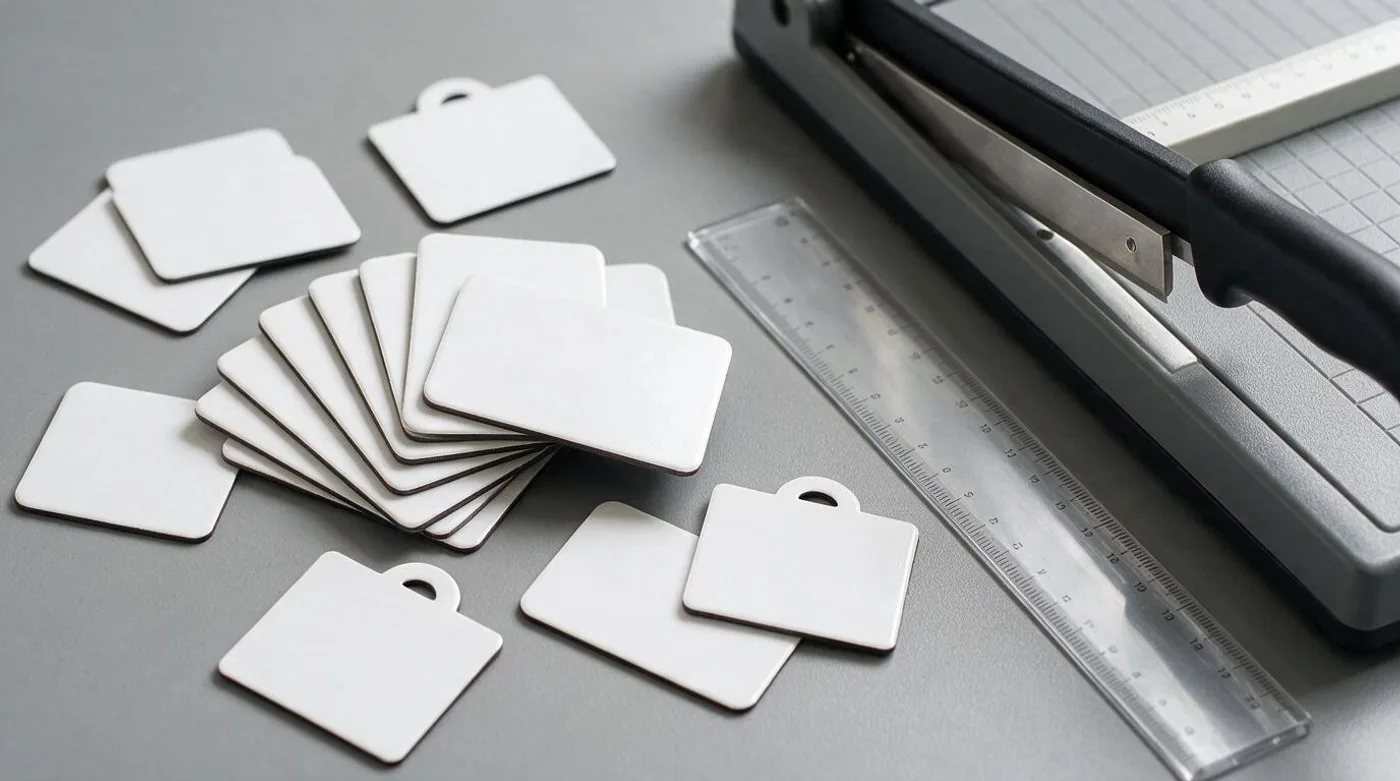
How many pizza shops have printed their number on your fridge door? Most kitchens have at least one, usually alongside an estate agent's house-shaped card and a dentist's appointment reminder. This is the largest category of fridge magnet by volume, and almost nobody who buys them thinks of themselves as buying magnets. They are buying an advert that cannot be thrown out with the junk mail, because it feels like an object.
The whole category runs on one material and a small number of shapes. Learn the thickness, the sizes and the way the quantity breaks work, and you can read any quote you are sent.
Why it is nearly always 0.5 or 0.75 mm sheet
Flexible magnet sheet is ferrite powder in a vinyl binder. It comes off a roll, takes ink directly on its white face, cuts with a die, and costs very little per square meter. Nothing else in the magnet world does all four, which is why the pizza calendar, the vet's card and the trade show giveaway are the same material with different artwork.
Thickness comes in two useful options for print work.
| Thickness | Holds at 50 x 50 mm | On a painted door | What it is for |
|---|---|---|---|
| 0.5 mm | 60 g | about 42 g | Cards, calendars, anything that only holds itself |
| 0.75 mm | 110 g | about 77 g | Magnets expected to pin a sheet of paper too |
The door column is the bare-steel figure multiplied by 0.7, since a painted or coated door keeps 60 to 80 percent of the plate number. Take more off for a textured door. Those two figures are the honest limit of the category: a promotional magnet holds paper, and only just. If a client wants their magnet to hold a child's painting, the answer is a thicker build such as a pressed magnet with a solid ferrite disc behind the print, not a bigger printed sheet.
The published product listings line up with this. Vistaprint lists its magnets at 0.5 mm in 2 by 3.5 in and 4 by 6 in. Shutterfly lists 0.75 mm with a laminated print in 2 by 3 in and 4 by 6 in. Two sellers, two thicknesses, the same material.
The sizes that actually get ordered
| Size | Metric | What it is |
|---|---|---|
| 2 x 3.5 in | 51 x 89 mm | Business card format, the default handout |
| 2 x 3 in | 51 x 76 mm | Wallet size, save-the-date |
| 3 x 3 in | 76 x 76 mm | Square, room for a logo and a QR code |
| 4 x 6 in | 102 x 152 mm | Calendar, bin collection chart, full photo |
| 2.25 in round | 57 mm | Button-style, badge look |
The business card format is the default because it fits a wallet, a stand at a trade show, and the pocket of anyone handing them out. The 4 by 6 in calendar is the format that survives longest on a door, since it is the one people look at rather than the one they merely notice.
Die cut shapes cost more and get remembered more. A house outline for an estate agent, a van for a removals firm, a tooth for a dentist. The die is a one-off tooling charge on the first run and free on every reorder that keeps the same shape, so ask whether a quote includes tooling and whether the printer keeps the die.
Minimum orders and what volume does to price
Almost every setup cost in this business is charged once. Artwork checks, plate or file setup, machine make-ready and the die all cost the same for 25 magnets as for 2,500, so the price per magnet falls steeply over the first few hundred and then flattens into the cost of the material and the ink.
Here is the only published price anchor we have, with the rest of the curve marked for what it is.
| Order quantity | Price per magnet | Basis |
|---|---|---|
| 1 | $2.50 | Shutterfly listed price, 0.75 mm, minimum order 1 |
| 25 | $1.20 | Vistaprint listed price, 0.5 mm, minimum order 25 |
| 100 | not published | Trade quote only |
| 250 | not published | Trade quote only |
| 500 | not published | Trade quote only |
| 1,000 | not published | Trade quote only |
| 5,000 | not published | Trade quote only |
We are not going to invent the missing rows. Trade printers quote per job, the number depends on the shape, the ink coverage and how full their press is that week, and a made-up figure in this table would be quoted back at us by someone negotiating with a supplier. Get three quotes at the quantity you actually want and one at double it, then compare. The second number often costs less than you expect, which is how you end up with 2,000 magnets in the stockroom.
Minimum orders divide the market cleanly. Consumer photo sellers take an order of one at a consumer price, Shutterfly's listed minimum being 1 at $2.50 each. Business-facing printers start at 25 and treat that as a sample run, Vistaprint's listed minimum being 25 at $1.20. Trade magnet houses often will not open a job under several hundred. If a printer quotes you a strangely good price at low volume, check whether they are ganging your artwork onto a shared sheet with other customers, because that saves money and costs you color control.
There is a fuller breakdown of the arithmetic in price per magnet and a sizing method in how many to order.
Flat color against photographs
Screen printing suits a small number of flat colors, so a logo over a block background with a phone number under it is its natural job. The ink sits thick on the surface, brand colors can be mixed to a specific reference rather than built out of process inks, and the price per magnet at volume is low because the material and setup dominate. It handles a photograph badly.
UV flatbed printing handles everything, including photographs, curing the ink the instant it lands so it neither soaks nor spreads on the vinyl face. It is the usual method behind a full color promotional magnet with no minimum worth mentioning.
Litho printing onto paper and then laminating that paper onto plain magnet sheet gives the best photographic result and adds a step. Shutterfly's flexible magnets are described as laminated prints, which is the same idea applied to a consumer product. If the design is a family photograph or a food shot that has to look appetising, ask specifically whether the quote is direct-to-magnet or laminated, because the two look different in the hand.
Gloss or matt lamination on top is worth its small cost on any magnet with heavy ink coverage. It stops kitchen fingers marking the print and stops the ink cracking along the crease when someone bends the magnet to peel it off the door. More on the trade-offs in printing methods.
How long it stays on the door
Nobody publishes a number for this that stands up, and we are not going to pretend otherwise. What can be said is what keeps a magnet up, from looking at what survives on kitchen doors.
Utility keeps it. A calendar, a bin collection schedule, a conversion chart, an emergency number, a local dialling code. Anything the household refers to rather than reads once. A logo with a phone number under it is competing against a phone that already knows every number in the world, so it lives on the door only until something more useful needs that space.
Physical survival is the smaller problem. A laminated 0.5 mm magnet on a smooth painted door outlasts the business that printed it. The failure modes are curled corners on unlaminated stock, grease on a magnet that spent time near a hob, and the slow slide down a textured door described in flexible rubber and vinyl magnets. Order the 0.75 mm option if the door in question belongs to a kitchen with a real cook in it.
Designing for arm's length
A fridge magnet gets read from about a meter away by someone doing something else. That sets the whole design.
The phone number is the point of the magnet, so make it the largest thing on it after the business name. If you cannot read the number at arm's length while squinting, it is too small, and a proof on a screen at 200 percent will lie to you about this every time. Print the proof at actual size, stick it to a fridge, and walk away from it.
Keep everything important well inside the trim. Die cutting on magnet sheet moves a little from piece to piece, so artwork needs bleed past the cut line and no text or logo close to the edge. On a shaped die cut this matters more, because a house outline with the roof running off the top is what happens when the artwork is drawn to the exact die line rather than past it. Never let a border of even width run around the outside edge, since a fraction of a millimeter of drift shows as a border that is fat on one side and thin on the other.
Color on white vinyl runs slightly warmer and denser than the same file on paper. If a brand color has to match a printed brochure, ask for a press sample on the actual magnet stock rather than trusting a paper proof.
What to check before approving the proof
Read the phone number out loud, digit by digit, against the source you were given. A wrong digit is the one mistake that turns the whole run into landfill, and it survives every other check because everyone reads what they expect to see.
Then work down the rest. Size and orientation match what you ordered. The thickness on the docket is the one you paid for. The artwork sits inside the trim with bleed all round and the die shape matches the drawing. The quantity and the delivery address are right, and any dated content such as a calendar grid or an opening time is the version you want printed thousands of times. Ask what the lead time is after approval, and whether that includes shipping. Vistaprint publishes 5 to 7 days for USA shipping and Shutterfly 5 to 8, which is a reasonable expectation to hold a trade printer to as well.
Ask for one physical sample before a large run if the job is shaped, laminated, or color-critical. A sample costs the price of a day's delay. A reprint costs the whole job.
Frequently asked
How much does a business card magnet cost?
Vistaprint publishes $1.20 each for a 0.5 mm magnet at a minimum order of 25. Trade printers quote lower per magnet at four figure quantities, but they do not publish those numbers, so you have to ask for a quote.
What thickness should a promotional magnet be?
0.5 mm is the default and 0.75 mm is the upgrade. At 50 by 50 mm the thin one holds 60 g and the thick one 110 g. Pay for 0.75 mm if the magnet has to hold a sheet of paper as well as itself.
How many magnets should I order?
Enough that the setup cost stops dominating. Setup is charged once whether you print 25 or 2,500, so the price per magnet falls steeply over the first few hundred and then flattens out.
Can I print a photograph on a promotional magnet?
Yes, on a UV flatbed press or as a litho print laminated onto plain magnet sheet. Flat brand colors and a phone number screen print more cheaply, so ask which method a quote assumes.
How long does a promotional magnet stay on someone's fridge?
Nobody publishes a figure worth quoting. What keeps one up is being useful, a calendar, a bin collection day, an emergency number, rather than being a logo on its own.