Letter and number magnets for kids
Children's letter and number magnets sit on either a thin flexible pad glued to the back or a small ferrite disc set into it. Flexible pads are weak, around 60 g for a 50 by 50 mm piece of 0.5 mm sheet, so large foam letters slide. Loose small magnets are a swallowing hazard.
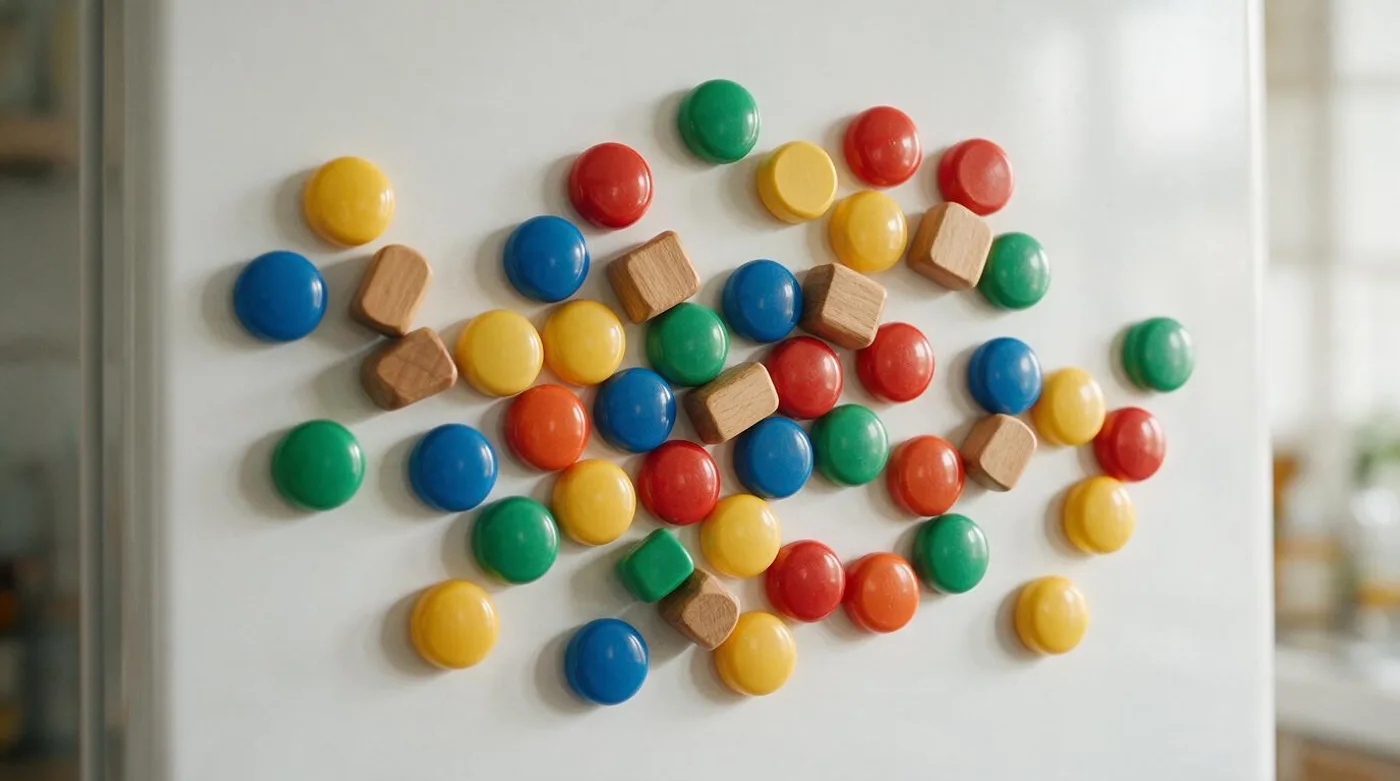
What is actually holding the letter on
Turn a child's magnetic letter over and you find one of two backings. Either a thin pad of flexible magnet, which is ferrite powder mixed into vinyl, cut roughly to the outline of the letter and glued on, or a small ferrite disc sunk into a molded recess. The pad is the cheap answer and the one that most foam and most laser-cut wooden sets use. The disc shows up in molded plastic alphabets, in the chunky preschool letters with a rounded profile, and in anything sold to survive a bath.
Those two backings are nowhere near each other in strength. Flexible sheet reads about 300 Gauss at the surface, and a 50 by 50 mm piece of the 0.5 mm grade holds 60 g flat against bare steel. Step up to 0.75 mm sheet at the same size and you get 110 g. A ferrite disc of 20 by 3 mm holds 500 g, roughly eight times the thin sheet, from a magnet you could cover with a thumbnail.
Then the door takes its cut. A painted or coated door keeps 60 to 80 percent of the bare-plate figure, so multiply by about 0.7 for a working estimate. Paint alone puts 0.1 to 0.2 mm between the magnet and the steel, and each tenth of a millimeter costs a small disc roughly 10 percent of its pull. Door texture and the gentle curve across the front of most doors add more gap on top of that. The arithmetic is not kind to a foam letter: 60 g on a plate becomes about 42 g on the door, and that is before anyone hangs a drawing off it. If you want the underlying physics rather than the numbers, how fridge magnets work covers it.
Set types, backing, and what each holds
The figures below are for the pad or the disc, not for the letter. Flexible sheet scales with contact area, so a letter that covers a quarter of a 50 by 50 mm square gets somewhere near a quarter of the hold. No maker of children's sets publishes a per-letter pull force, and we have not measured one, so treat the middle column as a rate and do the area sum yourself.
| Set type | What is on the back | Published hold | On a painted door |
|---|---|---|---|
| Die-cut foam letters | 0.5 mm flexible pad, glued | 60 g per 50 x 50 mm of pad | about 42 g |
| Molded plastic alphabet | small ferrite disc in a recess | not published | not published |
| Chunky preschool letters | ferrite disc, capped or welded in | not published | not published |
| Painted wooden alphabet | 0.5 to 0.75 mm pad, sometimes a disc | 60 to 110 g per 50 x 50 mm | 42 to 77 g |
| Magnetic poetry tile | 0.75 mm flexible pad, full tile | 110 g per 50 x 50 mm | about 77 g |
| Number set with discs | 20 x 3 mm ferrite disc | 500 g | about 350 g |
Run the sum on a poetry tile and you see how thin the margins get. A tile of 12 by 30 mm covers 360 square millimeters, about a seventh of a 50 mm square, so call it 15 g against bare steel and 10 g on a painted door. That is fine, because the tile weighs a fraction of a gram. It stops being fine the moment someone uses the same tile to pin a receipt.
The molded sets are the frustrating category, because the number that matters is the one nobody prints. A disc inside a plastic letter might be 8 mm across or it might be 15 mm, it might be 1 mm thick or 3 mm, and the box will say none of it. What you can check in a shop is whether the letter clicks onto a steel shelf edge and stays put when you tug it sideways.
Why cheap sets slide down the door
Four things go wrong, and only one of them is the magnet being weak.
The first is a pad cut smaller than the letter. Look at the back of a bargain foam set and the pad is often a rectangle stamped through the middle of the shape, leaving the arms of a K or the tail of a Q with nothing behind them. Contact area is the whole game for flexible sheet, and the maker just threw a third of it away to save vinyl.
The second is thickness. Sets printed on 0.3 mm sheet exist, sold on price, and they hold less than the 60 g we list for 0.5 mm. There is no way to tell from a photograph. There is a way to tell by feel, because thin sheet flexes like paper while 0.75 mm has a little stiffness to it and a noticeable snap when you bring it near the door.
The third is what the letter is made of. Foam is light, which is the one advantage it has. A solid wooden letter 6 mm thick with a full-height 0.5 mm pad behind it is asking a lot more of the same magnet, and a wooden set with a disc instead of a pad will outlast it on the door. Wood and acrylic magnets goes further into how the flat back changes the contact patch.
The fourth is the glue. Water-based adhesive on a foam letter that has been licked, dunked, and wiped down twice a week gives up long before the magnet does. The pad usually leaves first at a corner, and then the whole letter arrives on the floor with its magnet still on the door.
Small parts, loose magnets, and the CPSC position
The magnetism is not the hazard. The hazard is a hard object roughly the size of a coat button coming loose in a house with a two-year-old in it.
The US Consumer Product Safety Commission advises keeping small high-powered magnets away from all children and teens. Its concern is the medical mechanism: swallow one magnet and it usually passes, swallow two and they can find each other through loops of the gut, clamp the tissue between them, and cut off its blood supply. That is a surgical emergency, and the symptoms in the first hours look like an ordinary stomach upset. The same warning applies with more force to the small neodymium spheres sold as desk toys, which are not a children's product in any sense. Neodymium magnets covers those separately.
For a letter set, the practical checks are short. Run a thumbnail around every disc recess and press each disc; anything that rocks or shows a rim of daylight goes in the bin rather than back on the door. Ceramic ferrite is brittle, so a disc that has been dropped on a tile floor can crack in place and later shed a shard through a hairline gap in the molding. Foam letters have their own version of the same problem, since a chewed corner tears into a piece that is exactly the wrong size.
Age labeling on these sets is worth reading and worth distrusting in equal measure. A set marked three and up is not a set marked safe for a child who still mouths things, and a fridge door at toddler height is unsupervised by definition. Storage helps more than vigilance does: a steel biscuit tin holds the whole alphabet on its lid and inside, and it does not spill when a cupboard door swings. There is more on that in how to store magnets.
Cleaning without destroying the set
Warm water, a drop of dish soap, and a cloth. Wipe rather than soak, and dry the letters before they go back on the door, because water sitting in a disc recess will lift the molding and water in a foam letter will not come out for days.
The dishwasher ruins these sets, and not for the reason people expect. Ceramic ferrite works up to about 250 C, so a wash cycle does nothing to the magnet at all. The casualties are the adhesive under a flexible pad, which softens and lets go, and the thin molded plastic around a disc, which distorts just enough that the disc drops out on the next tug. A neodymium magnet would be a different story, since those start losing strength around 80 C, but nobody puts neodymium in a toddler alphabet and nobody should.
Alcohol wipes are fine on molded plastic and bad on painted wood, where they take the paint with them on about the fourth pass. For a wooden set, a barely damp cloth is the whole method. Magnetic poetry tiles are printed card or paper on vinyl and they do not want to be wet at all; a dry cloth and patience is what those get.
What makes a set last
A disc held in a molded recess and capped or ultrasonically welded over will outlive a glued pad by years, because there is no adhesive in the load path and nothing to peel. Second best is a thick pad, 0.75 mm rather than 0.5 mm, bonded across the full outline of the letter rather than a stamped rectangle in the middle.
After that, look at how the color got onto the piece. Paint and print that sit on the surface come off under fingernails and dishcloths; color molded through the plastic cannot. On wooden sets, an engraved letter filled with paint survives handling that a printed one does not.
The last thing to check is the door itself, before you buy anything. Stick a fridge magnet you already own on the spot where the set is going to live. If it slides on a textured door, a 42 g foam letter is going to slide harder, and the answer is a magnetic board or a steel tray rather than a stronger alphabet. Plenty of art-display setups work better that way anyway, which kids' art display gets into.
Frequently asked
Why do my foam letters keep sliding down the fridge door?
The pad on the back is flexible sheet, which holds about 60 g per 50 by 50 mm at 0.5 mm thickness on bare steel, and a painted door keeps only 60 to 80 percent of that. A letter with a pad smaller than its own outline has very little grip to give away.
Are magnetic letters safe for a toddler?
The risk is not the magnetism, it is the size of the parts. The US Consumer Product Safety Commission advises keeping small high-powered magnets away from children and teens, and two swallowed magnets can pull together through the gut wall. Bin any letter whose disc has worked loose.
Can letter magnets go in the dishwasher?
No. Ceramic ferrite itself puts up with about 250 C, so the magnet is not the weak part. The glue holding a pad on and the plastic around a disc are, and a dishwasher cycle will lift one or warp the other.
Do letter magnets work on a stainless steel door?
Only if the door is ferritic stainless, grade 430. Austenitic 304 stainless holds no magnetic domain and nothing sticks to it, though the painted mild steel side panel next to it usually works.