Decorative and art fridge magnets
Decorative and art magnets are gallery prints, ceramic tiles, glass cabochons, or pressed flowers in resin. The backing sets the hold. Flexible sheet gives 60 to 110 g at 50 mm square, a 20 by 3 mm ferrite disc gives 500 g, and a 12 by 3 mm neodymium disc gives 2,500 g.
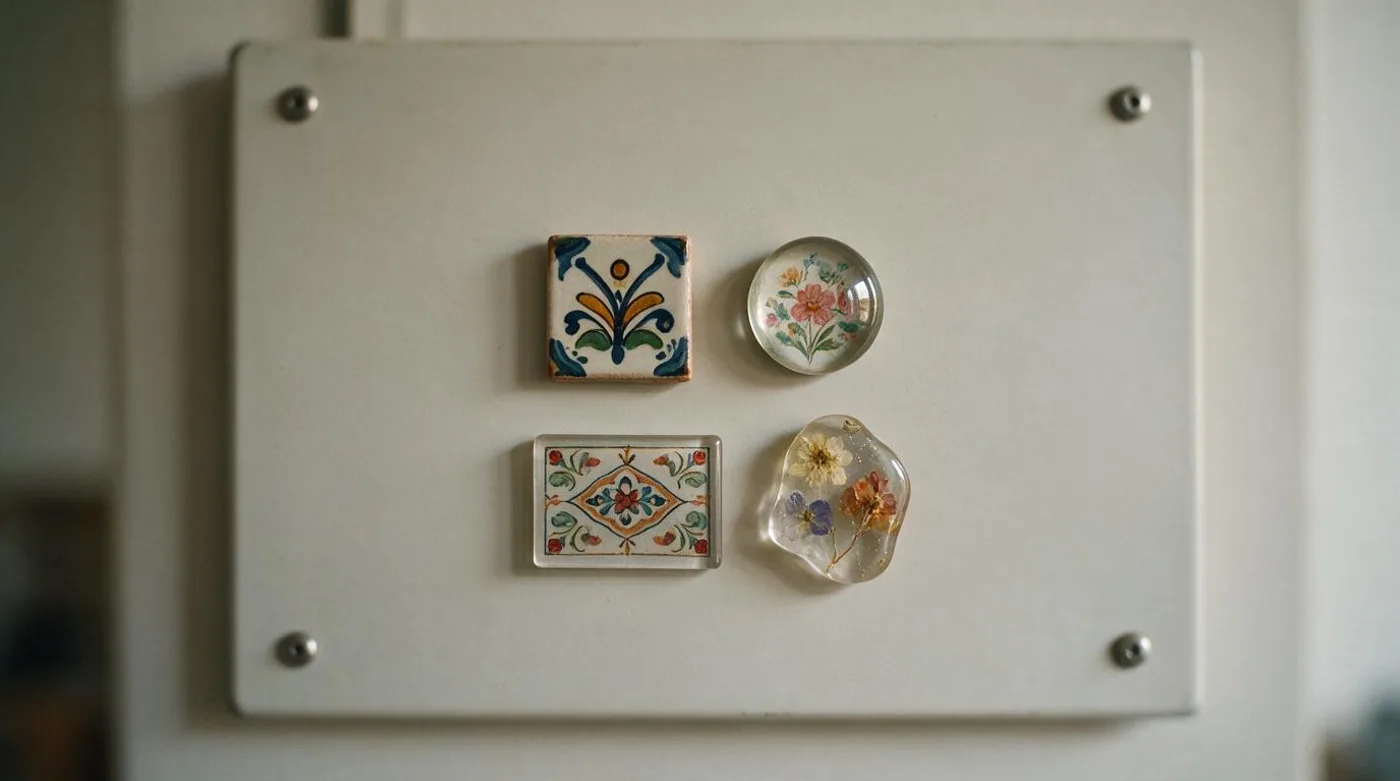
Will a glazed ceramic tile magnet hold a shopping list, or will it struggle to hold itself? The answer is on the back, and in a gallery shop the back is usually turned away from you, glued to a card, and covered by a price sticker. Everything in this category shares that problem. The front is the reason you are buying, and the back is the reason it works or does not.
What counts as a decorative magnet
Gallery reproductions come off a museum shop rack, a painting printed on card or steel at something like 60 mm across. Some are pressed the way a photo magnet is, with a mylar cover over the print and a ferrite slug in a steel shell, and those are the good ones. Most are card with a thin sheet pad on the back.
Illustrated sets are the boxed six or twelve, printed on board, usually die cut into shapes. Ceramic tiles are the heavy ones, a glazed square of clay with something fired or printed on the face. Glass cabochons are a domed glass lens over a paper image, and the dome magnifies the picture, which is the whole appeal. Pressed flowers under resin are a craft product, real plant material cast into clear epoxy, and they are lovely and the least stable thing in the category.
What each backing holds
| Backing | How it attaches | Bare plate | Painted door, estimated |
|---|---|---|---|
| Flexible sheet, 0.5 mm | Pad or full-area sheet | 60 g at 50 x 50 mm | About 42 g |
| Flexible sheet, 0.75 mm | Pad or full-area sheet | 110 g at 50 x 50 mm | About 77 g |
| Ferrite disc, 20 x 3 mm | Glued into a recess or flat | 500 g | About 350 g |
| Ferrite disc, 25 x 5 mm | Glued flat, wide pieces | 1,100 g | About 770 g |
| Neodymium disc, 10 x 2 mm | Glued flat, often two | 1,400 g | About 980 g |
| Neodymium disc, 12 x 3 mm | Glued flat, single | 2,500 g | About 1,750 g |
The right-hand column is the plate figure times 0.7, which is the middle of the 60 to 80 percent a coated door returns. The full set of figures sits in the magnet strength chart.
Note: the jump from ferrite to neodymium at the same size is about sevenfold. A 20 x 3 mm ferrite disc gives 500 g and a 20 x 3 mm N42 disc gives 3,500 g, which is why a small bare metal disc on the back of an art piece is doing more work than a large gray one.
Working out what a heavy piece needs
Put the magnet on a kitchen scale. This takes four seconds and settles the argument, because published weights for decorative magnets are rare and the ones printed on boxes tend to describe the box.
The magnet has to carry itself before it carries anything else, and it has to do it against friction rather than against straight pull. Pull force is measured perpendicular to the door. Sliding is resisted by the friction between the backing and the paint, and that gives out well before the pull figure does. A piece weighing a third of its rated pull will usually stay put on smooth paint. A piece weighing most of it will creep down over a few days.
Glass cabochons are light enough that a small ferrite disc is plenty. Pressed flower resin pieces are light too. Ceramic tiles are where this goes wrong, because a glazed tile is dense, thick, and has a hard flat back that only touches the door across a small area if the door is textured at all.
Thickness works against the tile a second time. Anything that lifts the magnet off the steel costs pull, paint alone accounts for 0.1 to 0.2 mm, and a tile with its disc set below the glaze line adds a millimeter of nothing.
Mounting a heavy magnet without wrecking it
Epoxy, not a glue gun. N42 neodymium is rated to about 80 C and starts giving up strength above that, and a hot melt gun can run past it. Ceramic ferrite is comfortable to about 250 C, so hot melt is fine under a ferrite disc and a poor idea under a rare-earth one.
Keep the glue line thin. Every tenth of a millimeter between the magnet and the door takes roughly 10 percent off a small disc, and a generous blob of epoxy is an easy way to turn a 1,400 g magnet into a 1,000 g one before it ever meets the fridge.
Two smaller discs beat one larger one on anything wider than about 60 mm. Two 10 x 2 mm N42 discs at opposite ends give 2,800 g on a plate between them and stop the piece pivoting off the door at the corners, where a single central disc lets it rock.
Handle bare neodymium carefully while you work. It is nickel plated and it chips when dropped, two discs snapping together will pinch a finger hard enough to break skin, and the US Consumer Product Safety Commission advises keeping small high-powered magnets away from children and teenagers entirely, which rules out this whole approach on anything a child will pull off a door. Ferrite is the safer choice at child height, and 500 g from a 20 x 3 mm disc is enough for most decorative pieces anyway.
One more thing about neodymium on the fridge. Grit trapped under a strong magnet is what marks paint, and a 2,500 g disc presses that grit in properly. Wipe the door and the back of the magnet before you stick it on, and slide it off rather than dragging it across. Do magnets scratch fridges has the detail.
What yellows, and what just fades
Ultraviolet light is the enemy for everything in this category, and nobody publishes a lightfastness rating for any of it. We have not measured fade, so we will not tell you how many years you get.
Clear epoxy resin ambers with age and light, which shows most on a piece that was water-clear over a white flower. Pressed plant material loses color on its own even sealed, since the pigments in a petal were never designed to outlive the plant. Paper under a glass cabochon is protected from moisture and thumbs but not from sunlight, and the dome does nothing to filter it. Printed card behind flexible sheet has the least protection of anything here, because the print is exposed unless the maker laminated it.
Ceramic is the exception worth knowing. A fired glaze does not fade, so a tile whose image was fired in rather than printed on top will look the same in twenty years, and if the picture matters more than the price, that is the material to buy.
Arranging sets and grids on a door
Usable door width is 40 to 60 cm on most fridges. A 50 cm door takes eight 57 mm pieces across with a few millimeters of air between them, or six at 76 mm, which is why boxed sets tend to come in sixes and twelves rather than tens.
Doors are not flat. Most curve slightly towards the vertical edges, so a wide rigid piece near the edge touches at its center and lifts at the sides, losing pull exactly where you wanted the arrangement to look deliberate. Put the large rigid pieces in the middle and the light flexible ones at the edges.
Grids also want a consistent backing. A row that alternates 42 g sheet pieces with 350 g ferrite ones behaves inconsistently every time the door shuts, and the sheet ones migrate downward while the ferrite ones do not.
What to pay
The only per-magnet prices we can quote are for printed sheet magnets from the sellers that publish them, at $2.50 each from Shutterfly and $1.20 each from Vistaprint with a minimum order of 25. Gallery reproductions, ceramic tiles, cabochons and resin pieces are sold by makers and museum shops that do not publish price lists, so there is no honest figure for us to print, and we would rather say that than invent a range. Price per magnet shows how the printed numbers work out per unit once minimum orders are in play.
What you can judge is whether the price matches the back. A fired ceramic tile with two flush ferrite discs is a different object from a printed card with a sheet pad, whatever the two cost side by side on the same rack, and our picks in best decorative magnets are chosen on that basis.
Before any of it, check the door is magnetic. Grade 304 austenitic stainless holds no magnetic domain at all and takes nothing, however strong. Grade 430 ferritic stainless does. The side panels on most fridges are painted mild steel and work regardless, so a 304 door means the collection goes around the corner rather than in a drawer, and why magnets do not stick to stainless explains which is which.
Frequently asked
What holds a heavy ceramic tile magnet on a door?
Weigh the tile on a kitchen scale first. A 20 x 3 mm ferrite disc gives about 350 g on a painted door and a 12 x 3 mm N42 disc gives about 1,750 g, so anything above a few hundred grams wants neodymium or two discs rather than one.
Can I glue a stronger magnet onto a decorative piece myself?
Yes, with epoxy rather than a glue gun. N42 neodymium is rated to about 80 C, which a hot melt gun can exceed, while ceramic ferrite is fine to about 250 C. Keep the glue line thin, because each tenth of a millimeter of extra gap costs a small disc roughly 10 percent of its pull.
Do art magnets fade or yellow?
No seller we cover publishes a lightfastness figure and we have not measured any, so we will not put a number of years on it. Ultraviolet light is what does the damage, so a door that catches direct sun is the wrong place for a paper print under glass or a pressed flower in resin.
How many magnets fit across a fridge door?
Usable door width is 40 to 60 cm on most models. A 50 cm door takes eight 57 mm pieces in a row with a few millimeters between them, or six at 76 mm.