Wood and acrylic fridge magnets
Wood and acrylic magnets are flat, rigid pieces with a magnet glued to the back rather than molded in. Both are light enough that a 0.5 mm flexible pad, good for 60 g per 50 by 50 mm on steel, will carry them. The joint and the door curve decide whether they stay up.
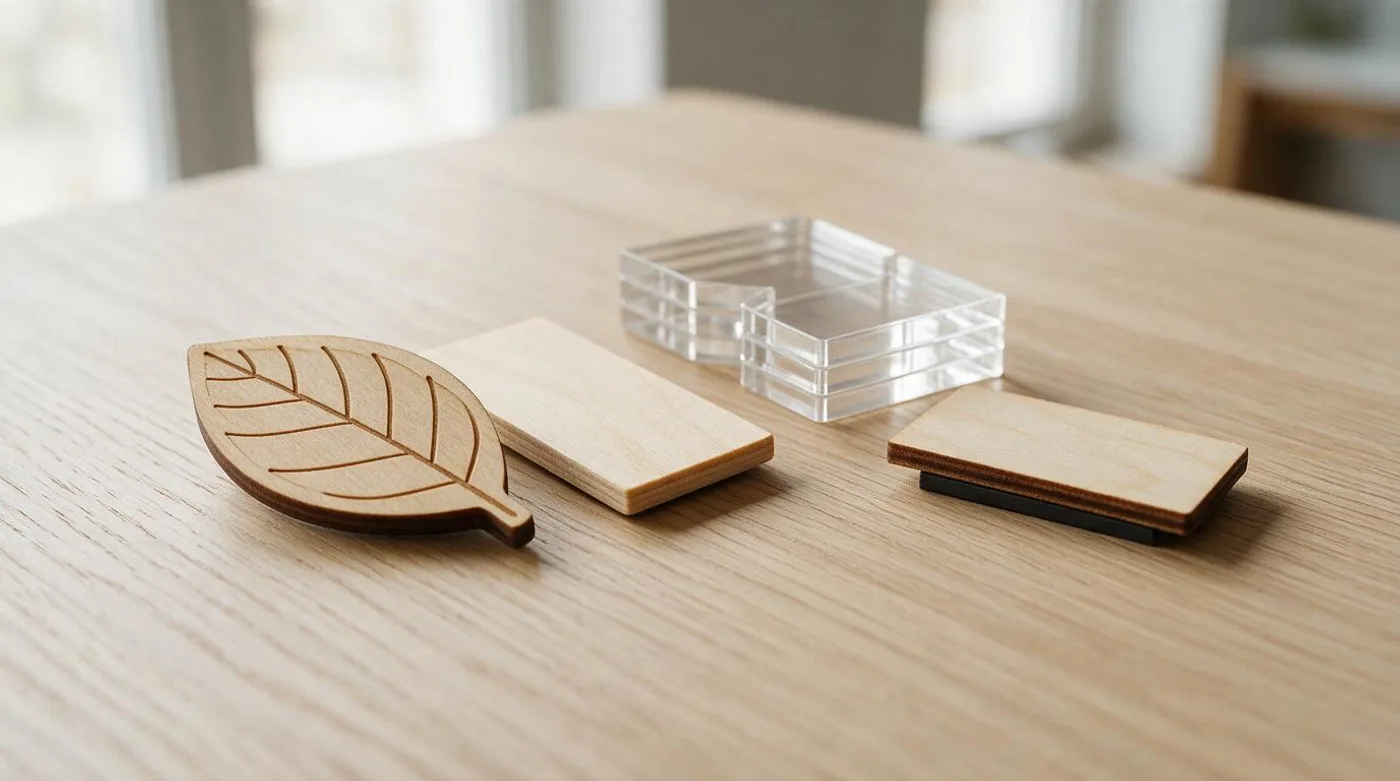
Two materials that fail in opposite directions
Plywood and acrylic end up in the same craft-market stall and behave nothing alike once they are on a door. Wood moves with the humidity in your kitchen and holds its color; acrylic ignores the humidity entirely and shows every scratch it has ever taken. A wooden magnet that fails has usually cupped away from the door. An acrylic one that fails has usually let go at the glue joint, or it has gone cloudy and nobody wants to look at it any more.
Both are flat, rigid, and made in essentially the same way. A sheet goes into a machine, a shape comes out, and someone glues a magnet on the back afterwards. Nothing is molded around the magnet, which is the important structural fact about this whole category. The joint is doing all the work and the joint is what you are really buying.
| Laser-cut plywood | Printed acrylic | |
|---|---|---|
| Usual thickness | 3 mm, sometimes 4 mm | 3 mm, sometimes 5 mm for layered |
| Back | 0.5 mm flexible pad, or a ferrite disc | 0.5 mm pad, or a disc in a milled pocket |
| Hold, 50 x 50 mm on a 0.5 mm pad | 60 g on bare steel | 60 g on bare steel |
| Same, on a painted door | about 42 g | about 42 g |
| Color method | laser engraving, UV printing, vinyl | UV printing, engraving from the back, vinyl |
| Kitchen humidity | swells and cups, worse in solid hardwood | no reaction |
| Sunlight | darkens, and the tone shifts unevenly | cast acrylic holds color; the glue goes first |
| Scratches | the finish scuffs, grain hides it | shows everything, especially on gloss black |
| Cut edge | charred, needs wiping before assembly | flame or diamond polished, or left frosted |
What a flat back does to the hold
A flat rigid back is the best case for a magnet and the worst case for a curved door, at the same time.
Best case, because the entire pad sits against the steel. Flexible sheet holds by contact area, and the 60 g we list for a 50 by 50 mm piece of 0.5 mm sheet assumes every square millimeter of it is touching. A domed resin casting or a chunky molded letter cannot promise that. A 3 mm plywood square can, and it weighs a few grams, so the pad has a wide margin over the load. Step up to 0.75 mm sheet and the same square holds 110 g.
Worst case, because a rigid piece cannot follow the door. Most fridge doors curve gently across their width, and paint adds 0.1 to 0.2 mm of gap on top of that before texture is counted. A rigid 100 mm wide acrylic panel bridges that curve and touches near its two ends, so the middle of its pad contributes almost nothing. Each tenth of a millimeter of gap costs a small magnet roughly 10 percent of its pull, which is a lot to lose across the belly of a wide piece. Flexible pads on a big flat magnet look like a strong solution on paper and disappoint on a curved door for exactly this reason. How fridge magnets work has the field-and-gap explanation behind that.
The fix makers use, when they bother, is to switch from a pad to two small ferrite discs set in milled pockets near the outer edges. Each disc touches on its own, the curve between them stops mattering, and a 20 by 3 mm disc brings 500 g on a plate and about 350 g on a door to a piece that weighs under 20 g. That is a much better magnet than a full-area pad, and it costs more to make, so it turns up on the pieces that were expensive anyway.
Adhesive, and why cheap sets come apart
The glue on the back of a wooden or acrylic magnet has one job and four common ways of failing it.
Double-sided foam tape is what most low-cost sets use. It goes on fast, needs no cure time, and the foam carrier is a compressible layer between a rigid magnet and a rigid piece, which sounds clever and is not. Under a shear load, foam tape creeps, so a magnet on a vertical door slowly migrates downwards inside its own adhesive until the disc is hanging off the bottom edge of the wood. Warm kitchens speed this up.
Hot glue is next, and it is worse. It bonds well to wood and badly to acrylic, and it softens well below the temperature at which either magnet type gives up: ceramic ferrite works to about 250 C and neodymium to about 80 C, so the adhesive is always the first casualty in a warm room.
Cyanoacrylate deserves a specific warning on acrylic. Its vapor condenses on nearby plastic and cures into a white haze, so a magnet glued this way often ends up ringed with a permanent frosted halo that no polish removes. On wood it soaks into the grain and starves the joint, which then snaps cleanly the first time the door slams.
What works is two-part epoxy on a back that has been scuffed with 120 grit and wiped with isopropyl alcohol. On acrylic you can also use a solvent cement to bond a plastic magnet housing, though not the magnet itself. The tell in a shop is simple. Press the magnet with a thumb and try to rotate it. Anything that moves at all is on tape, and it will be on the floor within a year. There is more of this check-before-you-buy reasoning in what to look for.
Wood movement, and where hardwood loses
A kitchen is a hostile place to hang a piece of solid timber. Humidity swings from a kettle boiling to an extractor running, and wood takes up and gives off moisture across the grain far more than along it. Solid hardwood 4 mm thick and 80 mm wide has enough width to cup measurably as it does so, and cupping on a fridge magnet is fatal, because it lifts the edges of the piece and takes the pad away from the steel with them.
Plywood does not have this problem, or rather it has it in both directions at once and so cancels it out. Birch ply glues thin veneers with the grain running at right angles from layer to layer, so each ply restrains the one next to it. Three millimeter birch ply, which is the standard material for laser-cut magnets, stays flat.
Sealing helps solid wood and does not cure it. An oil finish slows moisture exchange without stopping it, and a hard lacquer slows it more while making any movement that does happen more likely to crack the finish. The magnet is not the problem here at any point; the wood is.
One thing wood does better than any other material in this category is take an engraving. A laser cuts a dark, slightly recessed line into birch or maple that reads cleanly at arm's length, and it will not wear off, because it is a burn rather than a coating. Charring is the trade: laser-cut edges come out of the machine with soot that transfers onto fingers and onto the fridge door, and a maker who has not wiped the edges is a maker who has not finished the job.
Acrylic, scratching, and print methods
Cast acrylic is one of the better plastics under sunlight, so the yellowing people report on acrylic magnets usually comes from something else in the sandwich. On a layered piece it is the adhesive between the layers. On a printed one it is the ink or the clear coat over it. When the yellow follows the glue lines rather than covering the face evenly, the glue is telling you what it is.
Scratching is the real weakness, and gloss black is the worst offender because every scuff catches the light. Clean acrylic with soap and warm water on a soft cloth, and keep ammonia glass cleaner away from it, since ammonia attacks the surface and crazes it into a network of fine cracks. Isopropyl alcohol is safer but not entirely safe on a piece with molded-in stress, where it can start crazing at a cut edge.
For color, three methods dominate and they do not overlap much. UV flatbed printing lays curable ink straight onto the surface, which gives full color on wood and acrylic alike and sits on top where a fingernail can eventually find it; printing methods covers how it compares to the presses used for photo magnets. Engraving cuts into the material, so it survives anything, and on clear acrylic it is done from the back so the front face stays smooth. Cut vinyl is the cheapest and the most obvious, since it has visible edges you can catch with a thumbnail and it peels at corners after a couple of years of wiping.
Layered acrylic is worth calling out separately, since it is the one build in this category where the magnet choice is not optional. Two or three sheets bonded together at 3 mm each put real weight and real thickness behind the front face, and the whole stack pivots on the bottom edge of a small pad. Anything built that way wants discs rather than a pad, set high and set wide. If a listing shows a layered piece and does not say what is on the back, that is the question to ask before ordering. Decorative pieces run into the same problem at larger sizes, which decorative and art magnets goes through.
Frequently asked
Do wooden fridge magnets warp in a kitchen?
Solid hardwood does, because it takes on moisture across the grain and cups. A cupped magnet lifts one edge off the door and loses contact area, which is most of what a flexible pad has to give. Laser-cut birch plywood barely moves, since its plies pull against each other.
What glue holds a magnet to acrylic?
Two-part epoxy on an abraded, alcohol-wiped back. Avoid cyanoacrylate, whose vapor fogs acrylic into a permanent white bloom around the joint, and avoid hot glue, which creeps at kitchen temperature and lets go in warm weather.
Does acrylic go yellow?
Cast acrylic holds its color under sunlight better than most plastics, so what usually yellows first is the adhesive under a layered piece or the printed layer itself. A magnet that has gone amber at the glue lines rather than all over is showing you the glue.
Which holds better on the door, wood or acrylic?
Neither, at the same size and the same backing. Both are flat and rigid, so both hold about 60 g per 50 by 50 mm of 0.5 mm pad on bare steel and about 42 g on a painted door. Thickness changes the weight they ask the magnet to carry, not the grip.