Ferrite vs neodymium vs flexible magnets
At 20 by 3 mm a ferrite disc holds 500 g and a neodymium N42 disc holds 3,500 g, seven times more. Flexible sheet holds 60 to 110 g across a whole 50 mm square. Ferrite takes 250 C, neodymium only 80 C. Sheet exists to carry print, not weight.
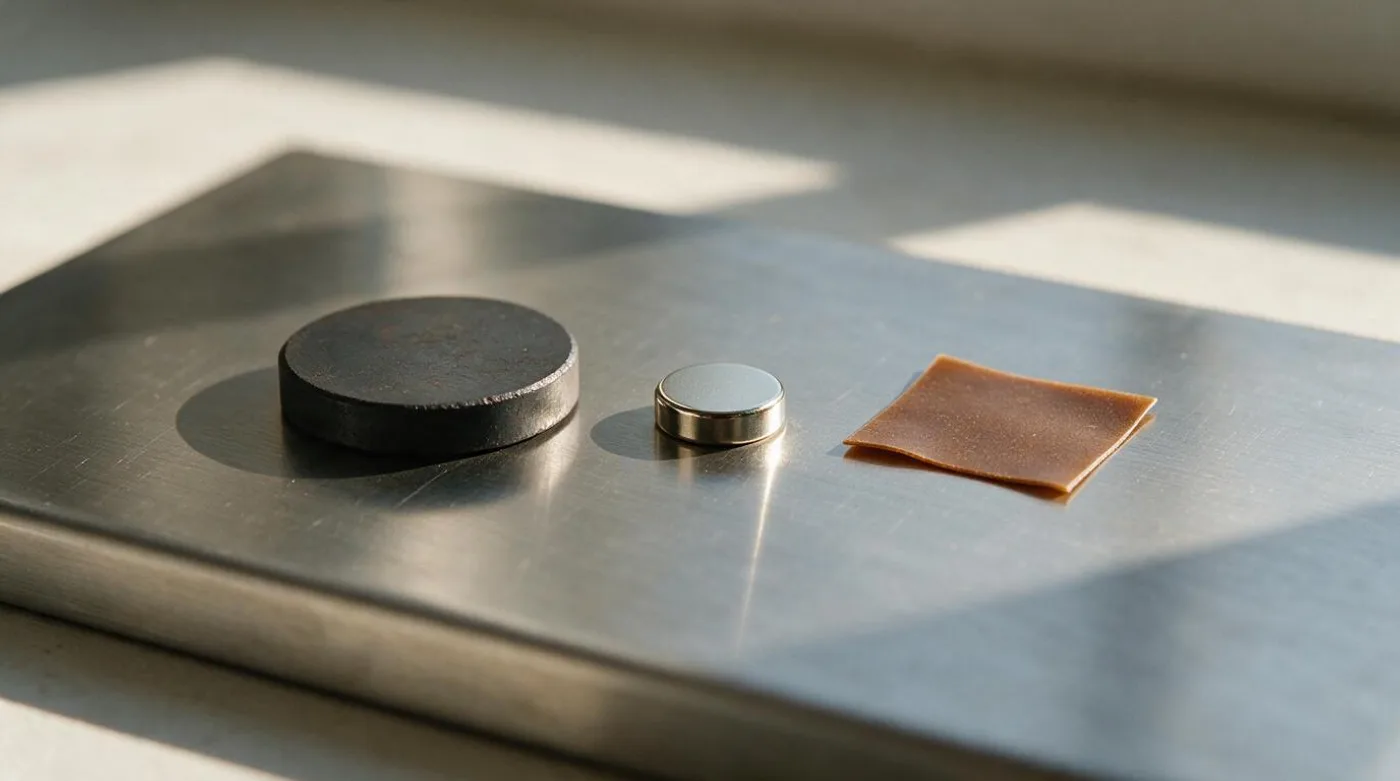
Take a disc 20 mm across and 3 mm thick. In ceramic ferrite it holds 500 g on bare steel. In N42 neodymium, same diameter, same thickness, it holds 3,500 g. In flexible sheet that shape does not exist at all, because nobody rolls a 3 mm sheet magnet, and a 50 mm square of the 0.5 mm stuff holds 60 g. Three materials, one factor of seven and one factor of nearly sixty, and every fridge magnet you have ever owned is made of one of them.
What each one is
Ceramic ferrite is iron oxide combined with strontium or barium carbonate and fired into a ceramic. It is dark gray the whole way through, chalky to the touch on a broken edge, and by a distance the cheapest magnetic material anyone makes. Grade C8 is what turns up in fridge magnets, souvenir backs, and craft packs.
Neodymium is an alloy of neodymium, iron, and boron, usually written NdFeB, sintered from powder into a dense block and then plated because the bare alloy corrodes. Grade N42 stores 42 MGOe of energy product, and it is the grade most fridge-relevant discs are sold in. Under the plating it looks like gray metal and behaves like a ceramic, which is to say it shatters rather than bends.
Flexible sheet is ferrite powder mixed into a vinyl binder and rolled flat, 0.5 to 0.75 mm thick for print work. The magnetic material inside it is the same family as the ceramic disc, diluted by the plastic holding it together, which is why its surface field sits around 300 Gauss against roughly 4,000 for a 12 mm neodymium disc. What it gives up in strength it returns in being cuttable with scissors and printable on a press.
How each one is made
Ferrite and neodymium follow the same four steps, powder, press, sinter, magnetize, and the differences are in the details. Ferrite powder is calcined and milled, pressed in a die under an aligning field, sintered in a kiln, ground flat where the shrinkage was uneven, and magnetized last. No plating, no vacuum, no atmosphere control. The process is old and cheap and the price reflects it.
Neodymium is melted and strip-cast, broken down with hydrogen until the alloy crumbles, jet-milled to particles a few micrometers across, aligned and pressed at the same moment, then sintered under vacuum or inert gas because the powder is reactive enough to burn in air. Then machining, then plating, and only then magnetizing. Every step after the melt is more demanding than the ferrite equivalent, and that is where the price difference comes from.
Flexible sheet skips sintering entirely. Ferrite powder goes into vinyl, the mix is calendered into a continuous roll, and one face is magnetized in narrow stripes of alternating polarity. Those stripes are why sheet magnet grips on one side only, and why the grip dies within a millimeter or two of the surface. How fridge magnets work has the detail on all three routes.
The three side by side
| Ceramic ferrite (C8) | Neodymium (N42) | Flexible sheet | |
|---|---|---|---|
| Composition | iron oxide with strontium or barium | neodymium, iron, boron | ferrite powder in vinyl |
| Made by | press and sinter, then grind | strip cast, sinter, machine, plate | calender into a roll |
| Pull, 20 x 3 mm disc | 500 g | 3,500 g | shape not available |
| Pull, 50 mm square | not made in sheet form | not made in sheet form | 60 g at 0.5 mm, 110 g at 0.75 mm |
| Surface field | lower than neodymium | about 4,000 Gauss at 12 mm | about 300 Gauss |
| Max working temperature | about 250 C | about 80 C | not published |
| Corrosion | nothing to rust, no plating | plated, usually nickel over copper over nickel | vinyl, unaffected |
| When dropped | chips and cracks | chips through the plating | bends, then carries on |
| Ageing at room temperature | very stable | about 1 percent per decade | very stable |
| Cuttable at home | no | no | yes, with scissors |
| Typical use | souvenir backs, pressed photo magnets, craft discs | hooks, heavy paper, small strong discs | printed giveaways, calendars, car signs |
Pull force at matched sizes
Matched-size comparison is the only fair one, and it is brutal. At 20 mm diameter and 3 mm thickness, ferrite holds 500 g and N42 holds 3,500 g. That is the seven times figure quoted everywhere on this site, and it holds up across the range: a 6 x 2 mm N42 disc holds 700 g, more than a ferrite disc more than three times its width.
Flexible sheet cannot be compared on disc geometry, so compare footprint instead. A 20 x 3 mm N42 disc holds roughly sixty times what a 0.5 mm sheet magnet holds across a 50 mm square of door. A pressed photo magnet, which is a flat ferrite disc in a crimped steel shell, holds several times a 0.75 mm sheet of the same 50 mm footprint, though the exact multiple is guesswork until somebody measures it. Nobody selling one publishes a pull force, and we have not run that test. What is not in doubt is the direction, since a solid ceramic disc carries far more magnetic material than 0.75 mm of ferrite powder in vinyl, and ferrite in a steel cup beats loose ferrite because the cup returns flux through the working face.
| Comparison | Ferrite | Neodymium | Flexible sheet |
|---|---|---|---|
| Same 20 x 3 mm disc | 500 g | 3,500 g | not applicable |
| Same 50 mm footprint | pressed build, no figure published | 3,500 g with a 20 mm disc | 60 to 110 g |
| Smallest disc that holds 1 kg | 25 x 5 mm at 1,100 g | 10 x 2 mm at 1,400 g | none |
That last row is the one that decides most purchases. If you need a kilogram of hold, ferrite gets you there at 25 mm across and 5 mm thick, a disc you can see from across the room. Neodymium does it at 10 mm across and 2 mm thick, which disappears into a rug and, more to the point, is small enough to swallow. The CPSC has published on ingestion of small strong magnets, and it is the reason neodymium has no place on a fridge shared with a toddler.
What you pay per gram of hold
We do not publish a price per disc for bare ferrite or neodymium, because the number moves with quantity, supplier, and plating, and an invented one would be worse than none. The arithmetic to run is the same either way. Divide what your supplier charges by the pull force you are buying, and compare that per-gram figure across materials rather than comparing sticker prices.
The break-even is easy to remember. Neodymium holds seven times what ferrite holds at the same size, so it wins on cost per gram of hold whenever it costs less than seven times as much per disc, and it wins on top of that any time size or weight matters. Ferrite wins whenever the job needs less hold than a ferrite disc already provides, which covers most of what goes on a fridge door, and it wins comfortably at large sizes where the ferrite is still cheap and the equivalent neodymium is not.
Printed sheet magnets are priced by the print rather than by the hold. Of the brands we cover, one lists 0.75 mm sheet at $2.50 each with a minimum order of 1, and another lists 0.5 mm sheet at $1.20 each with a minimum order of 25. Neither number is a magnet price. It buys artwork, printing, lamination, and postage, and the magnet underneath is the cheapest component in the stack. Price per magnet works through what the print side actually costs.
Heat, corrosion, brittleness, and time
Temperature separates the two rigid materials more sharply than anything except strength. Ceramic ferrite has a maximum working temperature around 250 C. Neodymium is listed at about 80 C, and above that the loss is permanent, not something the magnet recovers on cooling. A kitchen never gets close to either, but a car dashboard in summer, a magnet clipped to a hot appliance, or anything near an oven vent is a real risk for neodymium and none at all for ferrite.
Corrosion runs the other way in terms of blame. Ferrite is already an oxide, so there is nothing left in it to rust and it needs no coating. Bare NdFeB corrodes readily in humid kitchen air, so it arrives plated, most often nickel over copper over nickel. That plating is the weak point. Drop a neodymium disc on a tiled floor and it chips, and each chip is a hole in the barrier. Flexible sheet does not corrode and does not chip, because it is vinyl.
Both rigid materials are brittle. Ferrite cracks cleanly and tends to break into a few pieces. Neodymium chips at the edges and sends fragments a surprising distance, and two loose neodymium discs snapping together can pinch skin hard enough to draw blood. Handle them one at a time, and keep a card between them in storage.
Ageing barely registers next to any of that. Neodymium loses roughly 1 percent of its strength per decade at room temperature, so a magnet that holds 3,500 g today would still be well over 3,000 g after a century of sitting on a door. Ferrite is more stable still. Nothing on a fridge fails from magnetic decay. How long magnets last covers what does fail, which is plating, printing, and adhesive.
Six jobs and which material to buy
| Job | Buy | Reason |
|---|---|---|
| A photo you want intact in ten years | pressed photo magnet, ferrite core | mylar over the print, steel shell, and several times the hold of printed sheet |
| A printed calendar or menu given away in bulk | flexible sheet, 0.75 mm | 110 g per 50 mm square, cheap to print, cheap to post |
| A stack of school notices and permission slips | ferrite disc 25 x 5 mm | 1,100 g on the plate, about 770 g on a painted door, nothing small enough to swallow |
| A hook for oven gloves or keys | neodymium pot with hook, 16 mm | 6,000 g, and the steel cup does half the work |
| A souvenir with a resin or wooden front | ferrite disc 20 x 3 mm | 500 g is more than the souvenir weighs, and ferrite takes glue and heat |
| A magnet on a fridge shared with a toddler | ferrite, nothing smaller than 20 mm | CPSC warns on small strong magnets, and ferrite is both larger and weaker for the same job |
The pattern across those six is that neodymium earns its place only where the load is genuinely heavy or the space is genuinely small. Two of the six call for it, and one of those is a pot magnet where most of the performance comes from the steel cup rather than the alloy. Ferrite covers the fridge door. Flexible sheet covers anything that has to be printed by the thousand and posted flat, and flexible rubber magnets are worth ordering at 0.75 mm rather than 0.5 mm whenever the supplier offers the choice, because the difference between 60 g and 110 g is the difference between a magnet that slides and one that does not.
Frequently asked
Which magnet is strongest for its size?
Neodymium, by a wide margin. A 6 x 2 mm N42 disc holds 700 g, more than a ferrite disc three times its diameter. At matched sizes of 20 x 3 mm the figures are 3,500 g against 500 g.
Why do souvenir and photo magnets still use ferrite?
Ferrite costs a fraction as much per disc, takes 250 C without complaint, and cannot chip a finger. A pressed photo magnet with a flat ferrite back already outholds a printed sheet several times over, which is more than a photo needs.
Does neodymium rust?
Bare NdFeB corrodes quickly in a kitchen, so discs are plated, usually nickel over copper over nickel. Chip the plating by dropping the magnet and the exposed edge starts to degrade. Ferrite has nothing left to rust.
How fast does a magnet lose strength?
Neodymium loses roughly 1 percent per decade at room temperature. Ferrite is more stable still. Heat is the real risk, since neodymium above about 80 C loses strength permanently rather than gradually.
Is flexible sheet ever the right answer?
For anything printed and given away, yes. At 0.5 mm a 50 mm square holds 60 g and at 0.75 mm it holds 110 g, which carries its own printed face and nothing else. It also cannot scratch a car door.