Do magnets scratch fridge doors?
Not by themselves. A magnet face is softer than a fridge finish. Marks come from grit trapped underneath when a magnet slides, from chipped nickel plating rusting against the steel, and from adhesive on cheap souvenir backs. Clean both faces, and lift a magnet off rather than dragging it.
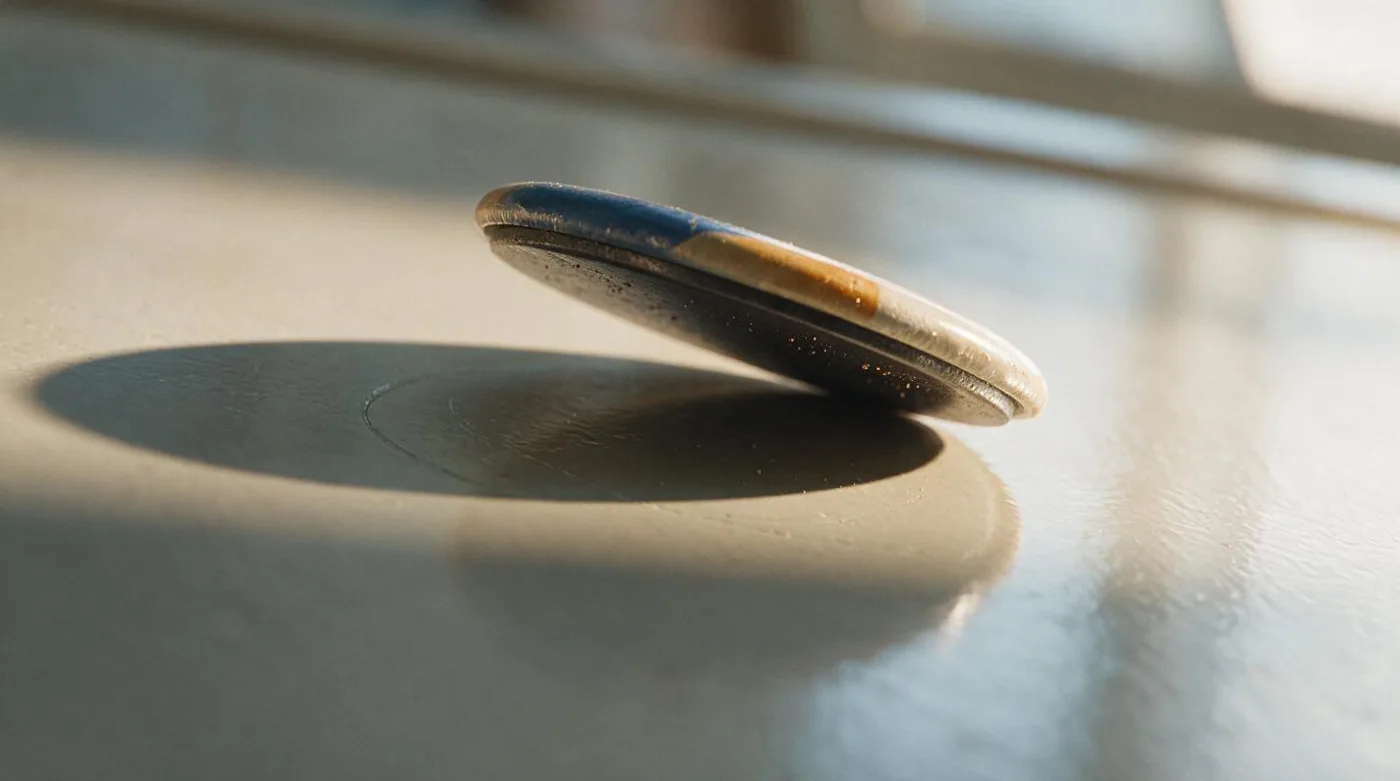
Lift a souvenir magnet that has lived in the same spot for years and there is often something underneath it. A brown ring, a dull patch, a set of fine curved lines like the marks a ring leaves on a table. All of that is real damage, and none of it was done by magnetism.
A magnet cannot scratch a fridge for the same reason a fridge cannot scratch a magnet through the air. The field crosses the gap; the surfaces do the touching. What sits between those two surfaces is where the trouble starts.
Three bodies, one scratch
The mechanism has a name in engineering, three-body abrasion, and a kitchen supplies all three parts without effort. Body one is the door finish. Body two is the magnet face. Body three is the hard particle that gets between them: a grain of sugar, a fleck of dried sauce, sand off a shoe, a crumb of the door's own dried cleaning residue.
The magnet's pull decides how hard that particle is pressed into the paint. Pull force is the clamping force, and on a painted door it is the plate figure times about 0.7. That gives a 20 by 3 mm N42 disc roughly 2,450 g of clamp across a face 20 mm wide. Put a grain of grit under it and the pressure at that one point is enormous, because the whole load funnels through a contact patch measured in fractions of a millimeter. Then somebody slides the magnet across the door to make room for a takeaway menu, and the grain cuts.
A 0.5 mm flexible sheet magnet at the same 50 mm footprint holds 60 g. It cannot generate that pressure, which is why nobody has ever complained about a fridge scratched by a pizza delivery magnet.
| Magnet | Pull on bare steel | Clamp on a painted door | Marking risk |
|---|---|---|---|
| Flexible sheet, 0.5 mm, 50 mm | 60 g | about 42 g | Negligible |
| Pressed photo magnet, 57 mm | not published | not published | Low, contact face is flat and smooth |
| Ferrite disc, 25 x 5 mm | 1,100 g | about 770 g | Moderate, bare ferrite is porous and rusts |
| N42 disc, 12 x 3 mm | 2,500 g | about 1,750 g | High if the plating is chipped |
| N42 disc, 20 x 3 mm | 3,500 g | about 2,450 g | High if the plating is chipped |
The pressed row carries no pull figure because no seller publishes one and nothing has been on a gauge here. Its ferrite magnet puts it well above the sheet row, and for this page that hardly matters, since marking risk comes from what the contact face is made of rather than from how hard it pulls.
The pattern in that column is not about the magnet's hardness. It is about how hard the magnet presses whatever is caught underneath.
Which builds cause the most damage
Bare ceramic ferrite is the classic offender. It is porous, it is dark gray and dusty at the surface, and it holds moisture. A 25 by 5 mm C8 disc stuck straight onto a door face and left alone for a year will leave a ring, because kitchen air is humid and the contact area never dries.
Neodymium with broken plating is the worse case. Sintered NdFeB corrodes readily and the nickel plating that stops it is only a few microns thick over a brittle core. Drop a disc on a tile floor or let two snap together across a gap and a flake comes off the rim. The exposed core then rusts, and what it rusts against is your door. Neodymium magnets goes into why the plating is so easily lost.
Cast resin souvenirs sit third. The magnet in the back is often a plain ferrite disc glued on, and the glue squeezes out around the rim in a hard ridge that stands slightly proud of the magnet face. That ridge is what touches the door, it is harder than the paint, and it collects grit like a rake. Souvenir magnets covers the range of builds you find on the back of them.
Pressed photo magnets are the safest build we list. The steel shell is crimped round a flat ferrite magnet, so the whole contact face is one smooth plated surface with no adhesive at the edge and nothing porous exposed. They also spread what pull they have across a wide flat face, so the pressure at any one point stays low. How photo magnets are made has the layer stack.
Wood and unsealed acrylic backs are worth naming for a different reason. Both are soft enough not to cut paint, but both absorb moisture and both can leave a stain rather than a scratch, which is harder to remove because it has soaked in rather than sitting on top.
What stops it
Lift rather than slide. Almost every scratch on a fridge door was made by a magnet traveling sideways rather than sitting still. Pinch the magnet, pull it straight off, put it down where you want it. On a strong disc that is genuinely difficult, which is an argument for owning fewer very strong magnets rather than for developing better technique.
Wipe the door face and the magnet face when you clean. The magnet face is the one nobody thinks about, and it is the one that has spent six months collecting whatever was in the air over the hob. Turn each magnet over once in a while and rub the back on a damp cloth.
Give strong magnets a soft face. A dot of clear silicone, a punched disc of felt, or a self-adhesive rubber bumper on the back of a neodymium disc removes the metal-to-metal contact entirely. It costs pull, since even a 0.5 mm pad adds gap and each tenth of a millimeter takes roughly 10 percent off a small disc, so a 2,500 g magnet with a 0.5 mm felt pad is doing well to hold half that. On a door holding paper, half of 2,500 g is still absurd.
Check the plating on neodymium every so often. A gray patch on a silver disc means the coating has gone and the magnet is now a rust source. Retire it to a drawer, or cap it.
Do not park magnets on the handle side of the door where hands and sleeves brush past them all day. That is the zone where sideways movement happens without anyone deciding to move anything.
Marks that are already there
Fine scratches in paint, rust rings, and adhesive residue each want a different approach, and the order matters because the harsh methods close off the gentle ones. Warm soapy water and a soft cloth first. Isopropyl alcohol for glue. A non-abrasive cream cleaner, worked along the grain rather than in circles, for a rust ring on stainless. Nothing abrasive on a brushed finish, ever, because a scouring pad replaces one small mark with a permanent bright patch that catches the light from across the room. Removing magnet marks sets out the full sequence with what to avoid at each step.
The one mark that does not come off is the outline left by a magnet that sat in direct sunlight for years. That is not dirt or damage under the magnet. It is the paint around the magnet fading while the covered patch stayed the shade it started at, and the only fix is time or a resprayed door.
Frequently asked
Will a neodymium magnet scratch a stainless door?
The nickel plating will not, while it is intact. A chipped disc with the sintered core exposed will, because the bare core is harder and rougher than the finish it sits on, and it rusts as well.
Are souvenir magnets worse than photo magnets?
Usually. A pressed photo magnet has a crimped steel rim and a flat ferrite back, so its contact face is smooth and flat. A cast resin souvenir is often glued to a bare ferrite disc, and the glue squeezes out around the edge and picks up grit.
Does a stronger magnet mark the door more?
It can, because pull sets contact pressure. A 20 by 3 mm N42 disc pressing at about 2,450 g on a painted door drives anything caught underneath into the paint. A 0.5 mm sheet magnet at 60 g cannot.
What is the brown ring under my magnet?
Rust, almost always from the magnet rather than the fridge. Bare ferrite is porous, and neodymium with broken plating corrodes quickly in kitchen air. Condensation on the door face does the rest.
Can I put magnets on a fridge that is still under warranty?
Fridge makers do not publish a position on this and we are not going to invent one. Cosmetic damage to a door finish is rarely covered by any appliance warranty, so the practical answer is to avoid causing it.