Calculate a magnet order's delivered cost
Compare magnet quotes by dividing the total payable by the delivered quantity. Include shipping, setup, and any applicable tax. Also divide by the number you actually need: a lower advertised unit price can cost more overall if it requires a much larger pack with pieces you will not use.
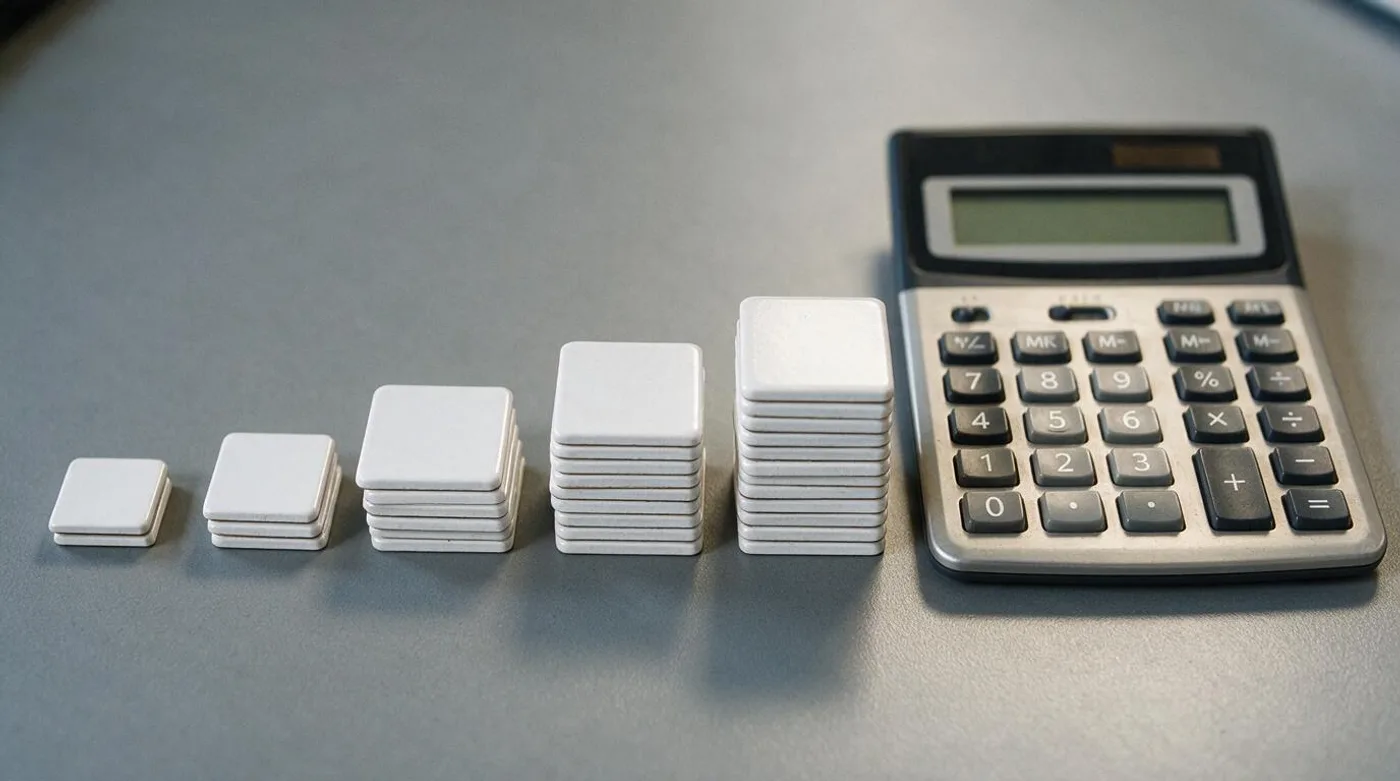
An $80 box can be a better buy than a $65 box, or a worse one. The answer depends on how many magnets arrive, how many you will use, and what the quoted amount includes. Write the pack quantity beside the total payable before dividing anything.
A displayed price per magnet often describes product alone. Shipping may change with the destination, tax may appear at checkout, and a quoted setup fee may apply to each design. The comparison you can act on is the cost for your particular order, with the same finished specification and delivery requirement on both sides.
Calculate the delivered cost and the cost for your actual need
Use two separate divisions. Delivered cost per magnet is the total amount payable divided by the quantity supplied. Cost per needed magnet is that same total divided by the quantity you intend to use. The second figure includes the cost of the surplus; it does not assume that spare magnets are worthless.
Suppose you need 18 magnets. The figures below are our worked example, not seller prices. Divide each total by the delivered quantity and by the 18 pieces needed; the results are rounded to cents.
| Quote | Product | Shipping | Delivered quantity | Total | Per delivered magnet | Per needed magnet |
|---|---|---|---|---|---|---|
| A | $40 | $8 | 20 | $48 | $2.40 | $2.67 |
| B | $45 | $8 | 30 | $53 | $1.77 | $2.94 |
Quote B has the lower price per delivered magnet. Quote A leaves $5 more in your budget for the 18 magnets you need. B also supplies ten more magnets than A. If those additional copies have a planned use, the $5 difference may be worthwhile. If they carry a date that will soon pass, count that limit before assuming you will distribute them later.
NIST explains unit pricing as a way to compare cost on a consistent quantity basis. A finished magnet is a useful unit for this calculation, provided the magnets have comparable dimensions and construction. A total divided by ten small squares and a total divided by ten large rounds gives two valid prices, but those prices alone do not identify which size fits your display.
Keep full precision while calculating and round the result at the end. In the table, $48 divided by 18 is $2.6666 repeated, displayed as $2.67. Multiplying that rounded display by 18 gives $48.06. The six-cent difference comes from rounding, not an additional fee. Use the actual order total when checking what you will pay.
If you divide a pack price by the number of images uploaded, you may get the wrong unit cost. Four designs repeated five times each make 20 magnets. The denominator for delivered cost is 20. For the quantity decision itself, the pack and minimum guide explains why a seller's pack count can exceed your recipient count.
Build a quote that includes the charges you will pay
Start with the exact product selection. Record the size, pack, finish, and whether every magnet can use a different image. Include any separate artwork preparation, physical sample, setup, or proof charges. A fee per design becomes expensive when one order contains many designs; a fee for the whole job behaves differently.
Imagine two hypothetical quotes for 50 identical magnets. Quote C lists $70 of product, a $12 setup charge, and $8 shipping, for $90 before any applicable tax. Quote D lists $82 of product, no setup charge, and $6 shipping, for $88 before tax. C's product price is lower by $12, yet D's complete quoted amount is lower by $2. Their costs per delivered magnet are $1.80 and $1.76. Neither figure is a current seller offer.
Enter tax as the actual amount shown for the delivery address. Avoid copying a rate from another buyer or multiplying every line by a guessed percentage. Keep the pre-tax comparison if that is all the seller has provided, label it clearly, and replace it with the checkout total when available. If the two quotes use different currencies, convert them on the same basis and include any payment charge you will incur.
Shipping has its own conditions. A free shipping threshold may require buying more magnets than you need. Suppose a hypothetical cart has $60 of product plus $9 delivery. Adding an $18 pack reaches the threshold and removes delivery, so the total becomes $78 rather than $69. You spend $9 more and receive an extra pack. Record that as an optional purchase rather than calling the threshold a $9 saving on the original order.
The Fresh Magnets catalogue is an example of why product options and an orderable quote must be checked separately. Prepared size and pack options exist, but the public storefront currently shows a coming soon notice. We do not treat catalogue entries as a live checkout price. Open the current product and confirm availability and the payable total before adding it to a budget.
When comparing sellers, keep shipping speed consistent. Economy delivery on one quote and expedited delivery on another measure different orders. A shop's production estimate also differs from carrier transit. Ask for the dispatch window, the delivery service, and any deadline-specific arrangement in writing. Paying for faster transit cannot remove time spent waiting for a proof or revised artwork.
Compare the magnet specification and the costs outside the box
Match the finished outer dimensions first. A nominal 2.5 inch square converts to 63.5 mm, but a rounded listing and a measured finished part may differ. The measurement guide covers that distinction. Compare flexible sheet with flexible sheet, or rigid pressed shell with a comparable assembly, if the purpose is to isolate price.
When you are choosing between constructions, list what each supplies instead of treating price as a quality score. Check the visible print area, edge treatment, backing, and overall thickness. A clear cover does not establish a published lifespan, and a thick body does not establish greater holding force. The sheet and pressed comparison gives practical checks for those missing figures.
Printing specifications can change the quote too. A price for repeated artwork may not include 50 individually prepared crops. An online preview may be included while a mailed sample costs extra. Ask what happens if a crop needs changing after approval, and whether the seller saves the file for a repeat order. Our printing guide separates the print process from the protective surface you touch.
For a mailing, the seller's shipping charge covers the trip to you. Your envelopes, inserts, protective packing, and onward postage are separate distribution costs. Suppose 50 hypothetical magnets cost $88 delivered, and individual packing costs $0.60 each. Packing adds $30, so the amount before onward postage is $118, or $2.36 per magnet. That calculation assumes all 50 are packed; if you keep five, enter 45 packing costs instead.
A magnet's thickness and the completed package can affect your choice of packing. Measure and weigh a sample with every insert in place, then obtain the applicable carrier price. Leave postage out of a magnet-only comparison if you prefer, but include it in the amount reserved for getting each magnet to its recipient. Label the two totals so another person can check the budget.
Save the quote with its date, selected options, and destination. Record whether a discount expires and whether a sample charge counts toward the final order. At checkout, compare the payable amount with your saved calculation. If a shipping line or quantity has changed, revise both unit costs before paying rather than carrying the earlier figure into the order record.
Frequently asked
Should shipping count in the unit price?
Include it when comparing the total cost to you. Keep it separate if you are comparing only product prices.
Is a larger pack always cheaper?
It may have a lower price per delivered magnet but a higher total. Compare both totals against the number you need.