How long fridge magnets last, and what fails first
Neodymium loses roughly 1 percent of its strength per decade at room temperature and ferrite is effectively stable, so the magnetism outlives everything else. Prints fade, adhesive lets go, plating corrodes, and ferrite chips. Heat above about 80 C for neodymium and 250 C for ferrite causes permanent loss.
Roughly 1 percent per decade. That is how fast a neodymium magnet at room temperature gives up its strength, and ceramic ferrite is slower still, near enough to stable that nobody bothers quoting a figure. Nothing else about a fridge magnet ages that gently. The magnetism is the one component with a working life measured in human generations, and it is almost never the reason a magnet ends up in the bin.
So a page about how long fridge magnets last is mostly a page about paper, glue, and plating.
The magnetism barely moves
Neodymium at grade N42 stores 42 MGOe of energy, and the slow drift downward comes from thermal agitation nudging domains out of alignment over time. A 20 x 3 mm N42 disc rated 3,500 g on a bare steel plate would be down by a few percent after several decades on a door, which is well inside the variation you would get from the paint thickness under it. Ceramic ferrite behaves even better, because it has less to lose and a structure that holds what it has.
There is one way to knock strength out of a magnet quickly at room temperature, and that is another magnet. Bring a strong neodymium disc up to a ferrite one in opposition and the reverse field can take a permanent bite out of the weaker material. It takes a deliberate arrangement, and shelf storage rarely produces it, so the practical rule is simply to keep ferrite and neodymium in separate boxes.
Geometry matters more than most people expect. Thin, wide magnets sit at a disadvantage because their own field loops back through themselves more aggressively, which is part of why a 0.5 mm flexible sheet at 50 x 50 mm holds 60 g while a small thick disc holds many times that. Storing a thin magnet stuck to steel closes that loop through the steel instead and is the kindest thing you can do to it.
The two temperature ceilings
N42 neodymium has a maximum working temperature of about 80 C. C8 ferrite is good to about 250 C. Below the ceiling, heat costs strength temporarily and the magnet recovers on cooling. Above it, some domains give up for good and the magnet comes back weaker than it went in, permanently.
A fridge door will never do this to a magnet. Kitchens still find ways. The top of an appliance that vents warm air, the wall behind a hob, the inside of a car in summer where somebody left a box of souvenir magnets on the parcel shelf: those are the places where an 80 C ceiling stops being theoretical. Ferrite's 250 C headroom is why it survives situations that flatten neodymium, and it is one of the arguments in neodymium versus ferrite. Magnets in heat goes through the recoverable and unrecoverable cases separately.
Print fading is the real clock
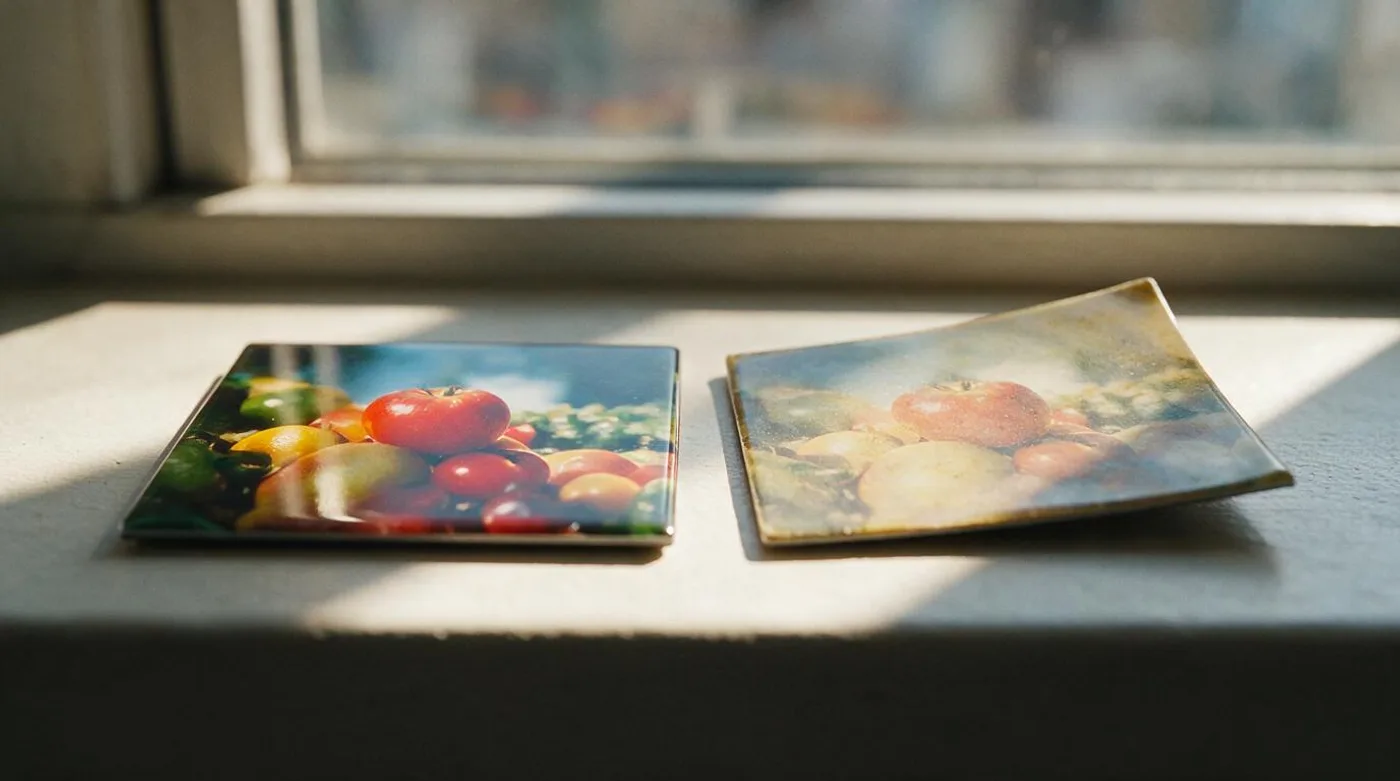
Ink is the shortest-lived thing on a photo magnet, and the gap between builds is wide. A pressed magnet keeps its print under a clear mylar cover inside a folded steel rim, which shields it from splashes, from cloths, and from a fair share of the light. Our working estimate for one of those indoors is a decade with the color still worth looking at, and that is an estimate rather than something we have measured.
An unprotected inkjet print laminated to flexible sheet is a different case entirely. Put it on a door that catches afternoon sun through a kitchen window and our estimate, again from the build rather than from a measurement, is visible shift in two to three years, with the cyan and magenta going first and skin tones going odd before anything looks obviously faded. UV drives it, and window glass blocks much less of the relevant band than people assume. Heat from the sun on a dark image compounds it.
Two habits stretch the life of any print. Keep photo magnets off the sunlit half of the door and put the fridge magnets you do not care about there instead, and wipe with a damp cloth rather than a kitchen spray, since solvent finds its way past the edge of a laminate faster than water does. Photo magnets compares the two builds in more detail.
Adhesive is the second thing to go
Almost every decorated magnet is a stack held together with glue. A resin souvenir front sits on a self-adhesive disc. A pressed magnet has its ferrite bonded to the steel shell. A laminated sheet magnet has an adhesive layer between the print and the vinyl.
Pressure-sensitive adhesive softens with warmth and creeps under sustained load, and a magnet on a door is under sustained load every day of its life. The visible symptoms are a resin front that rotates on its base, a ferrite disc you can twist with a thumb, or a print starting to lift at one corner of a sheet magnet. A magnet stored in a hot car ages its glue harder in one summer than in five years on a door.
Nothing usefully repairs a failed factory bond. A drop of cyanoacrylate on a clean, dry ferrite face gets a souvenir magnet back on the door, and it is worth doing before the two halves separate and one of them disappears under the fridge.
Plating, chips, and the damp corner of the kitchen
Neodymium arrives nickel plated because bare NdFeB corrodes readily. The plating is hard and thin, and it chips when a magnet is allowed to snap onto steel or onto another magnet at speed. Once a chip exposes the material underneath, corrosion starts at that point and works inward, and the magnet eventually crumbles at the edge. In a humid kitchen, over a dishwasher or beside a kettle, this runs faster.
Ferrite does not corrode, being an oxide already, but it is brittle and dark gray the whole way through, so a drop on a tiled floor takes a corner off or splits it. A cracked ferrite disc still works. It simply looks like what it is.
The steel around a magnet rusts too, which is a separate matter from the magnet ageing and is covered on do magnets damage fridges, because the stain usually ends up on the door rather than on the magnet.
Storage that buys years
Keep spares somewhere cool and dry, which for most homes means a drawer rather than a windowsill or the top of the fridge. Stick neodymium discs to a strip of steel or to each other rather than letting them roll loose, and put card between them so they cannot slam together and chip. Bring two neodymium magnets together by sliding them along a surface instead of letting them jump the last centimeter.
Store printed magnets flat, and do not stack them face to back with bare ferrite touching a gloss print, because ceramic ferrite is abrasive and it will haze the surface it rubs against. Interleave them with paper. Keep photo magnets out of a loft or a garage where the summer temperature swing is wide, and out of any box that is going to spend a week in a car.
A collection is worth checking once a year, which takes about five minutes. Lift each magnet, look at the paint underneath for a ring, twist the back to test the glue, and look at the front in daylight against a print you have somewhere else for comparison. The ones that have started to go are usually obvious side by side and invisible on their own, and a fading print is much easier to reprint than to rescue. How to store magnets covers the boxes and the spacing for anything you are not displaying.
Note: the table below is estimates, not measurements. Nothing on this site has been through a gauge or an accelerated ageing rig yet, and the magnet-strength figures are published manufacturer data. Treat the timescales as the order of magnitude to plan around rather than as numbers to hold anyone to.
| Failure | Estimated timescale | What it looks like | What slows it |
|---|---|---|---|
| Neodymium strength loss at room temperature | About 1 percent per decade | Nothing you would notice | Nothing needed |
| Ferrite strength loss at room temperature | Effectively none | Nothing | Keep it away from strong opposing fields |
| Inkjet print on unprotected sheet, sunny door | 2 to 3 years | Cyan and magenta shift first | Move it out of direct sun |
| Photo print under mylar, indoors | About a decade | Slow overall softening of color | Shade, and a damp cloth rather than spray |
| Adhesive bond in a warm kitchen | Several years | Front rotates, or the magnet twists | Keep off warm appliances |
| Nickel plating after a chip | Months once damp gets in | Rough edge, then crumbling | Avoid snap-together impacts |
| Ferrite cracking | One drop | Split or missing corner | Keep spares off the door edge |
| Permanent heat loss, N42 above 80 C | Immediate | Weaker and it stays weaker | Keep neodymium out of hot cars |
Frequently asked
Do fridge magnets get weaker over time?
Barely. A neodymium magnet loses roughly 1 percent of its pull per decade at room temperature, and ceramic ferrite is effectively stable. A 20 x 3 mm N42 disc rated 3,500 g will still be near that figure long after the picture on your fridge has faded.
What temperature ruins a magnet?
About 80 C for N42 neodymium and about 250 C for C8 ferrite. Past those ceilings the loss is permanent and cooling the magnet down does not bring the strength back. A fridge door never comes close; a parked car in summer can.
What usually breaks first on a fridge magnet?
The print or the glue, not the magnet. Ink on an unprotected flexible sheet fades in sunlight, and the adhesive holding a decorated front to its magnet gives up in a warm kitchen. Both happen while the magnet itself is unchanged.
Does cutting or breaking a magnet destroy it?
No. Each piece keeps its own north and south poles and works as a smaller magnet. Ferrite is brittle and chips into fragments, and a broken neodymium disc exposes bare NdFeB that then corrodes from the break.
How should I store spare magnets?
Cool, dry, and stuck to a piece of steel or to each other rather than loose in a drawer. Keep neodymium pieces apart with card so they cannot snap together and chip their nickel plating.