How fridge magnets work
A fridge magnet holds because the door is steel. Aligned domains inside the magnet magnetize the steel underneath it, and the two pull together. The weight hangs in shear rather than tension, so a pressed photo magnet slides down a painted door long before it ever falls off it.
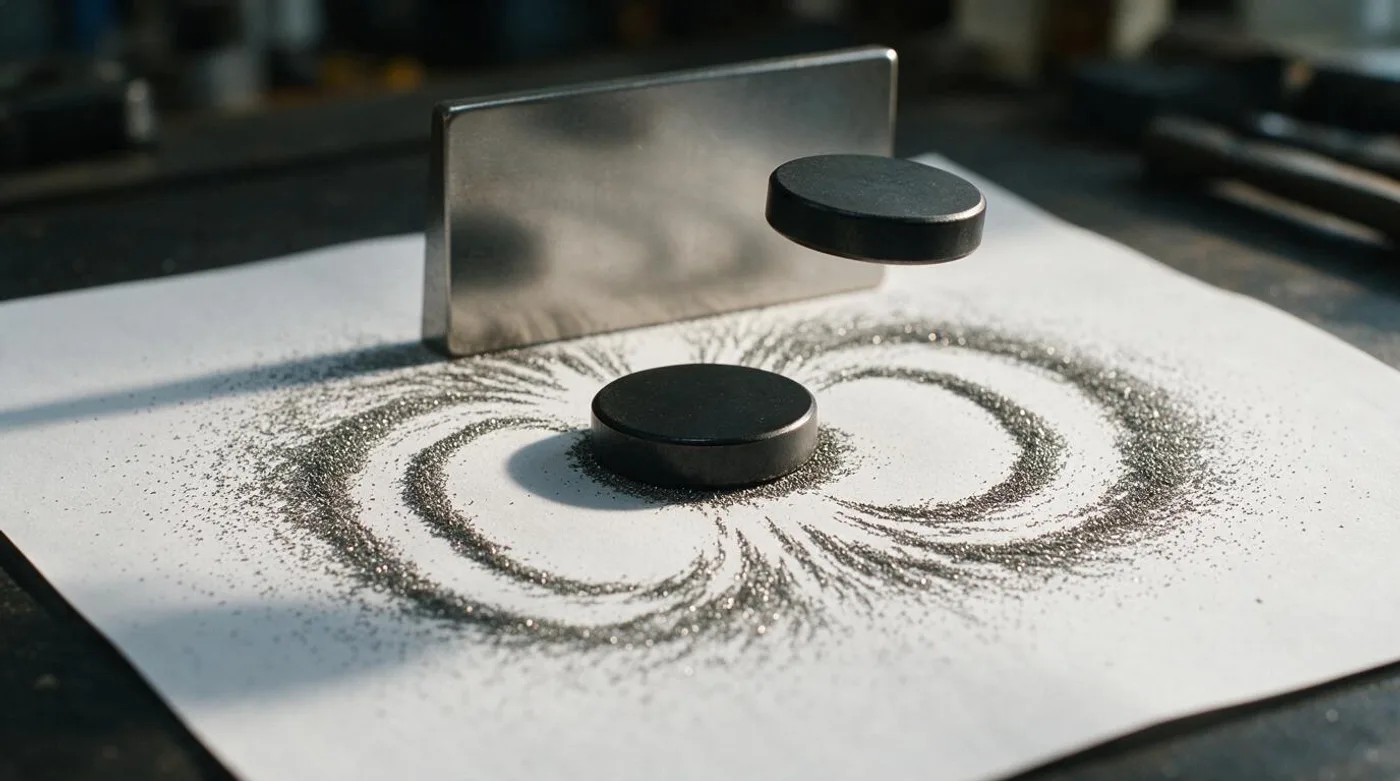
Snap a ferrite disc in half and you do not end up with a north piece and a south piece. You end up with two smaller magnets, each with its own north and south, each weaker than the one you started with. Snap those in half and the same thing happens again. Keep going, in theory, and you arrive at the reason. The magnetism was never a property of the disc as an object. It belongs to regions inside it, and there are billions of them.
Domains, and why some materials keep their alignment
Those regions are magnetic domains. Inside one domain the magnetic moments of the atoms all point the same way, held there by an exchange interaction between neighboring electrons that is far stronger than any field you could apply from outside. A domain might be a few micrometers across. A 20 mm ferrite disc contains an enormous number of them.
In a lump of unmagnetised iron the domains point in every direction and their fields cancel. Bring a strong field near it and the domain walls move. Domains already pointing the right way grow at the expense of their neighbors, and the ones that cannot grow rotate instead. The iron now has a net field. Take the external field away and, in soft iron, the walls slide back to where they were and the field collapses with them.
What separates a permanent magnet from a paperclip is how hard it is to move those walls back. In ceramic ferrite and in sintered neodymium the crystal grains are shaped and aligned so that a domain wall has to climb an energy hill to move at all. Grain boundaries pin it. The material resists being demagnetized, and the property that describes that resistance is coercivity. High coercivity is what "hard" means in a hard magnetic material. It has nothing to do with how tough the thing is, and both ferrite and neodymium are brittle enough to chip on a tiled floor.
| Behavior | Hard magnetic material | Soft magnetic material |
|---|---|---|
| Examples | ceramic ferrite, sintered NdFeB | the mild steel door, the steel shell of a photo magnet, a paperclip |
| Domain walls | pinned by grain structure | move freely |
| After the field is removed | keeps its alignment | loses almost all of it |
| Job on the fridge | supplies the field | responds to the field |
What the steel door actually does
A fridge door is soft magnetic material, usually painted mild steel. It has domains, but it does not hold them. Put a magnet against it and the domains in the patch of steel under the magnet swing into line with the incoming field. That patch becomes a temporary magnet, and it becomes one with the polarity that pulls, because an induced pole is always the opposite of the pole that induced it.
Which is why a fridge magnet works whichever way up you turn it, and why nothing you own repels the door. Flip the magnet and the steel obligingly flips too. Two magnets can repel each other. A magnet and a piece of plain steel never can.
The same effect explains part of the pressed photo magnet build. The crimped steel shell behind the print is not there only for stiffness. Steel offers the field an easy path, so a steel cup around a magnet gathers flux that would otherwise leak out of the back and turns it out through the open face instead. That is the whole trick behind a pot magnet. A 16 mm neodymium pot with a hook holds 6,000 g, more than a 10 mm neodymium cube at 4,800 g, on less magnet material.
Front to back, a pressed photo magnet runs clear mylar cover, photo print, crimped steel shell, flat ferrite magnet, about 4 mm thick overall. What that stack holds on a plate is not published by anyone selling one, and we have not put a gauge on it, so there is no figure here. The construction still tells you where it sits. A solid ferrite disc has far more magnetic material in it than 0.5 to 0.75 mm of ferrite powder in vinyl, so a pressed magnet holds several times what a sheet magnet of the same footprint does. Size cuts the other way once a magnet gets wide and rigid, because a 64 mm square has to lie flat against a door that curves and a 57 mm round has less width to fight over.
The gap does more damage than the size
Magnetic force between a magnet and a steel plate falls off steeply with distance. Not gently. A magnet that carries 500 g in contact carries a good deal less with a business card in between, and the loss happens over fractions of a millimeter, which is exactly the scale of everything sitting on a real fridge door.
Paint alone adds 0.1 to 0.2 mm. Textured and brushed finishes hold the magnet off the metal at the high points, so the true gap is set by the roughness rather than by the paint film. Door curvature does the same thing to anything rigid and wide. The working rule is that each tenth of a millimeter costs a small disc roughly 10 percent of its pull.
| Gap between magnet and steel | Roughly what is left |
|---|---|
| Direct contact, bare plate | 100 percent, the listed figure |
| Paint film only, 0.1 mm | about 90 percent |
| Paint plus texture, 0.2 to 0.3 mm | 70 to 80 percent |
| Paper and a photo trapped underneath | less again, and it compounds |
Measured against a painted door rather than a plate, the range lands at 60 to 80 percent of the listed number. Multiply by 0.7 and stop worrying about it. Contact area works the other way and is easier to exploit, because a wider magnet grips more steel: widening a neodymium disc from 6 mm to 10 mm at the same 2 mm thickness takes it from 700 g to 1,400 g. Magnet strength explained treats thickness and diameter separately, since they do not behave the same.
Shear, not tension, is what you are really testing
Every pull force figure is measured by pulling the magnet straight away from the plate. Your fridge door is vertical. Gravity acts along the surface rather than away from it, so the magnet is loaded in shear, and what stops it moving is friction between its back face and the paint.
Friction depends on the normal force, which the magnet supplies, and on a coefficient that nobody publishes for magnet backings on appliance paint. The practical result is that a magnet rated at 1,100 g of pull starts to creep with far less than 1,100 g hanging from it, and that two magnets with identical pull figures can behave completely differently. A vinyl-faced flexible sheet grips paint reasonably well across its whole area. A nickel-plated neodymium disc is a polished surface on a polished surface, and it slides.
When something keeps sliding, add area rather than strength. A second magnet, a wider one, or one with a rubber-covered back will all do more than swapping up a grade. And if a magnet slides while carrying nothing at all, the problem is the door. Some stainless doors hold nothing at all, whatever you put on them.
Permanent, temporary, and the point where it stops being either
The magnet is permanent. The door is temporary. So is the steel shell inside a pressed photo magnet, so are the screws in a drawer that briefly attract each other after a strong magnet has been through, and so is a knife blade that picks up a paperclip for an afternoon and then stops bothering.
Permanent is a relative word. Heat a magnet and thermal agitation starts to undo the alignment its grains are holding. Above the material's Curie point the alignment goes completely and does not return on cooling. Working limits bite long before that. Neodymium is listed at about 80 C maximum working temperature, which is why it has no business on a hot appliance or behind a car windscreen in summer. Ceramic ferrite runs to about 250 C. Neither of them will ever notice a kitchen.
How ferrite and neodymium get made
Both are ceramics of a sort, and both follow the same four steps: powder, press, sinter, magnetize. The last step is last for a good reason. A fully magnetized block would grab every tool and every steel chip in the workshop, so a factory machines and plates the material while it is still magnetically inert, then charges it in a coil at the very end.
Ceramic ferrite starts as iron oxide mixed with strontium or barium carbonate. The mix is calcined, milled to a fine powder, and pressed in a die, often with a field applied during pressing so the grains line up before they are locked in place. The pressed part goes into a kiln and sinters into a dense ceramic, shrinking as it does. Shrinkage is not perfectly even, so discs leave the kiln oversized and get ground flat and parallel on a diamond wheel. Then they are magnetized. Ferrite comes out dark gray, costs very little, and needs no plating, because there is nothing left in it to rust.
Neodymium takes more work. Neodymium, iron, and boron are melted together and cast into thin strips, then broken down into powder, commonly by letting the alloy absorb hydrogen until it crumbles, followed by jet milling into particles a few micrometers across. That powder is aligned in a magnetic field and pressed at the same moment, so every crystal axis points one way. The compact is sintered under vacuum or inert gas, since the powder is reactive enough to catch fire in air. Machining follows, then plating, usually nickel over copper over nickel, because bare NdFeB corrodes readily in a kitchen. Magnetizing happens last, in a coil that delivers a field several times stronger than the finished magnet will ever produce. Grade N42 comes out of this holding 42 MGOe of energy product, and a 20 x 3 mm disc of it lifts 3,500 g against 500 g for the identical shape in ferrite.
Flexible sheet skips almost all of that. Ferrite powder is mixed into a vinyl binder and calendered into a roll, then magnetized in narrow parallel stripes of alternating polarity across one face. The stripes are why a sheet magnet grips on one side and does nothing on the other, and why two offcuts laid face to face either lock together or slide apart depending on how you rotate them. Fine stripes give a usable grip over a very short range, which is all a material needs when its only job is holding up its own printed face. At 0.5 mm it holds 60 g across a 50 mm square, and at 0.75 mm, 110 g. Both are a long way below what a pressed photo magnet does with the same footprint.
Frequently asked
Why does a magnet stick to steel but not to aluminum?
Steel contains iron, and iron has magnetic domains that line up with a nearby field. Aluminum has no such domains, so nothing lines up and nothing pulls. The same goes for copper, glass, and grade 304 stainless.
Why do my magnets slide down the fridge door?
Gravity pulls along the door, not away from it, so a magnet holds paper by friction. A magnet listed at 1,100 g of pull can start creeping with a fraction of that hanging off it, especially on smooth paint.
Does leaving a magnet on the fridge wear it out?
No. Sitting on steel does not drain a magnet. Neodymium loses about 1 percent per decade at room temperature and ferrite is more stable still. Heat above 80 C is what actually costs a neodymium magnet its strength.
Does a bigger contact area really hold more?
Yes, and the gap matters as much. Every tenth of a millimeter between magnet and steel costs a small disc roughly 10 percent of its pull, which is why paint and door texture take back 20 to 40 percent.