Neodymium vs ferrite fridge magnets
Neodymium holds about seven times what ferrite holds at the same size. A 20 by 3 mm N42 disc lists 3,500 g against 500 g for ferrite C8. Ferrite is cheaper, survives 250 C, and does not chip. Neodymium stops at about 80 C. Buy ferrite for photo and souvenir magnets, neodymium for hooks.
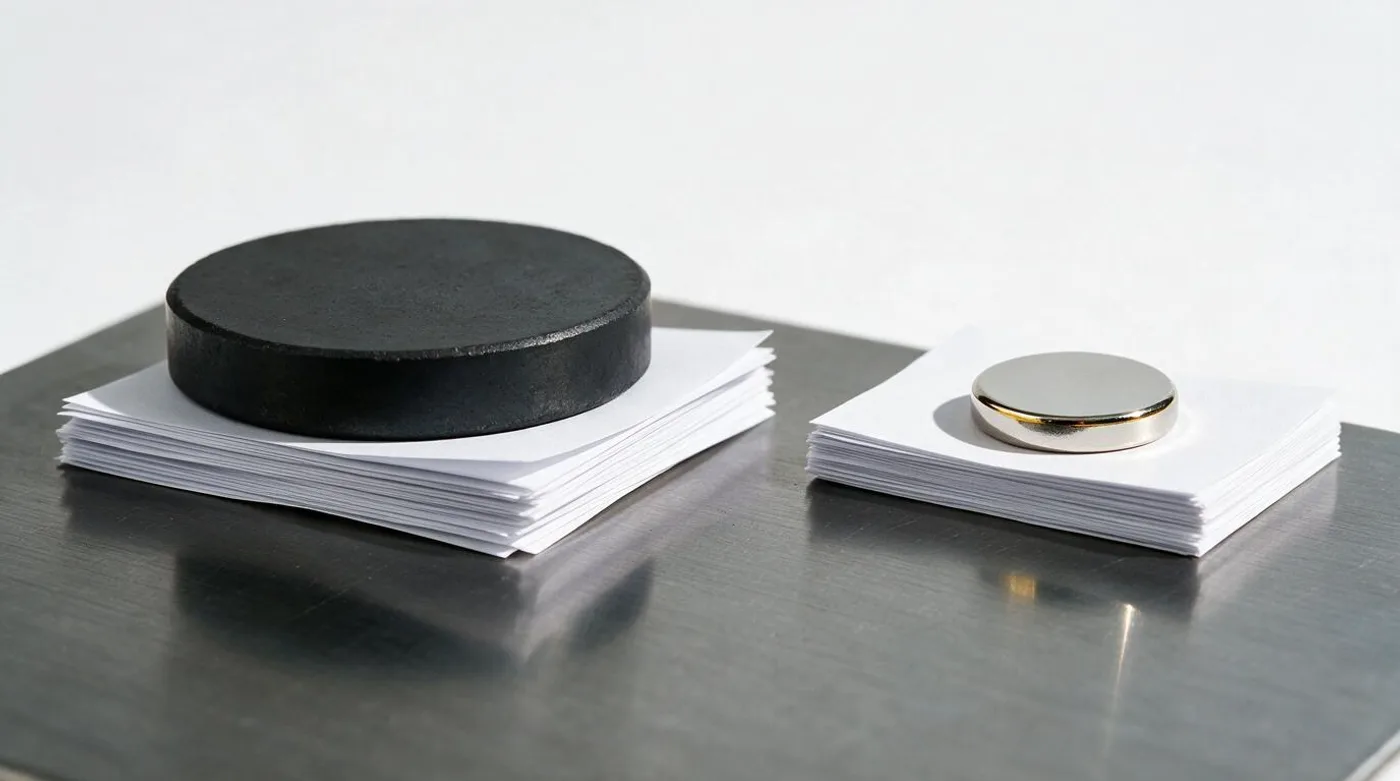
Two discs, each 20 mm across and 3 mm thick. In a palm they look like the same object, one dark gray and matte, one bright and slightly reflective. On a flat steel plate the gray one holds 500 g. The bright one holds 3,500 g.
That is the whole argument, and the rest of this page is about what the stronger disc costs you: heat tolerance, corners that chip, plating that can rust, and a genuine hazard if a small child is in the house.
Seven times the pull at the same size
Ferrite here means ceramic grade C8, the dark gray material inside almost every souvenir and photo magnet ever made. Neodymium means NdFeB at grade N42, the common commercial grade, energy product 42 MGOe. Both figures below come from manufacturer listings on flat bare steel, which is the friendliest surface either material will ever meet.
| Property | Ferrite C8 | Neodymium N42 |
|---|---|---|
| Pull, 20 x 3 mm disc | 500 g | 3,500 g |
| Pull, smallest useful disc | 1,100 g at 25 x 5 mm | 700 g at 6 x 2 mm |
| Maximum working temperature | about 250 C | about 80 C |
| Chips or shatters when dropped | brittle, but usually survives | yes, plating splits and corners break |
| Needs plating | no | yes, normally nickel |
| Loss at room temperature | effectively none | about 1 percent per decade |
| Cost per piece | low | several times higher |
| Safe to leave loose around a toddler | still a choking hazard | no |
| Typical fridge use | photo magnets, souvenirs, sheet stock | hooks, heavy paper stacks |
Read the second row twice. A neodymium disc 6 mm across and 2 mm thick, small enough to lose in a carpet, out-pulls nothing in ferrite that you would call small. Scale it up and the gap widens in absolute terms: 20 x 3 mm neodymium reaches 3,500 g, more than three times the 1,100 g of a much chunkier 25 x 5 mm ferrite disc.
Every figure on this page is a flat-plate figure. A real fridge door has paint on it, and paint adds 0.1 to 0.2 mm of gap that a small magnet feels immediately. Multiply by about 0.7 for a working estimate on a painted door, and by less than that on a textured or curved one. Our page on what pull force actually measures goes through why the loss hits thin magnets hardest.
What a gram of hold costs
Neither material is sold by the gram of hold, so the honest way to compare cost is by how much material you need to buy. Take the volume of each disc and divide the listed pull by it.
A 20 x 3 mm ferrite disc is about 940 cubic millimeters of ceramic and returns 500 g. That is roughly half a gram of hold per cubic millimeter. A 25 x 5 mm ferrite disc is bigger, about 2,450 cubic millimeters, and returns 1,100 g, so the ratio barely moves. Ferrite sits near half a gram per cubic millimeter wherever you look.
Neodymium at the same 20 x 3 mm returns 3,500 g from the same 940 cubic millimeters, near four grams of hold per cubic millimeter. Go smaller and the ratio climbs: the 6 x 2 mm disc packs 700 g into about 57 cubic millimeters, which is twelve grams per cubic millimeter, twenty-odd times the ferrite ratio.
So neodymium is expensive per piece and cheap per gram of hold, because you buy so little of it. Ferrite is the other way around. The material is iron oxide with strontium or barium carbonate, none of it scarce, and it needs no plating. Neodymium is a rare earth alloy that has to be coated before it will survive a kitchen. We do not publish prices for loose discs, because the three brands we cover sell finished printed magnets rather than bulk stock, and quoting a figure we have not seen listed would be a guess.
Heat, chipping, and rust
Ferrite works to about 250 C. That covers the top of a fridge, the side of a toaster oven, the hood above a gas hob, and any other warm spot in a kitchen you can name.
Neodymium N42 quits at about 80 C, and quitting is permanent. Warm the magnet past its limit and some of the aligned domains inside it flip and stay flipped. Let it cool and the pull does not come back. A car dashboard in summer sun will do it. A conservatory windowsill will do it. There is more on that failure in what heat does to a magnet.
Both materials are hard and brittle rather than tough. Ferrite is a sintered ceramic and will crack in half if you drop it on tile, though it usually survives a fall onto a kitchen floor because it is not moving fast when it lands. Neodymium is the one that breaks, and it breaks for a reason worth knowing: two neodymium discs approaching each other accelerate over the last centimeter and hit hard enough to chip. Splinters come off the edge, the nickel plating splits, and the exposed NdFeB underneath starts to corrode. Once the plating is broken, that magnet is on a clock.
Ferrite has no such problem. It is already an oxide, so there is nothing left for damp air to do to it. A ferrite disc pulled off a forty year old souvenir works exactly as it did when it was glued on. That indifference is the reason souvenir magnets and pressed photo magnets still use it.
What ten years does
Neodymium loses roughly 1 percent of its strength per decade at room temperature. On a 3,500 g disc that is 35 g after ten years, which nobody will ever detect by hand. Treat neodymium ageing as a non-issue unless the magnet gets hot, in which case the loss arrives in an afternoon rather than a decade.
Ferrite at room temperature is effectively stable. What ages on a ferrite fridge magnet is never the magnet. It is the glue holding the ferrite slab to the resin body, or the print on the front, or the foam pad that turns yellow and lets go. We go through those failure modes in how long magnets last.
Children and small neodymium
The CPSC has a standing warning about small high-powered magnets, and it is not about pinched fingers. Swallow two neodymium magnets at different times and they find each other through the wall of the intestine, clamp, and cut off the blood supply. That is surgery, and it has killed children. Ferrite discs are usually too big to swallow and too weak to clamp through tissue.
In a house with a toddler, keep loose neodymium above head height or out of the house entirely. If you want the strength on a low part of the door, buy it as a pot magnet with a hook, which is too large to swallow and hard to prise apart. Letter and number magnets for a child's own use should be molded ferrite or sheet, in pieces bigger than a mouth.
Six jobs, six answers
Holding a thick stack of school paper or a fistful of takeaway menus. Neodymium. A 12 x 3 mm disc lists 2,500 g on plate, call it 1,750 g on a painted door, and it will hold more paper than the door has room for. Ferrite at that size manages a few sheets.
Keeping a photo on the door. Ferrite, because the decision is already made for you. A pressed photo magnet has a flat ferrite slab in a crimped steel shell, which puts far more magnetic material behind the print than a flexible sheet of the same face carries. A photograph weighs a few grams, and nobody has ever needed a stronger photo magnet.
A souvenir from a trip. Ferrite, and preferably a bigger disc than the maker fitted. Heavy resin souvenirs slide down doors because the backing disc was chosen for cost, and a 20 mm ferrite disc under a 60 g resin lump is working near its limit.
A hook for keys, oven gloves, or a tea towel. Neodymium, in a steel pot. The 16 mm pot with a hook lists 6,000 g, and the steel cup around the magnet both concentrates the field and protects the brittle disc from the knock it would otherwise take.
Play magnets for a child. Ferrite or flexible sheet, always, in pieces too large to swallow.
Notes on a whiteboard or a steel office board. Ferrite. A whiteboard is thin steel, the paper weighs nothing, and a neodymium disc on a whiteboard is a magnet you will chip trying to get your fingernail under. If you want to see where any given size lands before you buy, the magnet strength chart lists both materials at every size on this page.
Frequently asked
Is neodymium the strongest fridge magnet?
For its size, yes. A 16 mm neodymium pot magnet with a hook lists 6,000 g on flat steel, and nothing in ferrite comes close at that diameter. A ferrite disc has to grow to reach the same figure.
Does neodymium lose strength over time?
About 1 percent per decade at room temperature, which no one notices. Heat is the real thief. Above roughly 80 C an N42 magnet gives up strength permanently, and cooling it down does not bring the strength back.
Why do souvenir and photo magnets use ferrite instead of neodymium?
Cost and shape. A flat ferrite slab is cheap, takes a glue line across its whole face, and never needs plating. A pressed photo magnet with a ferrite back holds several times what a flexible sheet of the same face holds, which is already more than a photo needs.
Will a neodymium magnet scratch a fridge door?
The nickel plating is harder than fridge paint, and a neodymium disc lands hard because it accelerates over the last centimeter. Slide it on from the side instead of dropping it on, or put a felt pad between the magnet and the paint.
Can I put a neodymium magnet near the oven or on a grill hood?
Ferrite for anything that gets warm. Neodymium is rated to about 80 C and a hood above a gas burner passes that. Ferrite holds its strength to about 250 C.