The physics of fridge magnets
Put two magnets on the counter. A 12 mm neodymium disc reads about 4,000 Gauss at its face. A printed sheet magnet cut from a takeaway menu reads about 300 Gauss. That is thirteen to one on the field reading. On weight held, the disc beats the sheet by roughly forty to one. The Gauss figure never told you that, and it never will.
Two ideas carry the rest of this section, and once they are in place the individual pages are mostly arithmetic.
Pull force is the number that matters
Pull force is the weight a magnet holds before it comes away from steel. Manufacturers measure it with the magnet in direct contact with a thick, flat, bare steel plate, pulled straight off at right angles. Grams or kilograms, one number, comparable between a ferrite disc and a neodymium one because the test does not care what the magnet is made of.
Gauss measures flux density at a single point, usually the center of the pole face. It tells you how hard the field is right there and nothing about how much steel the magnet is gripping. Widen a disc from 6 mm to 10 mm at the same 2 mm thickness and the surface reading barely moves, while the hold goes from 700 g to 1,400 g. Two magnets can share a Gauss figure and differ by a factor of ten in what they will carry. Magnet strength explained works through the whole business, grades included.
The door takes some of it back
Every pull force figure you read was measured under conditions your fridge does not meet. The plate was bare. Your door is painted, and paint adds 0.1 to 0.2 mm of gap. It may be textured, which means the magnet rides on the high points. It is probably slightly curved, so a rigid 64 mm square touches at two edges rather than across its face.
Each tenth of a millimeter of gap costs a small disc roughly 10 percent of its pull. Add texture and curvature and a painted door gives back 60 to 80 percent of the plate figure. Multiply by 0.7 and you will not be far off. That correction applies to every number on this site, so we quote the plate figure and let you do the multiplication once you know your own door.
Some doors take all of it. Austenitic stainless, grade 304, is not magnetic at all: nickel stabilises a face-centered cubic structure that holds no magnetic domain, and a magnet slides off it like it slid off the tiles. Ferritic stainless, grade 430, is magnetic and looks identical in the showroom. The side panels of most fridges are painted mild steel whatever the door is doing, which is the usual rescue.
What each family holds
| Family | What it is | Typical hold |
|---|---|---|
| Flexible sheet, 0.5 mm | ferrite powder in a vinyl binder | 60 g at 50 x 50 mm |
| Flexible sheet, 0.75 mm | the same, thicker | 110 g at 50 x 50 mm |
| Pressed photo magnet | flat ferrite in a crimped steel shell | not published, several times a sheet magnet |
| Ceramic ferrite disc, C8 | pressed and sintered iron oxide ceramic | 500 g at 20 x 3 mm |
| Neodymium disc, N42 | sintered NdFeB, nickel plated | 3,500 g at 20 x 3 mm |
| Neodymium pot with hook | an N42 core in a steel cup | 6,000 g at 16 mm |
The spread inside that table is larger than most buyers expect. A 20 x 3 mm neodymium disc holds about seven times what a ceramic ferrite disc of exactly the same dimensions holds, and about sixty times a 0.5 mm sheet magnet covering a 50 mm square of door. A pressed photo magnet, which is only a flat ferrite disc in a steel shell, holds several times a 0.75 mm sheet magnet of the same footprint, and that row stays wordy because no seller publishes a pull force for the pressed build. Nobody is cheating. The materials store different amounts of energy per unit of volume, and the steel shell in a pressed magnet channels the field forward instead of letting half of it leak out the back.
Heat and time sort them differently. Ceramic ferrite works up to about 250 C and does not care. Neodymium starts losing strength permanently above about 80 C, which rules it out of anything that sits on a hot appliance, and it drops roughly 1 percent per decade at room temperature. That is a slow enough loss that the plating failing and the magnet rusting will matter first. How long magnets last covers the failure modes in order.
What we have not measured
Every figure here is a published or manufacturer number. We have not put any of these magnets on a gauge ourselves, and until we do, no page on this site carries a star rating or a test result. Where a brand does not publish a thickness, a price, or a minimum order, we write that it is not published rather than filling the gap with something plausible. The strength chart lists everything we have in one place, and how we test describes what would have to change for those numbers to become our own.
How fridge magnets work
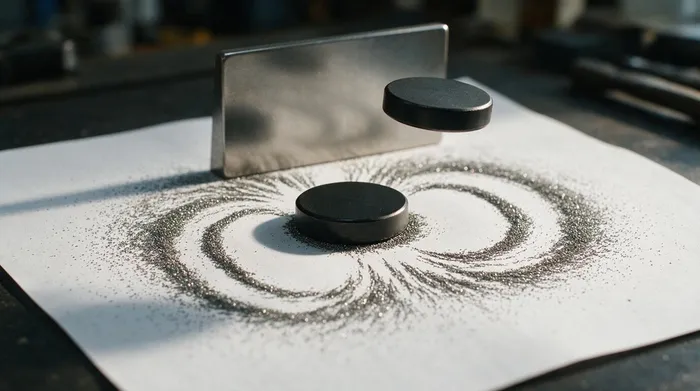
Domains, steel, the gap, and why a magnet on a door is in shear. Plus how ferrite and neodymium magnets are actually manufactured.

Magnet strength explained, pull force and Gauss
What pull force means, the test conditions behind it, why Gauss does not predict holding weight, and how to size a magnet for a real fridge door.
Ferrite vs neodymium vs flexible magnets
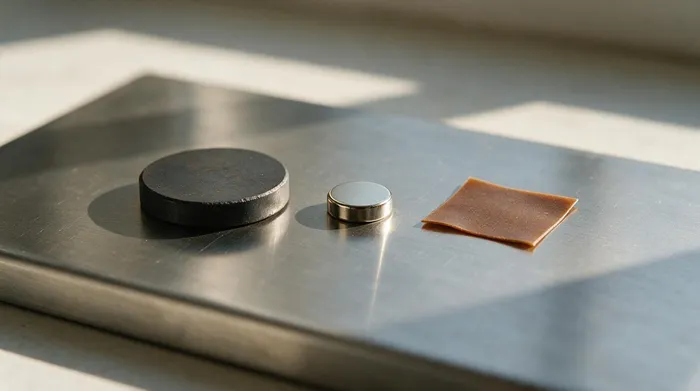
Composition, manufacture, pull force at matched sizes, heat limits, corrosion, brittleness, and which of the three materials to buy for six specific jobs.

Do magnets damage fridges? What marks a door
Ferrite and neodymium magnets leave the door steel and the control board alone. Grit, adhesive, rust rings and dropped magnets are what mark a fridge.

Why magnets do not stick to stainless steel
Austenitic 304 holds no magnetic domain, ferritic 430 does. How to test a fridge door in ten seconds and what each workaround actually costs you.

How photo magnets are made, step by step
The pressed photo magnet production line from print to crimped rim, the flexible sheet route by contrast, and the four faults you can spot by hand.

How long fridge magnets last, and what fails first
Neodymium loses about 1 percent per decade and ferrite is stable, so the print, the adhesive and the plating are what actually end a fridge magnet.