Do magnets damage fridges? What marks a door
No. The field from a fridge magnet collapses within a few centimeters and the control board sits behind steel, so neither ferrite nor neodymium reaches it. Marks come from grit dragged under a magnet, adhesive residue, rust rings on a damp door, and heavy magnets falling.
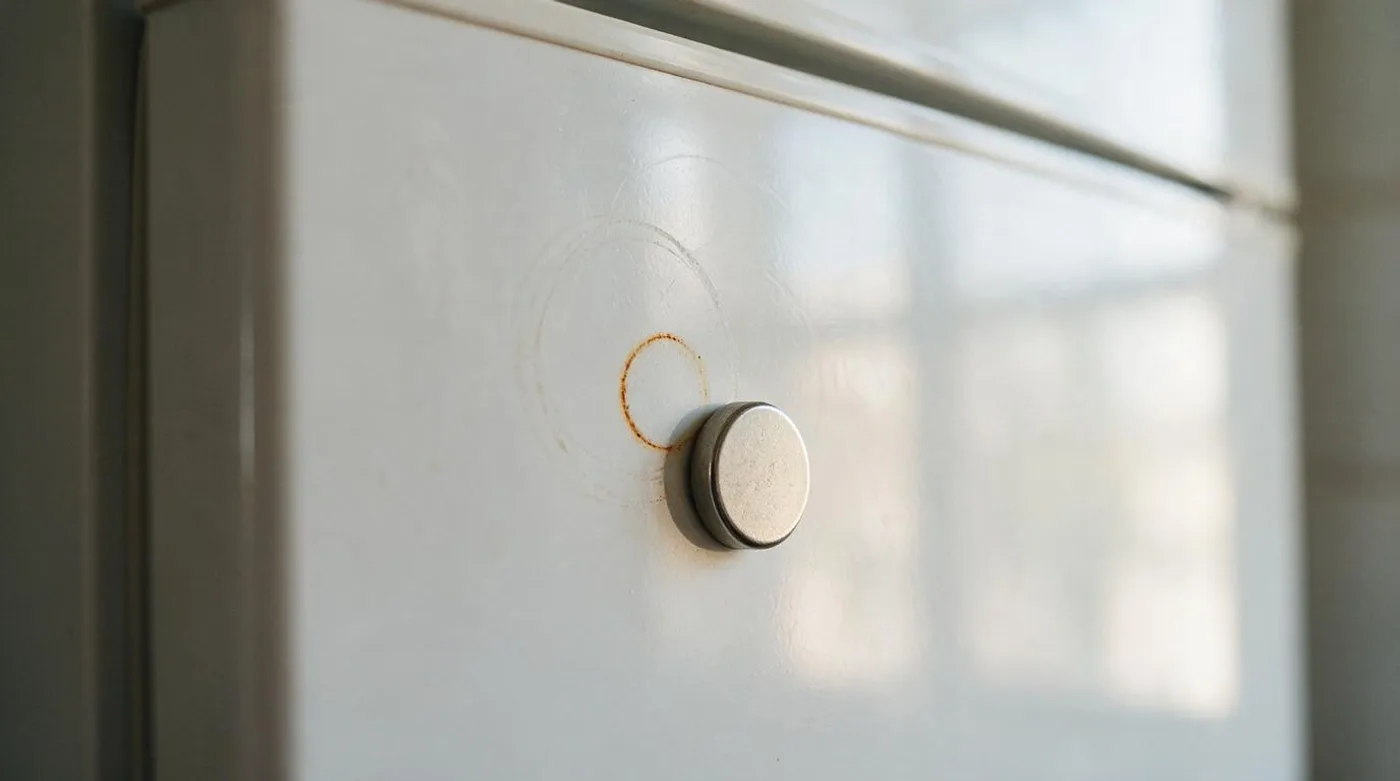
Someone will eventually tell you that a strong magnet wrecks the electronics in a modern fridge. It does not, and the reason is geometry rather than luck. The field from anything you can stick on a door has run out a few centimeters away, and the parts of a fridge that would mind a magnetic field are not behind the door skin.
What follows is mechanism. We have not taken a gauge to a fridge door, and every pull force figure on this site is a published manufacturer number rather than one of ours. The physics does not vary by brand, which is why this page can be blunt where our product pages cannot.
The field runs out before it reaches anything
A 12 mm N42 disc reads about 4,000 Gauss at its face. That sounds alarming until you move it. Field from a small magnet falls away roughly with the cube of distance once you are a diameter or two off the surface, so a magnet that snatches itself out of your fingers on contact is hard to detect across the width of your hand. How fridge magnets work walks through why the drop is that steep.
The door helps as well. Mild steel is an easier path for flux than air is, so the door skin carries the field sideways through itself instead of letting it through to the inside. Behind the skin sits several centimeters of foam and then a plastic liner. The control board on most fridges lives at the back or in the top housing, and the compressor with its start relay sits at the bottom rear. A 20 x 3 mm ferrite disc holding 500 g cannot reach any of that. Neither can the 20 x 3 mm N42 disc that holds 3,500 g, which is about seven times the ferrite figure and still nothing at that distance.
Two honest exceptions. Some fridges sense the door with a magnetic reed switch rather than a mechanical plunger, and a strong magnet parked right beside one can hold it in the wrong state, so the interior light stays on or refuses to come on. Nothing is damaged and moving the magnet ends it. Which models use reed switches is not published, so if the light starts misbehaving after a neodymium magnet lands near the hinge, try moving the magnet before you call anybody out.
The other is the gasket. The seal around a fridge door contains a strip of ferrite powder in vinyl, the same material as a flexible sheet magnet, and that strip is what pulls the door shut over the last centimeter. Magnets do not harm it. A magnet left sitting on it does, because anything caught between the gasket and the cabinet holds the door open a fraction and the compressor then runs longer than it needs to.
Grit under a magnet is what cuts the paint
A painted door carries 0.1 to 0.2 mm of paint, which is not much to lose. The back of a magnet is smooth ferrite, a flat steel rim, or nickel plating, and none of those is hard enough on paint to matter by itself. Kitchens supply the abrasive. Sugar crystals, grit off the bottom of a shopping bag, a dried splash of something: one of those gets pinned under the flat back of a 57 mm pressed photo magnet, and it becomes a cutting tool the second somebody slides the magnet along to make room for a takeaway menu.
The fix is dull and it works. Lift the magnet, move it, set it down. Wipe the door and the back of the magnet when you rearrange things. Pressed photo magnets deserve extra care here, because the crimped rim is a hard, narrow contact ring that concentrates the load onto whatever is underneath it. Do magnets scratch fridges has the short answer if that is all you came for.
Adhesive backs and what they leave behind
Souvenir and craft magnets are usually assembled with a self-adhesive disc between the decorated front and the magnet. On cheap ones that adhesive is a soft pressure-sensitive rubber, and after a warm summer it creeps out past the edge of the disc. What escapes collects dust, bonds itself to the paint, and later comes away as a gray ring the size of the magnet.
The deliberate version of the same problem is adhesive-backed magnetic strip stuck straight onto the door to mount a knife rack or a note holder. At that point the magnetism is decorative and tape is doing the work, and tape pulled off a cold painted door takes paint with it often enough to be worth avoiding. Warm the area with a hairdryer until the door is uncomfortably warm to the palm, then peel slowly and flat against the surface rather than straight out. Isopropyl alcohol on a cloth lifts the residue. Keep acetone away from painted steel and plastic trim entirely.
Rust rings come from the steel, not the ferrite
Ceramic ferrite is already an oxide, so a bare ferrite disc will not rust. The rust belongs to the steel around it. A pressed photo magnet has a steel shell. A cheap disc magnet often sits in a bare or thinly plated steel cup. Put either against a door that gets condensation, beside a kettle or across from a dishwasher vent, and water wicks into the capillary gap between two flat surfaces and stays there, because nothing in that gap ever dries. The result is orange staining in the exact outline of the magnet, sometimes with pitting under it.
Neodymium is nickel plated for this reason. The plating is thin and hard, it chips when the magnet snaps onto something, and NdFeB with a chip in its coat corrodes fast and crumbles from that edge outward. A chipped neodymium disc on a damp door is the quickest way we know to stain paint. Ask for nickel, chrome or epoxy coating, keep magnets off the strip of door next to the kettle, and lift them now and then so the paint underneath can dry.
Heavy magnets dent doors when they fall
This is the failure nobody predicts. A 16 mm neodymium pot magnet with a hook holds 6,000 g and a 10 mm N42 cube holds 4,800 g, and both are dense lumps of plated metal. Hang a bag of shopping on the pot magnet, overload it, and the whole assembly leaves the door at speed. The dent lands on the door below, on a tiled floor, or on a glass hob. Ferrite goes one better and shatters, since C8 is brittle and gray the whole way through.
Keep loaded hook magnets low on the door where the drop is short, and away from the edge above a hob. If you want holding weight without the mass, neodymium versus ferrite sets out what each material gives you per gram.
Dispensers, touch panels and the screen myth
Capacitive touch panels sense a finger changing the capacitance of a sensor pad. Magnetic field takes no part in that measurement, so a magnet resting on the glass does nothing to the controls, and the board behind the panel is as unreachable as the main control board. The worry usually traces back to CRT televisions, where a magnet did bend the electron beam and stain the phosphor. Fridge displays are LCD or LED, and neither steers a beam.
Avoid the dispenser recess for mechanical reasons instead. It is a tight pocket with a paddle in it, a magnet knocked into it can jam the paddle or chip the trim, and the area stays damp.
Stainless shows what paint hides
A brushed stainless door records every fingerprint and every wipe, so a magnet that has sat in one place for a year leaves a visibly cleaner patch when it moves. That is not damage. It is the rest of the door having aged around it. Grease also settles into the brush grain, and a magnet dragged across the grain smears it along.
Not every stainless door takes a magnet at all. Austenitic 304 holds no magnetic domain and ferritic 430 does, and why magnets do not stick to stainless explains how to tell which one you have in about ten seconds.
| Risk | What causes it | How to avoid it |
|---|---|---|
| Scratched paint | Grit trapped under the magnet, then slid sideways | Lift and place, never drag. Wipe both faces |
| Gray adhesive ring | Squeeze-out from a cheap stick-on back, or tape used as a mount | Warm it, peel flat, clean off with isopropyl alcohol |
| Orange rust ring | Steel shell or unplated cup holding water against damp paint | Nickel, chrome or epoxy coating. Keep magnets away from kettles and vents |
| Corroded neodymium | Chipped plating after the magnet snapped onto steel | Bring magnets together by hand rather than letting them jump |
| Dented door or floor | An overloaded 16 mm pot magnet holding 6,000 g letting go | Mount hook magnets low, away from hobs and glass |
| Door held ajar | Magnet resting on the ferrite-in-vinyl gasket strip | Keep the last few centimeters of the door edge clear |
| Clean patch on stainless | The surrounding door ageing while the magnet sat still | Move magnets occasionally and wipe the whole panel |
| Cracked magnet | Ferrite dropped on a hard floor | Store spares in a drawer, not balanced on the door edge |
Next time you clean the front of the fridge, take everything off it, wipe the back of each magnet, and look at the paint where each one was sitting. A ring caught early is a wipe. A ring left for a year is a repaint.
Frequently asked
Can a strong magnet damage a fridge's electronics?
No. A 20 x 3 mm N42 disc holds 3,500 g on a test plate and still has almost no field left a few centimeters from its face. The control board sits at the back or in the top housing, behind steel and several centimeters of foam.
Do fridge magnets scratch paint?
The magnet does not. Grit pinned under it does, once somebody slides the magnet sideways. Door paint is only 0.1 to 0.2 mm thick, so one sugar crystal clamped under a rigid magnet is enough to cut a line.
Why is there an orange ring under my magnet?
A steel shell or an unplated steel backing plate held water against the paint. Ceramic ferrite is an oxide already and does not rust, so the stain comes from the steel around it or from chipped plating on a neodymium disc.
Are magnets safe next to a water dispenser or a touch panel?
Yes. Capacitive touch panels respond to a finger changing the capacitance of a sensor pad, not to magnetic field, and a magnet on the glass does nothing to them. Keep magnets out of the dispenser recess for mechanical reasons instead.