How to remove magnet marks from a fridge
Work from gentle to harsh. Warm soapy water and a microfibre cloth lift most of it. Adhesive residue gives way to isopropyl alcohol. Rust rings need a non-abrasive cream cleaner worked along the grain. Scratches in paint take touch-up, and a sun-faded outline does not come back at all.
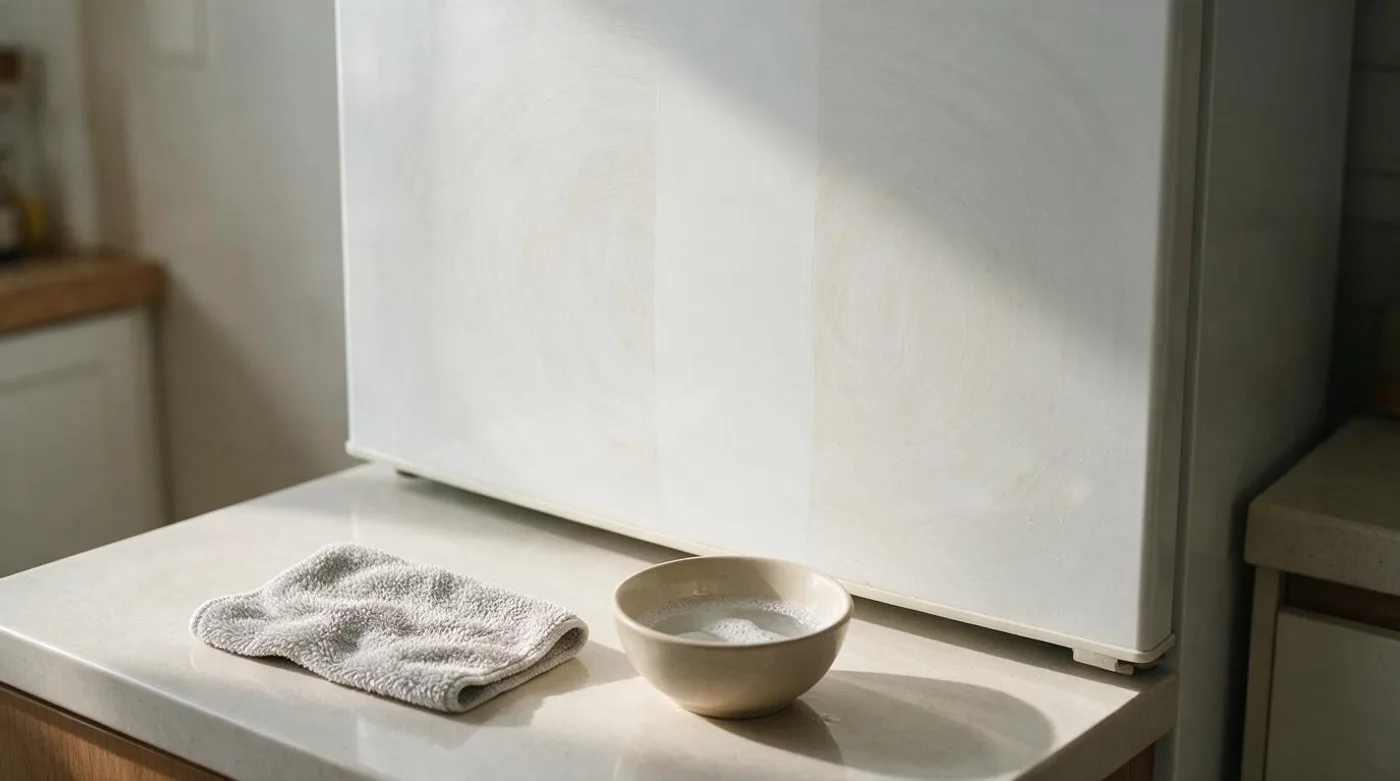
Peel off a magnet that has been in the same spot since the fridge was delivered and you find out which kind of mark you are dealing with. A brown ring is corrosion. A sticky halo is adhesive. A set of fine curved lines is abrasion. A pale rectangle is the absence of damage, because the paint around it faded and the covered patch did not.
Getting this wrong is expensive in a particular way. Every method here forecloses the gentler ones, so a scouring pad taken to a rust ring on brushed stainless leaves a bright burnished patch that catches light from across the room and cannot be undone. Identify the mark, then start at the bottom of the ladder.
| Mark | What it is | First move |
|---|---|---|
| Brown or orange ring | Rust from bare ferrite or chipped plating | Warm soapy water |
| Sticky halo, often with grit in it | Adhesive from a souvenir or a stick-on back | Isopropyl alcohol |
| Fine curved scratches | Grit dragged under the magnet | Nothing. Fill or accept |
| Pale rectangle or disc | Sun bleaching of the paint around it | Nothing. Move the magnet and wait |
Rust rings
The rust is almost always the magnet's, not the fridge's. Ceramic ferrite is porous and holds moisture, and sintered neodymium corrodes fast wherever the nickel plating has chipped. Either one sits in a permanently damp contact patch on a door that gets condensation and splashes, and it deposits iron oxide onto the finish.
Start with warm water and a drop of washing-up liquid on a microfibre cloth. A surprising amount of what looks like corrosion is loose staining sitting on top of the finish, and it lifts without any chemistry at all. Give it a minute of soaking before you rub.
If a shadow remains, move to a non-abrasive cream cleaner sold for stainless steel. Put it on the cloth rather than on the door, work along the brush grain in straight strokes, and stop as soon as the ring goes. Circles are what leave a visible swirl on a brushed finish, because the grain runs one way and your polishing marks run every way. Test on the bottom edge of the door where nobody looks.
Rinse with clean water and dry with a fresh cloth. Cream cleaner left to dry on stainless leaves a chalky haze that then needs its own removal, which is an annoying way to spend an afternoon.
The magnet that caused it goes in the bin, or at least off the door. A magnet with exposed sintered core or bare ferrite will make the same ring again in the same time, and do magnets scratch fridges has the list of which builds do this.
Adhesive residue
Cast resin souvenirs are glued to their magnets, foam pads come on the back of promotional magnets, and both leave a ring of hardened adhesive with kitchen grease and grit set into it.
Isopropyl alcohol is the right solvent for nearly all of it. Wet a cloth, hold it against the residue for a minute so the glue softens, then roll the softened glue off with a thumb or the edge of a plastic card. Scrubbing dry adhesive drags the grit trapped inside it across the paint, which turns a cleaning job into a scratching job. Repeat the soak two or three times rather than pressing harder.
Warmth helps on stubborn residue. A hairdryer on low, held back from the surface, softens the adhesive enough that it comes away in one piece. Do not overheat a door with plastic trim, and do not do this on a magnet you intend to keep, since a neodymium magnet loses strength permanently above about 80 C.
Caution: acetone, nail polish remover and citrus degreasers all strip fridge paint and cloud plastic trim. Cooking oil on a cloth is the gentle fallback for a small tacky patch, and it works better than it sounds, though it then needs washing off with detergent.
Scratches in paint
There is no method here, only management. A scratch is missing material, and nothing you rub on will put it back.
On a white or colored painted door, an automotive touch-up stick or a bottle of appliance touch-up paint fills fine scratches well enough that they stop catching the eye. Clean and dry the scratch, apply less paint than you think you need, let it dry, and add a second coat rather than trying to fill it in one. Color match is the hard part, and appliance white is not one color.
On stainless, a scratch is a groove in the metal. A fine one can sometimes be blended with a stainless finishing kit, which is a set of graded abrasive pads used strictly along the grain to re-establish the brushed pattern across the whole panel rather than at one spot. Doing it in one place produces a shiny stripe. This is worth attempting on the side panel and worth thinking hard about on the door.
Anything deep enough to catch a fingernail is permanent. A magnetic board mounted over the area is the practical answer, and it also removes the magnet traffic that made the scratch.
Sun outlines
A pale rectangle where a photo magnet lived for six years on a door in a sunny kitchen is not a mark. The paint everywhere else has faded and the covered patch stayed the color the fridge came in.
There is nothing to remove. Cleaning does nothing, cream cleaner does nothing, and polishing only thins the finish that is holding on. The patch evens out over time once the magnet moves and the covered area gets the same light as everything else, which takes as long as the fading took. Meanwhile, the obvious cover is another magnet in the same place.
This is also a reason to rotate what goes on a sun-facing door. The magnets fade too. A photo print under mylar and the laminate on a flexible sheet both lose color in direct sun, which is one of the arguments in how to store magnets for keeping the collection out of the light.
What never to use
Steel wool and scouring pads on any fridge surface. They cut both painted steel and stainless, and the damage is bright, wide, and permanent.
Bleach on stainless. Chloride attacks the passive layer that makes stainless stainless, and the result is pitting that appears days later, long after anyone connects it to the cleaning.
Abrasive powder cleansers, including the ones sold for sinks. Fridge finishes are much thinner than sink steel.
Melamine foam blocks on brushed stainless or gloss paint. They are a fine abrasive despite looking like a sponge, and they burnish a matte finish to a shine in a patch the size of your hand.
A magnet parked back over a fresh repair. Touch-up paint takes days to harden properly and a 2,500 g disc will print its own outline into it.
How to clear a magnet mark
- Work out which mark you have. Rust ring, glue residue, scratch, or sun outline. Each takes a different method and the wrong one makes the mark permanent.
- Start with warm soapy water. A drop of washing-up liquid in warm water on a microfibre cloth removes surface grime and most light rust staining.
- Move to isopropyl alcohol for glue. Soak the residue for a minute rather than scrubbing it, then roll it off with a thumb or a plastic scraper.
- Use a cream cleaner on rust rings. A non-abrasive stainless cream on a soft cloth, worked along the brush grain, never in circles. Test on the bottom edge of the door first.
- Rinse, dry and inspect in raking light. Wipe off every trace of cleaner with clean water, dry with a fresh cloth, then look along the door at a low angle to check for a haze.
- Fill remaining scratches. A paint touch-up stick matched to the door for painted steel. On stainless, a scratch is in the metal itself and only a specialist finishing kit will help.
Frequently asked
What removes the brown ring left by a magnet?
Warm soapy water first, since a lot of it is surface staining rather than corrosion. If it stays, a non-abrasive stainless cream cleaner on a soft cloth, worked along the grain. Do not reach for a scouring pad, which trades a brown ring for a permanent bright patch.
Can I use a magic eraser on a fridge door?
A melamine foam block is a very fine abrasive, not a sponge. It will dull gloss paint and it will burnish a brushed stainless finish. Keep it for white painted doors, use it lightly, and never on the brushed grain.
How do I get old magnet glue off?
Isopropyl alcohol on a cloth, held against the residue for a minute so it softens, then rolled off with a thumb. Repeat rather than scrubbing. Acetone and nail polish remover strip paint and cloud plastic trim.
Why is there a lighter rectangle where a magnet used to be?
The door around it faded and the covered patch did not. That is sunlight bleaching the paint, so nothing under the magnet needs removing. The surrounding paint has to catch up, which takes as long as it took to fade.
Will a scratch in a stainless door polish out?
A fine one sometimes, with a proper stainless finishing kit worked along the grain. A deep one is a groove in the metal and it will not. Painted steel is easier, because a touch-up stick fills a scratch that stainless cannot hide.