Best strong fridge magnets, by pull force
For a fridge door, a 12 by 3 mm N42 neodymium disc is the pick. It holds 2,500 g on a steel plate and about 1,750 g on a painted door, enough for a stack of paper. Bigger discs, cubes and pot magnets hold more and pinch harder.
Where these figures come from
This comparison uses published product specifications. We have not handled or measured these products. Prices and availability can change; check the seller's listing before ordering. Method, equipment, and limits are on the how we test page.
Spec comparison
| Spec | Neodymium disc, N42, 12 x 3 mm | Neodymium disc, N42, 20 x 3 mm | Neodymium disc, N42, 10 x 2 mm | Neodymium disc, N42, 6 x 2 mm | Neodymium cube, N42, 10 mm | Neodymium pot with hook, 16 mm | Ceramic ferrite disc, C8, 25 x 5 mm | Ceramic ferrite disc, C8, 20 x 3 mm |
|---|---|---|---|---|---|---|---|---|
| Material | Sintered NdFeB, grade N42, nickel plated | Sintered NdFeB, grade N42, nickel plated | Sintered NdFeB, grade N42, nickel plated | Sintered NdFeB, grade N42, nickel plated | Sintered NdFeB, grade N42, nickel plated | NdFeB in a steel cup with a threaded hook | Sintered ceramic ferrite, grade C8 | Sintered ceramic ferrite, grade C8 |
| Listed thickness | 3 mm | 3 mm | 2 mm | 2 mm | Not listed | Not listed | 5 mm | 3 mm |
| Sizes | 12 mm diameter | 20 mm diameter | 10 mm diameter | 6 mm diameter | 10 mm cube | 16 mm diameter | 25 mm diameter | 20 mm diameter |
| Price per magnet | Not listed | Not listed | Not listed | Not listed | Not listed | Not listed | Not listed | Not listed |
| Minimum order | Not listed | Not listed | Not listed | Not listed | Not listed | Not listed | Not listed | Not listed |
| Shipping | Not listed | Not listed | Not listed | Not listed | Not listed | Not listed | Not listed | Not listed |
| Pull force | Not yet measured | Not yet measured | Not yet measured | Not yet measured | Not yet measured | Not yet measured | Not yet measured | Not yet measured |
| Measured thickness | Not yet measured | Not yet measured | Not yet measured | Not yet measured | Not yet measured | Not yet measured | Not yet measured | Not yet measured |
| Print sharpness | Not yet measured | Not yet measured | Not yet measured | Not yet measured | Not yet measured | Not yet measured | Not yet measured | Not yet measured |
| Corner lift after 30 days | Not yet measured | Not yet measured | Not yet measured | Not yet measured | Not yet measured | Not yet measured | Not yet measured | Not yet measured |
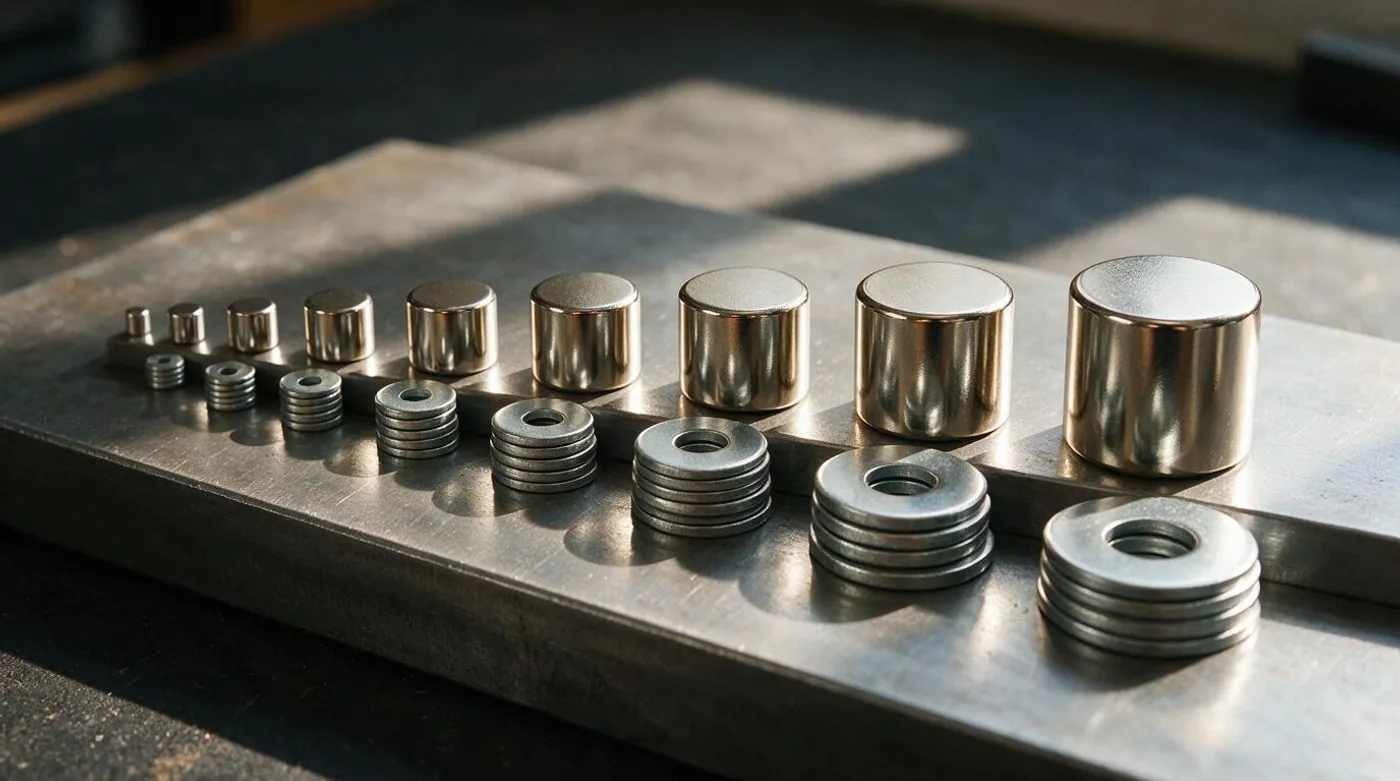
A 16 mm pot magnet with a hook holds 6,000 g on a flat steel plate. That is six liters of milk hanging from something the size of a coat button, and it is also a magnet most people cannot lift off a door with their fingertips once it has landed. Strength is easy to buy. Strength you can still get off the fridge takes a little more thought.
This page compares magnet builds rather than retail brands, because published specifications from sellers in this category are not available. Grade, plating and pull force are usually missing from the listing, so a brand table would be a row of blanks. The entries below are builds instead, each one a material, a grade, a shape and a size. Every figure here is a manufacturer listing or a generic value from our facts sheet, and none of it has been measured in our own hands.
What the listed pull force numbers say
| Build | Size | Bare steel plate | Painted door, at 0.7 |
|---|---|---|---|
| Neodymium pot with hook | 16 mm | 6,000 g | about 4,200 g |
| Neodymium cube N42 | 10 mm | 4,800 g | about 3,360 g |
| Neodymium disc N42 | 20 x 3 mm | 3,500 g | about 2,450 g |
| Neodymium disc N42 | 12 x 3 mm | 2,500 g | about 1,750 g |
| Neodymium disc N42 | 10 x 2 mm | 1,400 g | about 980 g |
| Neodymium disc N42 | 6 x 2 mm | 700 g | about 490 g |
| Ceramic ferrite disc C8 | 25 x 5 mm | 1,100 g | about 770 g |
| Ceramic ferrite disc C8 | 20 x 3 mm | 500 g | about 350 g |
The plate column is how magnets are sold. A manufacturer tests against thick, flat, bare steel, the friendliest surface a magnet will ever touch. A fridge door is painted, usually curved across its width, and on some models textured as well. Paint alone adds 0.1 to 0.2 mm of gap, and every tenth of a millimeter costs a small disc roughly 10 percent of its pull, which is where the 0.7 in the last column comes from. Shop on pull force and ignore Gauss. A 12 mm N42 disc reads about 4,000 Gauss at its surface, and that number describes the field at one point rather than the weight it will carry. We go through the difference in magnet strength explained.
Two patterns fall out of the table. Neodymium climbs steeply with size, so going from 10 x 2 mm to 12 x 3 mm buys 2 mm of diameter and 1 mm of thickness and adds 1,100 g of pull. Material then does more than size at the small end, since a 20 x 3 mm neodymium disc holds seven times what the identical ferrite disc holds, 3,500 g against 500 g, from the same footprint on the door. That ratio is the whole argument in neodymium versus ferrite.
Why a 12 by 3 mm disc is the pick
At 2,500 g on a plate and about 1,750 g on a painted door, this disc holds far more than a fridge door is ever asked to hold. A school newsletter, a stack of takeaway menus and a photo on top of them come to a small fraction of it. The size is what makes it liveable. Twelve millimeters hides behind a 57 mm photo or inside a molded shape, and 3 mm of thickness matters more than it sounds, because there is enough edge to get a fingernail under and enough body to push the magnet sideways to the edge of the door and off. Sliding is the only sane way to remove a strong magnet. Pulling straight out is how people bend fingernails and drop discs on tile floors.
The 20 x 3 mm disc holds another 700 g on a door and asks for noticeably more effort to shift, because the wider face means more of it is in contact when you start sliding. Nobody hangs 2.4 kg on a fridge. Buy it if you are holding a heavy chopping board or a steel rail, and skip it for paper.
The 10 mm cube and the 16 mm pot magnet are a different category of object. A cube at 4,800 g and a pot at 6,000 g are made for hanging tools, cables and signs from steel beams. On a kitchen door they mainly demonstrate that a magnet can travel the last 30 mm on its own and arrive hard enough to mark the paint, which is one of the two ways magnets damage a finish. The other is grit dragged underneath, covered in do magnets scratch fridges.
Where ferrite still earns its place
A 25 x 5 mm ferrite disc holds 1,100 g on a plate and about 770 g on a door. That covers everything a fridge door does, at a fraction of the price of neodymium and with no plating to fail. Ferrite is rated to roughly 250 C against 80 C for N42, so it shrugs off a dishwasher, a hot car and a spot on the wall beside the hob. It is brittle in a different way from neodymium: dropped on tile it tends to split in half rather than shed chips.
The weaker field is occasionally the point. A ferrite disc reaches less far into whatever sits behind the door, which is easier to live with around bank cards, hearing aids and anything else that ends up pinned to a fridge.
Small high-powered magnets and children
The CPSC's magnet safety center states the risk plainly. Swallowing one small high-powered magnet is a problem, and swallowing two or more is an emergency, because the magnets attract each other through the walls of the bowel, trap the tissue between them and cut off its blood supply. The result is surgery, not a wait-and-see. A 6 x 2 mm N42 disc holds 700 g on steel and is the size of a lentil.
Loose magnets are the hazard rather than the ones already on the door. They fall off, roll behind the fridge, come free when a resin souvenir cracks, or get prised out of a broken toy. If there is a toddler in the house, ferrite sealed inside a molded body does the whole job and nothing on this page is worth the trade. Our kids magnet review goes through the safe builds.
Pinch injuries and chipped plating
Adults get caught too. Two 20 x 3 mm discs closing on the web of a finger from 20 mm apart make a blood blister at best, and the discs are brittle enough under that impact to throw a chip of nickel plating. Move strong magnets one at a time. If two must travel together, put a card or a piece of foam between them and separate them by sliding sideways, never by pulling apart.
Neodymium is nickel plated because the alloy underneath rusts. Once a corner chips, the exposed face corrodes and crumbles, so a dropped disc has a shorter working life even while it still holds. Heat is the other limit, with N42 topping out around 80 C. Age is not a limit worth worrying about: neodymium loses roughly 1 percent of its strength per decade at room temperature, so the magnet will outlast the fridge, the kitchen and probably the house. There is more on that in how long magnets last.
Matching the magnet to the load
Most people buy far more magnet than the job needs, so it helps to see the range in one place. A 0.5 mm flexible sheet at 50 x 50 mm holds 60 g and a 0.75 mm sheet the same size holds 110 g. A pressed photo magnet lands well above both, though the figure is not published anywhere. A 20 x 3 mm N42 disc holds roughly sixty times the 0.5 mm sheet from the same 50 mm footprint.
For a single photo, the pressed build is already generous. For a paper stack that keeps growing, a 10 x 2 mm neodymium disc at about 980 g on a door will hold more paper than the fridge magnet is the right place for. Anything past that is a shelf problem wearing a magnet costume.
Buying a disc when the listing tells you nothing
Four things make a listing worth trusting. A stated grade, written as N42 or N45 rather than "super strong". A stated plating, usually nickel-copper-nickel. Dimensions in millimeters as diameter by thickness. And a pull force with the test surface named, because a figure measured on 10 mm steel plate is not the figure you will see on a 0.6 mm door skin under paint.
If a listing gives Gauss and nothing else, it has told you the least useful number it had. A seller who cannot answer those four questions about their own stock is worth walking away from, because the price difference between a graded disc and an ungraded one is measured in pennies.
If nothing sticks at all
Check that the door is magnetic before buying any of this. Many stainless fridge doors are austenitic 304, whose face-centered cubic structure holds no magnetic domain, and not one magnet on this page will stay on one. Ferritic 430 stainless is magnetic, and the side panels of most models are painted mild steel even when the door is not, which is why the strongest magnet in a lot of kitchens ends up on the side of the fridge holding the calendar. The metallurgy is in why magnets do not stick to stainless.
Frequently asked
What is the strongest fridge magnet?
Of the builds here, a 16 mm neodymium pot magnet with a hook holds the most at 6,000 g on a steel plate, roughly 4,200 g on a painted door. For paper on a fridge, a 12 by 3 mm N42 disc at 2,500 g is already far more than needed.
How much weaker is a magnet on a real fridge door?
A painted or coated door keeps 60 to 80 percent of the plate figure. Multiply by about 0.7. Paint adds 0.1 to 0.2 mm of gap, and each tenth of a millimeter costs a small disc roughly 10 percent of its pull.
Is neodymium always better than ferrite?
It holds about seven times more at the same size, 3,500 g against 500 g at 20 by 3 mm. Ferrite wins on price, on heat (about 250 C against 80 C) and on having no plating to chip off.
Will a strong magnet damage the fridge?
The magnetism does not harm steel. The impact does. A 4,800 g cube snapping onto a door from 30 mm away arrives hard enough to mark paint, and dragging grit under it scratches the finish.