What is the strongest fridge magnet?
A 16 mm neodymium pot magnet with a hook, at 6,000 g of pull on bare steel and roughly 4,200 g on a painted door. Among plain discs the strongest common one is a 20 by 3 mm N42 at 3,500 g. A 10 mm N42 cube holds 4,800 g.
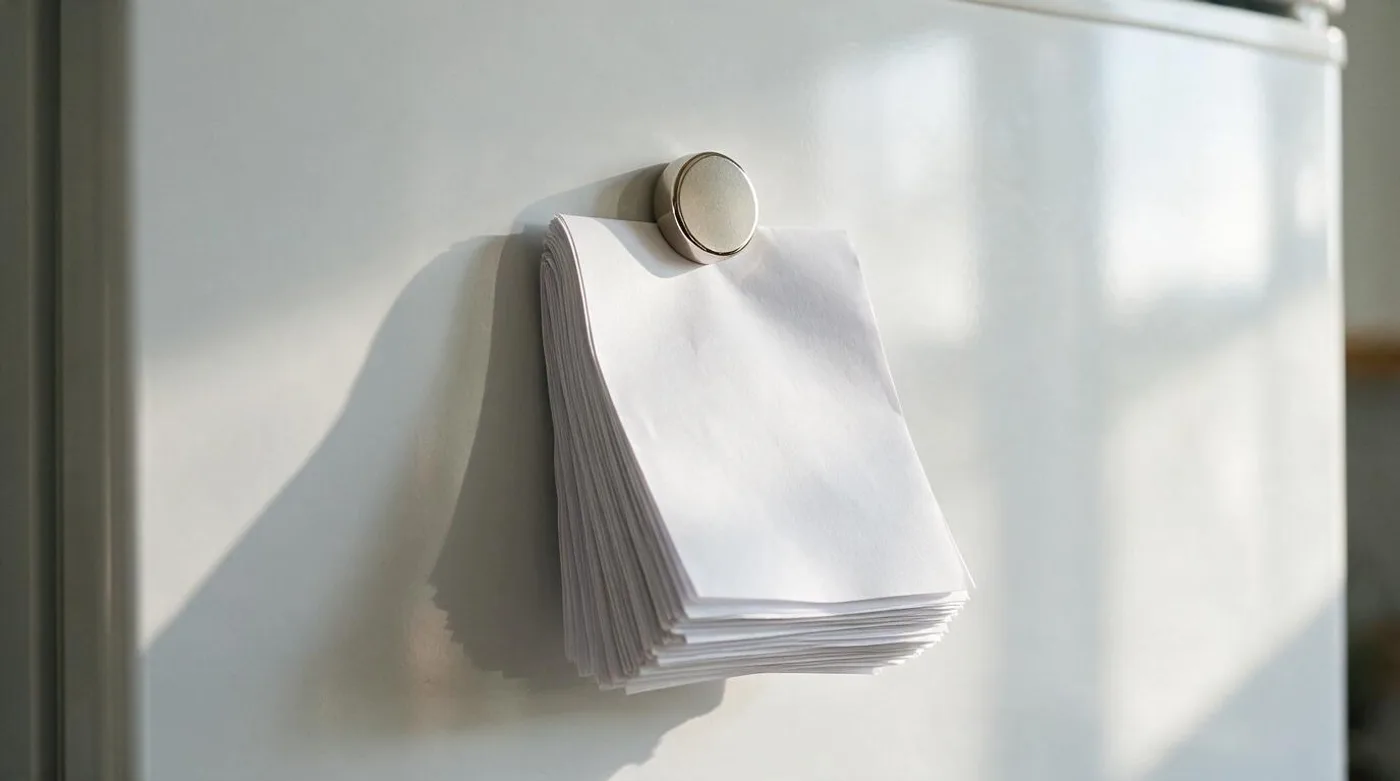
Six kilograms, from a steel cup 16 mm across. That is the top of our figures list, and it is a neodymium pot magnet: a small N42 disc sunk into a steel cup with a hook screwed into the back. The cup catches the flux that would otherwise loop out behind the magnet and pushes all of it through the open face, which roughly doubles what the same disc manages on its own. On bare steel it holds 6,000 g. On a painted door, about 4,200 g.
If you want a flat magnet rather than a hook, the answer changes. A 20 by 3 mm N42 disc holds 3,500 g. A 10 mm N42 cube holds 4,800 g from a face a quarter the area, which is the first sign that this question is not about how wide the magnet is.
What the sizes actually hold
Every figure below is pull force on a flat bare steel plate, quoted for grade N42, which is the grade sellers publish data for. The right-hand column is the same number multiplied by 0.7, which is the working estimate for a painted or coated door.
| N42 magnet | Size | Bare steel | Painted door, estimate |
|---|---|---|---|
| Disc | 6 x 2 mm | 700 g | about 490 g |
| Disc | 10 x 2 mm | 1,400 g | about 980 g |
| Disc | 12 x 3 mm | 2,500 g | about 1,750 g |
| Disc | 20 x 3 mm | 3,500 g | about 2,450 g |
| Cube | 10 mm | 4,800 g | about 3,360 g |
| Pot with hook | 16 mm | 6,000 g | about 4,200 g |
Read the cube row against the 20 mm disc row. The cube presents a 10 mm square face and beats a disc twice its diameter, because there is more magnet material behind that face. Thickness, not width, is where the pull lives. The same effect shows up in the disc rows themselves: 10 by 2 mm holds 1,400 g and 12 by 3 mm holds 2,500 g, nearly double, for one extra millimeter of thickness and two of diameter. For small discs, doubling the thickness adds 40 to 70 percent.
Set that beside what a normal fridge magnet does. A 0.5 mm flexible sheet magnet at a 50 mm footprint holds 60 g, and a pressed photo magnet of similar face size holds a large multiple of that, on a figure no seller publishes. The 20 by 3 mm neodymium disc holds roughly sixty times the sheet magnet from a face you could hide under a thumbnail. Neodymium against ferrite works through the other side of that trade, which is price and brittleness.
Strongest means shear, not tension
The catalogue number stops describing your kitchen at this point. Pull force is measured straight off the plate, with the magnet pulled perpendicular to the surface. A fridge door is vertical, so almost nothing you hang loads a magnet that way. The weight hangs down, parallel to the door, and the magnet has to resist sliding rather than lifting.
Sliding is a friction problem. The magnet's pull sets how hard the two faces are pressed together, and then the friction between those faces is what actually carries the load. A polished nickel disc on smooth gloss paint has very little of it. Nobody publishes a friction coefficient for that pairing and we are not going to invent one, so treat the shear figure as a large fraction of the pull number gone, and test with the actual load before you trust a magnet with anything heavy.
Two things improve it. A rubber or silicone face on the magnet grips far better than bare nickel, which is why pot magnets sold for hanging often come with a coated cap. And spreading a load across two magnets set apart vertically stops the top one from peeling, because a single magnet under a hanging weight rotates slightly and lifts along one edge, and once a corner lifts the gap costs it pull, and the loss feeds itself.
Note: peeling is why a heavy item drops overnight rather than instantly. The magnet does not fail at the moment you hang the pan. It creeps.
The painted door correction
A painted or coated door keeps 60 to 80 percent of the plate figure. The gap is the reason. Paint adds 0.1 to 0.2 mm between the magnet face and the steel underneath, and every tenth of a millimeter costs a small disc roughly 10 percent of its pull. Textured finishes add more, because the magnet rests on high points and bridges the low ones. A curved door adds more again, since a rigid 20 mm disc touches a curved panel along a line instead of across its whole face.
Multiply by 0.7 and you will not be far out. Multiply by 0.6 if the door is textured, matte, or noticeably curved. The arithmetic and the reasoning behind it sit in magnet strength explained.
None of this applies if the door is austenitic stainless, in which case the answer to what holds best is nothing at all, and magnets on stainless steel is the page you want instead.
Gauss is not strength
Sellers quote Gauss because it is a big number. A 12 mm N42 disc reads about 4,000 Gauss at its face and a flexible sheet magnet reads about 300. Those two figures are real, and the ratio between them tells you almost nothing useful, because Gauss describes field strength at a single point on the surface while holding weight depends on how much flux the magnet drives into the steel across the whole contact patch.
A wide weak magnet and a small strong one can read similar surface Gauss and hold wildly different weights. Buy on pull force in grams, at a stated size, on a stated surface. If a listing gives you Gauss and no pull figure, it has told you the temperature of the room and not the size of it.
Where more strength stops helping
There is a point past which a stronger magnet is just a worse magnet, and most kitchens reach it well before 3,500 g.
Grip is the first cost. A 20 by 3 mm disc holding a shopping list to the door presses that piece of paper against the paint with about 2,450 g behind it. Slide the magnet sideways with a crumb of dried food or a grain of grit under the paper and it will mark the finish, which is the whole mechanism described in do magnets scratch fridges. A 60 g sheet magnet cannot generate enough contact pressure to do it.
Removal is the second. Getting a 4,800 g cube off a flat door means sliding it to an edge, because there is nothing to grip and lifting it straight off is beyond most people's fingers. Doing that repeatedly is the surest way to put a scuffed track down a door.
The magnet itself is the third cost. Sintered NdFeB is brittle and the nickel plating over it is a few microns thick. Two 20 mm discs allowed to snap together across a gap arrive with 3,500 g behind them and spall a flake off each face, and the bare spot rusts. Storage is where most of that damage happens, which how to store magnets deals with.
Then there is the reason to stop entirely. The CPSC advises keeping small high-powered magnets away from all children and teenagers, because two swallowed magnets can find each other through separate loops of intestine and clamp the tissue between them. That is a surgical emergency, not a stomach ache. If a small child lives in the house, the strongest magnet you want on the door is a pressed photo magnet, which is 57 mm across, far too big to swallow, and holds a school timetable without complaint.
| Job | What is actually needed | Sensible choice |
|---|---|---|
| Holding a photo print | 60 g of paper | Pressed photo magnet, 57 or 64 mm |
| A stack of school letters | Under 200 g | 10 x 2 mm N42 disc, 1,400 g |
| A wire kitchen rail | 1 to 2 kg, in shear | Two 16 mm pot magnets |
| Cast iron pan on the side panel | 3 kg plus, in shear | Two 16 mm pot magnets with hooks |
The pattern in that table is the point. Every row except the last is over-specified by an order of magnitude if you buy the strongest thing you can find, and the cost of over-specifying shows up as marks on the door rather than as anything you notice on the day.
Frequently asked
What is the strongest magnet that will fit under a photo?
A 20 by 3 mm N42 disc at 3,500 g on bare steel, which is about 2,450 g on a painted door. It is 3 mm thick, so it will stand a print off the door slightly and the photo will not sit flat.
Is a bigger magnet always stronger?
No. A 10 mm N42 cube holds 4,800 g and a 20 by 3 mm N42 disc, with four times the face area, holds 3,500 g. Volume of magnet material matters more than the width of the face.
Why does my strong magnet slide down the door?
Because pull force is measured straight off the surface and a door loads a magnet sideways. Sliding is resisted by friction, not by the full pull figure, and a smooth painted door with a smooth magnet face is the worst combination for it.
Does a stronger magnet damage the fridge?
The magnet does not, but a stronger magnet presses harder on anything caught underneath it. A 3,500 g disc dragged across a door with a crumb of grit under it will mark the paint where a 60 g sheet magnet would not.
Will a strong magnet affect the fridge electronics?
No. The control board sits behind plastic and steel, far enough from the door face that the field has already fallen away to nothing. Magnetic field strength drops off very steeply with distance.