How to store fridge magnets
Store them separated, dry and out of direct sun. Stacking neodymium chips the plating, and a chipped magnet rusts and then marks whatever it touches later. Keep the box away from bank cards and drives, and stop souvenir pieces from grinding against each other in a drawer. Label what you own.
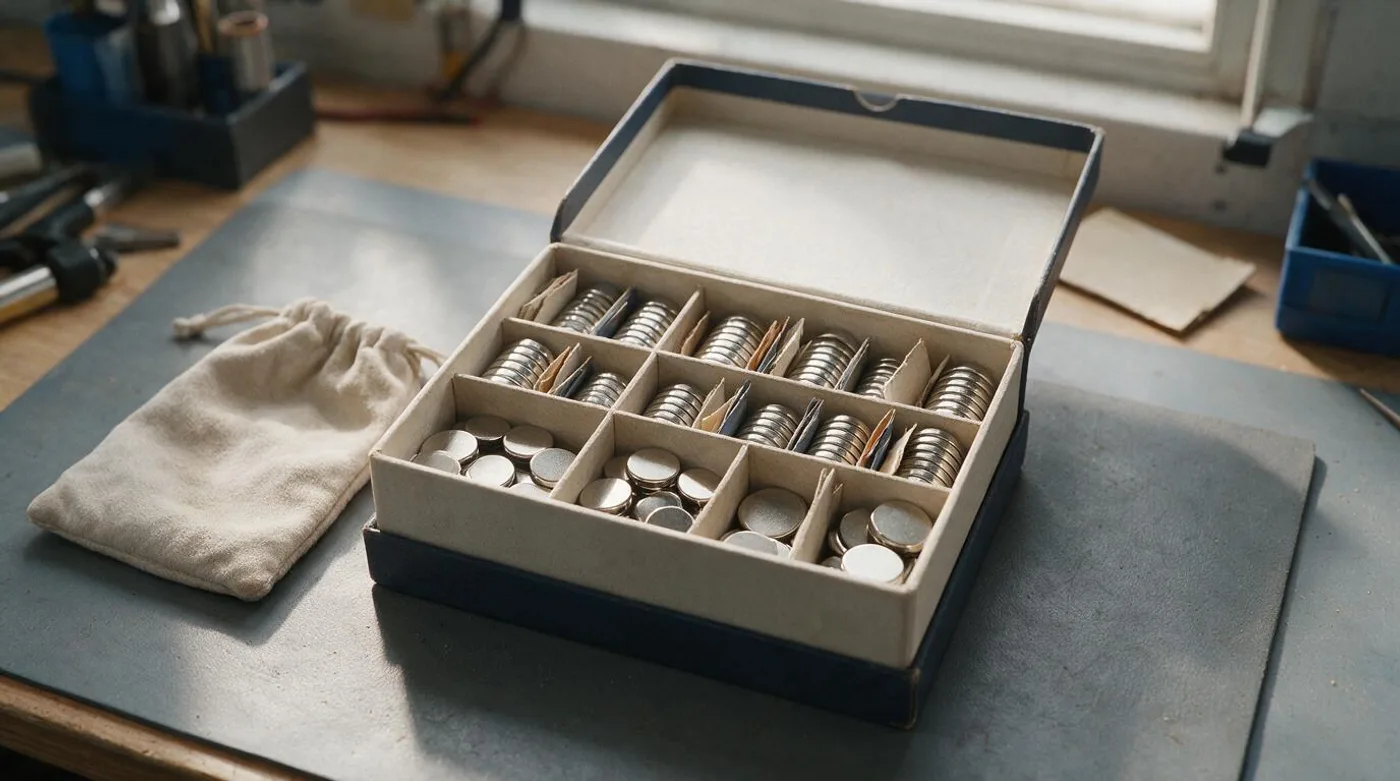
Open the drawer where the spare magnets live and it is usually one lump. A clot of neodymium discs welded to a steel ruler, three souvenir buildings with their paint scuffed off the same corner, a photo magnet face down under all of it, and a hotel keycard somewhere in the middle that has not worked for a year.
Magnets do not wear out. At room temperature an N42 magnet gives up roughly 1 percent of its strength per decade, which is a rate no household will ever notice. What kills them is the drawer.
Why stacking wrecks neodymium
Sintered NdFeB is pressed powder fired into a solid, so it behaves more like a ceramic tile than like metal. Over it sits nickel plating a few microns thick, hard and brittle in its own right, and that plating is the only thing standing between the core and kitchen air.
Let two 20 by 3 mm discs snap together across a gap and they arrive with 3,500 g of pull behind them, accelerating hardest over the last few millimeters. A flake comes off each face. Once the plating is broken the exposed core takes up moisture and rusts, and a rusting magnet marks the door it later sits on, which is the whole subject of do magnets scratch fridges.
The larger the magnet, the worse the collision. A 10 mm N42 cube brings 4,800 g and a 16 mm pot magnet brings 6,000 g, and the pot at least has a steel cup protecting its core. Bare discs have nothing.
Two habits fix nearly all of it. Slide magnets apart sideways rather than pulling them straight off each other, because the sideways force needed is far lower than the perpendicular pull figure. And never let one travel across a gap to meet another. Bring them together in contact, controlled, or keep something between them permanently.
Foam sheet, corrugated card, or a compartment tray with one magnet per cell all work. A strip of card between each disc in a stack is enough, and it means the stack can be picked up as a stack.
Note: two large discs closing on a fingertip carry the full pull figure between them and they arrive fast. A pair of 20 by 3 mm N42 discs is enough to raise a blood blister. Pick up large magnets one at a time.
Humidity and plating
Corrosion is the second killer and it is slower and quieter. Sintered neodymium corrodes readily wherever the plating has failed, and ceramic ferrite is porous and absorbs moisture through its whole surface without needing any damage at all.
That rules out a few storage places that people otherwise like. A bathroom cabinet. A windowsill above a sink. An unheated garage that condenses every time the weather turns, which is worse than a cold one that stays cold. A sealed box in a heated room is the easy answer, and a silica gel sachet dropped in costs nothing.
Check plating before a magnet goes into storage rather than after. A gray or brown patch on a silver disc means the nickel is gone and the magnet is now a corrosion source sitting against its neighbors. Retire it. Neodymium magnets covers the plating stack and why it is so easily lost.
Ferrite wants the same dry conditions for a different reason. It will not rust away, but a damp ferrite disc leaves a brown ring on whatever it rests against, including the inside of the box.
Prints, sunlight and the souvenir problem
A collection of souvenir magnets is a collection of small painted objects, and it should be packed the way small painted objects are packed.
Sunlight is the first enemy and it does not need heat to do its work. A photo print under mylar fades in a window, and so does the laminate on a flexible sheet magnet. A clear plastic box on a sunny shelf is the worst of both worlds, since it looks like display and behaves like a greenhouse. Store prints in the dark and put the ones you want to look at on the door where they belong.
Abrasion is the second. Cast resin pieces have raised detail and hard edges, and a bag of them grinds itself smooth in a house move. Pack print face to print face, or with paper between, and use a rigid box rather than a bag. The joint that fails under pressure is the glue holding the magnet to the resin body, which is why souvenirs come out of a move with the magnet still in the packing material.
Heat is the third and the one that comes with a number. Neodymium stops at about 80 C and ferrite runs to about 250 C, so a loft in summer is a real risk for a box of neodymium discs and no risk at all for a box of souvenirs. Magnets in heat has the rest of it. A travel collection that has outgrown the door is dealt with in travel collections, which is mostly an argument for displaying more of it and boxing less.
What must not share the drawer
| Item in the drawer | Risk from a bare neodymium disc | Verdict |
|---|---|---|
| Bank card with a magnetic stripe | Direct contact can corrupt the stripe | Different drawer |
| Hotel keycard or access card | Low-coercivity stock is easier to disturb | Different drawer |
| Portable hard drive | Shielded, but not worth the contact | Different drawer |
| Mechanical watch | Can be magnetized and then runs fast | Different drawer |
| Memory cards, USB sticks, SSDs | None. Flash storage is not magnetic | Fine |
| Tools, keys, screws | None to them. They will stick to everything | Annoying, not harmful |
The pattern is contact. Field falls away steeply with distance and a few centimeters of air ends the argument, so a closed box in the same drawer as a wallet is already fine. What causes trouble is a loose disc that migrates across the drawer and comes to rest flat on a stripe. Magnets and credit cards works through which of these are real and which are folklore.
Labeling, and counting
Write the size, the grade and the number on a strip of tape on the lid. Twelve by three N42, twenty of them. It takes ten seconds and it saves buying the same discs twice, because a 6 by 2 mm disc at 700 g and a 12 by 3 mm disc at 2,500 g look far more alike in a drawer than those figures suggest.
The count matters for a second reason. The CPSC advises keeping small high-powered magnets away from all children and teenagers, because two swallowed magnets can pull together through separate loops of intestine and clamp the tissue between them. A labeled count is how you know a magnet has gone missing rather than assuming it rolled behind the sofa. If there are small children in the house, the box goes high up and stays shut, and the door carries pressed photo magnets instead, which are 57 mm across and cannot be swallowed by anybody.
How to pack a magnet drawer
- Sort by material first. Neodymium in one group, ferrite and pressed photo magnets in another, flexible sheet in a third. They fail in different ways and want different treatment.
- Separate every neodymium magnet. A layer of card or foam between discs, or one compartment each. Never let two snap together across a gap, because that is what chips them.
- Check the plating before it goes away. A gray patch on a silver disc means the nickel is gone. Retire that magnet rather than storing it against others it can now rust onto.
- Lay flat magnets face to face. Photo magnets and souvenirs go print side to print side, or print side to a sheet of paper, so nothing hard rides against a printed face.
- Choose a dry, dark, cool place. Not a windowsill, not a bathroom, not a garage that swings between damp and hot. Sunlight fades prints and humidity corrodes plating.
- Keep cards and drives out of the same drawer. A bare neodymium disc resting on a magnetic stripe can corrupt it. Wallets, keycards and portable drives belong somewhere else entirely.
- Label the box. Size, grade and count on a strip of tape. It stops you buying the same discs again and it makes a missing magnet obvious in a house with children.
Frequently asked
Why should I not stack neodymium magnets?
Sintered NdFeB is brittle and the nickel plating over it is a few microns thick. Two 20 by 3 mm discs snapping together carry 3,500 g of pull between them and spall a flake off each face, and the bare spot then rusts.
Do magnets lose strength in storage?
Almost none. An N42 magnet gives up roughly 1 percent of its strength per decade at room temperature. Magnets in a drawer die from chipping, corrosion and heat, not from age.
Does storing magnets stuck together weaken them?
Not if they are stuck north to south, which is how they want to sit. The damage from stacking is mechanical rather than magnetic. Chipped plating is the thing to avoid.
Can I keep magnets in the garage?
A dry garage is fine. One that swings between damp winters and hot summers is a poor choice, because condensation attacks plating and a hot roof space can push a neodymium magnet past its 80 C ceiling.
How should souvenir magnets be stored between moves?
Wrapped individually, print face to print face, in a rigid box rather than a bag. Cast resin chips against its neighbors, and the glue holding the magnet to the body is the first joint to fail under pressure.