Using the fridge as a gallery for kids' art
Paper between a magnet and the fridge creates a gap that can reduce its hold. A clip keeps the paper in a jaw while its magnetic base touches the door. Check the complete arrangement on your surface, leave room for the artwork, and keep small high-powered magnets away from children and teens.
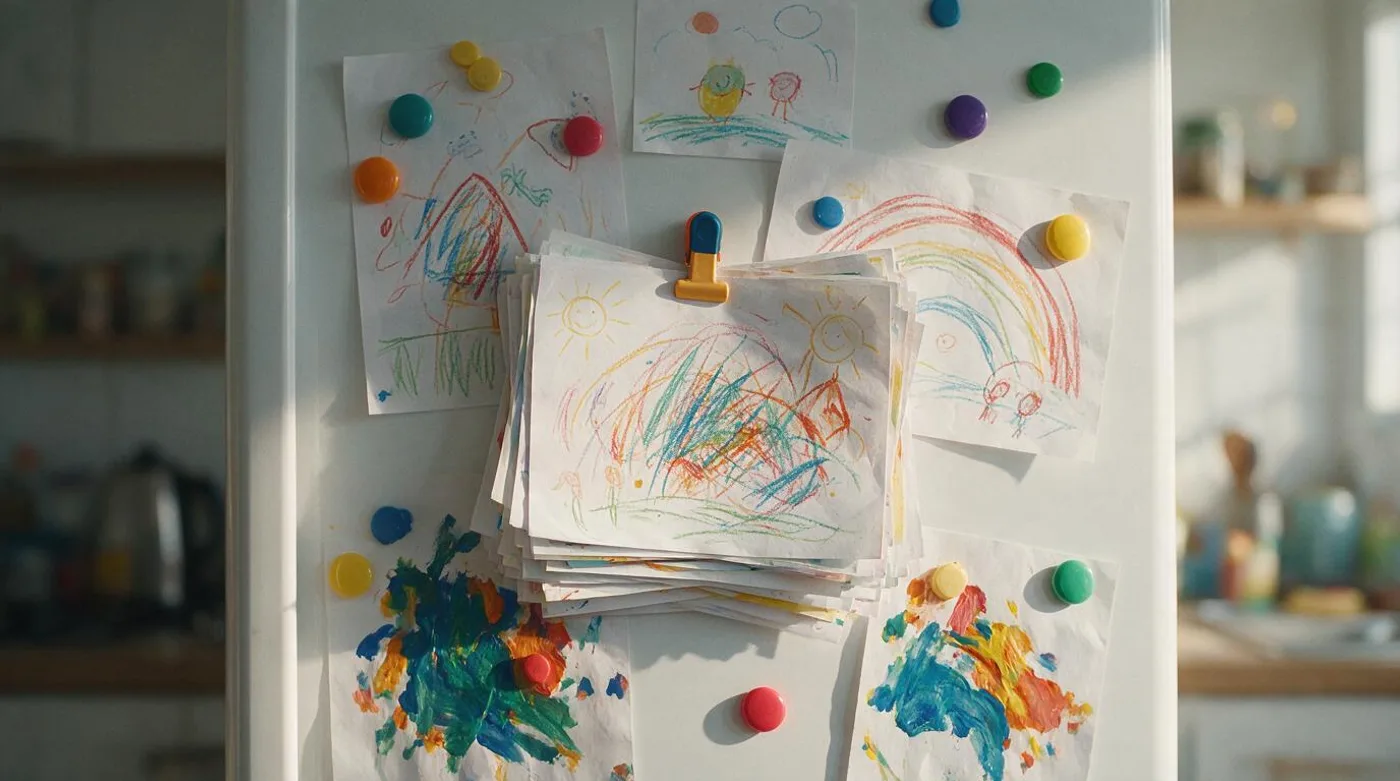
Something arrives home from school on Monday, goes on the door, and stays. By Thursday there are four more behind it. The magnet that held the first drawing now has a stack between its back and the fridge, and the latest painting may include a lump of dried glue. If the pile slides, take the artwork down before adding another magnet and hoping it stays.
The stack adds weight and distance between the magnet and steel. Both affect the arrangement. A drawing can also curl away from the door or catch a sleeve when someone reaches for the handle. Look at where the magnet sits, what is underneath it, and which edge moves first. That gives you a more useful starting point than buying another decorative magnet with an unspecified hold.
What a sheet of paper weighs
Paper weight depends on area and grammage, measured in grams per square meter. As a worked example, a US letter sheet is 8.5 x 11 inches (215.9 x 279.4 mm), an area of about 0.0603 square meters. At 80 gsm, that sheet weighs about 4.8 g before adding paint or glue. This is arithmetic from the example dimensions and grammage, rather than a measurement of a child's finished drawing.
Use the artwork itself when checking a display. A tissue-paper collage and a card covered in glued pasta can have the same outside dimensions and different weights. A seller's direct pull rating measures a different task from resisting a downward slide on a vertical fridge door. It cannot tell you how many drawings a particular magnet will hold without knowing the paper, the backing, and the surface.
Why the stack changes the hold
Measure a stack if you need to know its thickness. For an illustrative calculation, twenty sheets at about 0.004 inch each (0.1 mm) create about 0.08 inch (2 mm) of separation. Your stack may be thicker or thinner. Measuring ten sheets together is often easier than measuring one, particularly when the ruler has coarse markings.
Paper and other nonmagnetic material can reduce attraction by increasing the gap. The reduction depends on the magnet's dimensions, grade, and arrangement with the steel. K&J Magnetics' calculators use those inputs rather than a fixed loss for each additional sheet. Do not apply a blanket percentage for fridge paint either. The magnet strength guide explains the difference between a quoted pull and the job a fridge display asks it to do.
Children's artwork rarely stays uniform. Construction paper and card may be thicker than the copy paper used in your calculation. Dried paint, glued pasta, and a cotton wool sheep can add a raised area in the exact spot where the magnet wants to sit. Choose an undecorated edge for a flat magnet or use a clip so the thick part stays outside the contact area.
| Approach | Where the paper sits | What to check |
|---|---|---|
| Flat flexible magnet | Between magnet and door | Backing area, paper thickness, slipping |
| Rigid display magnet | Between magnet and door | Actual back contact, rim clearance, slipping |
| Clip magnet | Inside a jaw | Jaw opening, paper grip, base contact |
| Hook magnet with a hanging clip | Below the magnetic base | Complete suspended load and hook guidance |
These are construction checks, not measured capacities. We have not tested the magnets in your kitchen, and a front size does not reveal the magnetic material or its contact area. Check one drawing at a time before building a stack. If an arrangement begins to slide, reduce the load or change how the paper is supported; another drawing will not improve it.
Clips and pots, which move the paper out of the way
With a clip magnet, the paper goes in a jaw and the magnetic base can remain against the door. That removes the paper stack from between the magnet and steel. It also creates another limit: the jaw must accept the stack and grip it securely. Open the clip normally rather than forcing a thick bundle inside, and check that the paper cannot pull free under its own weight.
Check the base after filling the clip. A protruding edge or an awkward load can tilt it away from the door. Price and front decoration tell you little about that fit. A clip that works with one sheet may still need a smaller stack even though the paper no longer sits beneath the magnet.
For a hanging line, assess the hooks, cord, and complete load together. Two hooks holding a length of cord experience a different arrangement from a magnet pulled straight off a steel plate. Follow the hook seller's guidance for the direction of loading and keep the line clear of the handle. The neodymium guide explains housed magnets, but choosing neodymium does not establish a capacity for the assembled line.
For a flat display, begin with magnets at the upper corners of a single drawing and check the lower edge. If it curls into a walkway or catches a hand, add support at the bottom or move the drawing. There is no universal five-sheet threshold for switching to a clip. Use the arrangement that grips the actual artwork without covering its subject.
Make room for letter-size drawings
Measure the clear width of your own panel. Two US letter sheets in portrait orientation, each 8.5 inches wide (215.9 mm), need 17 inches before you add a gap. With a 0.75 inch gap (19.05 mm), the pair needs 17.75 inches (450.85 mm). That is a worked layout example. It excludes outer margins and any room needed beside the handle.
Landscape letter sheets are 8.5 inches tall. Three rows with two 0.75 inch gaps need 27 inches vertically (685.8 mm). Mark that height with paper before arranging the artwork. The bottom row might sit below a dispenser, while the top row might be hard for a child to see. Use fewer rows if the only way to fit them is to cover controls or put magnets where small children can reach loose parts.
An accessible side panel may offer another display area. Test that panel separately, since a response on the front does not establish what happens on the side. Check the space with the door fully open and closed. Keep the artwork and any hanging line away from appliance vents, hinges, and the path of the handle.
Rotating it, so the door does not become an archive
Set aside a few display spaces and decide where the drawings will go when they come down. A folder or flat box can hold selected originals without leaving them behind the latest sheet. Write the child's name and date on the back before storing a drawing; an unlabeled pile is much harder to sort a year later.
Pick a fixed number of slots, four or six, and treat them as slots rather than as space. When a new piece arrives, something comes down. This is easier if the thing coming down has somewhere to go, which is where a flat box on top of a wardrobe earns its place, and it is much easier if the child chooses which one goes.
The pieces that come down do not all need keeping. Photograph them before deciding which originals to save, and let the child choose favorites where practical. A file preserves the appearance of a drawing, but it will not preserve the texture of a collage or a note written on the back. Photograph those details too when they belong to the record you want.
Photographing the artwork, and putting it back on the door
Lay the piece flat on a plain surface near a window, with no direct sun falling across it. Hold the camera parallel to the artwork so the rectangular page stays close to rectangular in the picture. Check for reflections in glossy paint and take another photograph if a bright patch hides the detail. Keep the original file before making a crop for printing.
Photographing a drawing gives you a copy you can print without putting the original paper on the door. Fresh Magnets' custom fridge magnet collection is one place to compare fixed shapes for the photographed artwork. Its 2 x 3 inch rectangle (50.8 x 76.2 mm) gives a different crop from its 2.5 inch square (63.5 mm). Check the visible print area and the finished outline separately, then follow the seller's template so an edge does not remove a name or part of the drawing. The construction guide explains how a printed sheet differs from a pressed shell.
Crop before you order. A drawing photographed on a wooden floor may leave more floor than drawing in the frame. On a 2.5 inch square (63.5 mm), that border reduces the room available for the artwork. Keep any handwritten title that you want to preserve inside the printable area. The same cropping checks that apply to photo magnets apply to a dinosaur.
Small magnets and small children
Read the Consumer Product Safety Commission's magnet guidance before placing high-powered magnets in a family display. The agency warns that they pose an ingestion risk to children from toddlers through teens.
When swallowed magnets attract each other internally, they can cause serious injury. CPSC reports cases requiring surgery and advises seeking immediate medical attention if magnet ingestion is suspected. Keep small high-powered magnets away from children and teens. Loose discs and spheres used for adult projects do not belong among a child's artwork supplies.
Inspect decorative magnets and clips for detached backings or damaged housings, and remove damaged pieces from the display. A large printed front does not make every component large or permanently attached. Keep display hardware out of reach and account for it when changing the artwork. Check the floor if a magnet falls, since the backing may separate from its front.
Check letter magnets according to the maker's age guidance and inspect them too. Their backing area varies, so a toy that sticks to the door may not grip a drawing through the paper. The letters and numbers guide covers that separate category. Put display magnets back in a container controlled by an adult when the artwork comes down.
Frequently asked
Why does the magnet slide down when I put several drawings under it?
The paper adds weight and creates a gap between the magnet and the door. If each sheet is about 0.004 inch thick (0.1 mm), twenty sheets add about 0.08 inch (2 mm) of separation. The resulting hold depends on the magnet and surface; there is no universal percentage loss per sheet.
What magnet holds a thick stack of artwork?
Try a clip magnet that accepts the stack without forcing its jaw. Its base can contact the door while the paper sits in the clip. Check the seller's load guidance and the complete arrangement; a pull rating alone does not establish how much paper a clip holds vertically.
Are small magnets safe around young children?
The US Consumer Product Safety Commission warns that high-powered magnets pose an ingestion risk to children and teens. Keep them away from children, and check display magnets for loose or damaged parts. A large decorative front alone does not establish the safety of its backing.
How do I keep the artwork instead of the fridge door?
Photograph each piece flat in daylight, then save the file with the child's name and date. A 2.5 inch square (63.5 mm) can display a cropped copy, while the paper original goes in a flat storage box. Check the crop before ordering.