Magnetic sheet vs pressed magnets: layers and edges
Flexible sheet and pressed photo magnets use different assemblies. Sheet carries a print on a flexible magnetic backing; a pressed piece uses a rigid shell and a separate backing. Compare finished dimensions, edge protection, and surface contact, then check strength with comparable measurements rather than assuming one construction always wins.
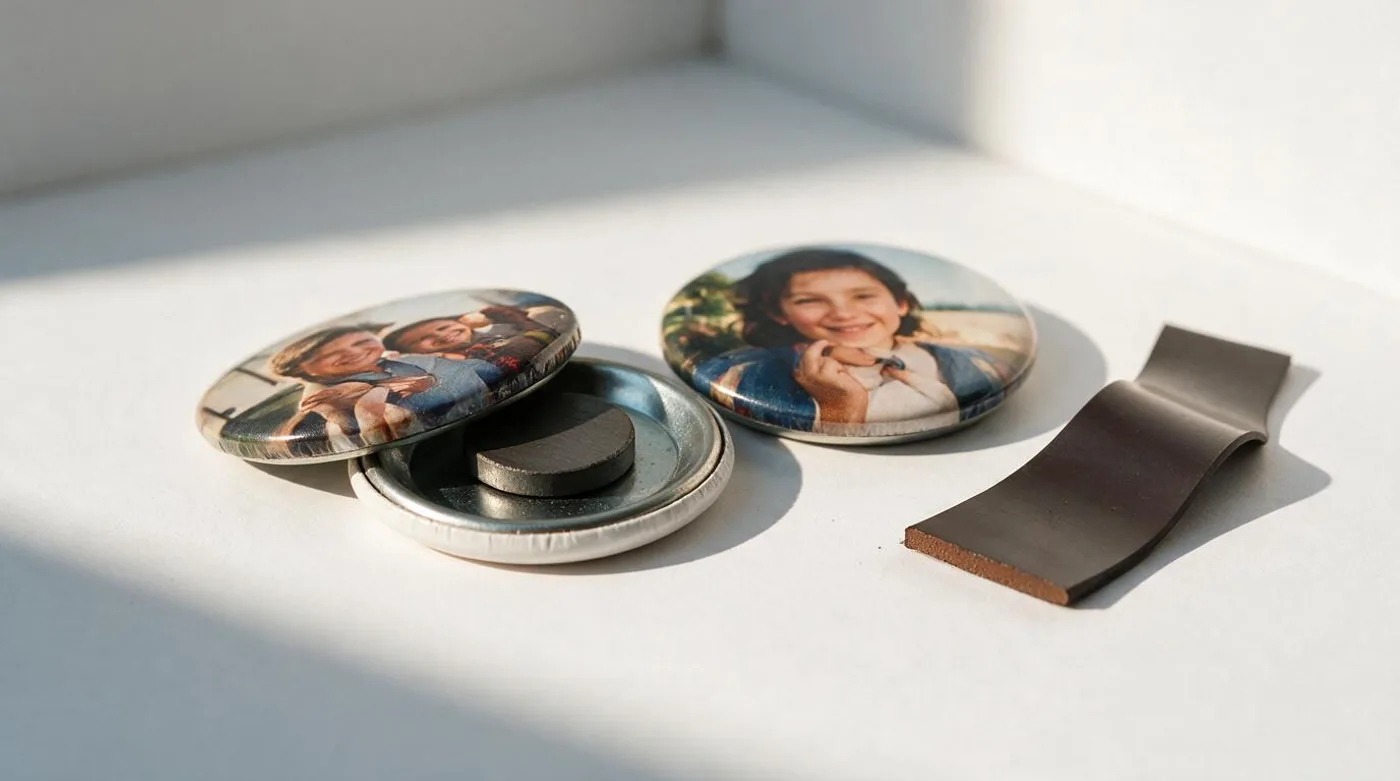
A flexible photo magnet can bend when you lift a corner. A pressed photo magnet has a rigid shell that keeps its shape. Those differences are easy to see, but neither one tells you how much paper the magnet will hold on your refrigerator. Compare the layers, edges, and backing before treating either construction as the better choice for your job.
Two magnets with the same 2 inch square outline can use different print surfaces and different magnetic backs. A catalogue photograph may show only the front. Ask for a back view and a finished thickness measurement when those details affect packing, fit, or contact with the door.
Identify the layers without assuming the backing material
A flexible sheet magnet uses magnetic material as the bending body. The image may be printed on a suitable surface or attached as a separate print layer. Magnum Magnetics' product catalogue lists direct-printable magnetic media as well as plain magnetic sheeting to which an adhesive or printed laminate can be added. That range explains why the phrase magnetic sheet does not identify one print method or finish.
A pressed assembly uses a rigid shell with a picture and a protective front layer or finish. A fitted backing completes the magnet. The exact assembly depends on the maker. A construction diagram can explain one arrangement, but it cannot identify an unseen seller's adhesive, cover material, or magnet grade.
| Detail to compare | Flexible sheet | Pressed shell |
|---|---|---|
| Body | Bends within the material's limits | Rigid shell keeps its outline |
| Magnetic part | Magnetic sheet forms the backing | Magnetic backing is fitted to the shell |
| Printed picture | May use a printable surface or an attached print | Picture sits on or within the shell assembly |
| Face protection | Ask about coating or laminate | Ask about cover or protective finish |
| Edge | Inspect trimmed corners and any lifted print layer | Inspect the rim and the fitted backing |
| Packing dimension | Measure the whole finished sheet | Measure the shell, face, and backing together |
The diagram shows one pressed assembly. The fitted backing and protective face of a finished product depend on the maker. The photo magnet guide explains the construction vocabulary you may encounter in listings. Use a seller's specification to establish which parts a particular magnet contains.
The Fresh Magnets collection is a seller example of pressed photo magnets. The seller describes a rigid pressed shell and a protective finish. The catalogue does not specify the exact backing material or provide a measured holding force. Its shop currently shows a coming soon notice, so the catalogue serves as a product reference rather than confirmation of an orderable listing.
Thickness needs a label. A listing that gives magnetic sheet thickness may exclude the image, laminate, and adhesive. A shell depth may exclude the raised face or backing. Ask for the finished overall measurement for sleeves or a display tray. Our size and thickness guide separates that measurement from the visible picture area and outer outline.
Check surface contact and holding behavior separately
The magnetic back needs a suitable surface at the place where you intend to display it. Check the refrigerator door with a known magnet first and follow the appliance maker's guidance on surface care. A refrigerator can have different materials on its front and side; a result on one panel does not establish the result on the other.
Look across the sample at door level. Does the backing sit flat, or does the magnet rock against a raised edge? A flexible piece with a curled corner may leave part of its back away from the door. A rigid assembly can also have a recessed or uneven contact surface. The front's appearance cannot answer that question.
K&J Magnetics' explanation of refrigerator holding separates magnetic attraction from friction that resists sliding. Its strength testing description also explains how a gap between a magnet and steel reduces pull force. Those sources describe test conditions and mechanisms. Their ratings for specific magnets are not ratings for a flexible photo sheet or an unmeasured pressed product.
Paper changes the contact arrangement. Placing a drawing underneath adds a gap between the backing and door and introduces another surface that can slip. Several sheets change the gap again. A straight pull rating measured against steel therefore does not translate directly into a number of pages held vertically. The strength chart explains what information a useful rating needs.
For a household check, use the same door location for both samples. Clean it as the appliance maker directs, inspect both backs for grit, and try each magnet by itself. Then try the actual paper you plan to display, with the same number of sheets in the same position. Record any sliding after a chosen observation period and after normal door opening. This is a check of your samples in your kitchen, not a universal product rating.
Keep the result narrow. If a sample holds your single sheet through normal use, that supports the use you tried. It does not establish how the magnet will behave on another appliance, with a heavier card, or after a backing change in a future batch. If holding a document is essential, ask the seller for a comparable test or keep a tested sample before ordering many copies.
A thicker body can include more shell or a raised front without adding magnetic material. Greater weight also increases what the backing must keep on the door. Compare measured behavior on the intended surface instead of ranking samples by how substantial they feel in your hand.
Inspect edges, picture protection, and the completed package
A protective cover reduces direct contact with the printed face. It does not supply a lifespan in years. The print, cover, light exposure, moisture, and handling all affect the finished result, and a durability claim needs evidence for that assembly. Ask what cleaning method the maker permits before using an abrasive pad, alcohol, or another household cleaner.
Inspect the edges in good light. On a sheet sample, look for a lifted laminate, rough cut, or corner that no longer lies flat. On a pressed sample, look for an uneven rim, loose backing, or a sharp contact point. Avoid dismantling a finished magnet to identify its layers; request the maker's description instead. Keep a sample out of use if a loose part or sharp edge appears.
For frequent rearranging, check how you can lift the piece without dragging its back across the door. Grit trapped beneath either construction can rub against an appliance finish. Leave a gap around the displayed magnets so you can reach an edge. Follow the seller's handling guidance and the appliance maker's instructions for the specific finish.
Packing comparisons need finished measurements. As a hypothetical example, twenty flat magnets each measuring 0.03 inch overall would occupy 0.6 inch before separators. Twenty rigid magnets each measuring 0.16 inch overall would occupy 3.2 inches under the same flat-stack assumption. Those are invented sample measurements, not specifications for either category. Raised faces, nesting rims, and protective separators can change the stack, so measure the arrangement you will send.
Weigh a completed package with its insert and padding. A flexible magnet inside a rigid backing card becomes part of a rigid package; a pressed magnet in an envelope still needs protection from movement and edge pressure. Ask the carrier how that actual package will be classified. Construction names alone do not determine postage or safe handling.
Compare the delivered quotes after choosing the specification and packing. The cost guide includes shipping and the quantity you will use. Keep the selected sample's dimensions, backing description, and accepted crop with the order. For a repeat purchase, confirm that the seller still uses that assembly before reusing a holder or mailing package sized to the first batch.
Frequently asked
Can the construction tell me which holds more?
It helps identify the product, but it is not a measured force rating. The backing and test surface still matter.
Does a clear cover prove that a print will last longer?
It can protect against direct contact. Lifespan also depends on the print, finish, light, moisture, and handling, so a number of years needs its own evidence.
Which is easier to post?
Check the complete packed sample. Weight, dimensions, and rigidity affect handling; the construction name alone does not establish a postal category.