Shutterfly photo magnets review
Shutterfly sells laminated photo prints on 0.75 mm flexible magnetic sheet in 2 x 3 and 4 x 6 inch sizes, listed at $2.50 each with a minimum order of 1 and USA shipping in 5 to 8 days. At a 50 mm footprint that sheet holds 110 g.
Where these figures come from
This comparison uses published product specifications. We have not handled or measured these products. Prices and availability can change; check the seller's listing before ordering. Method, equipment, and limits are on the how we test page.
Spec comparison
| Spec | Shutterfly |
|---|---|
| Material | Flexible magnetic sheet, laminated print |
| Listed thickness | 0.75 mm |
| Sizes | 2 x 3 in (51 x 76 mm), 4 x 6 in (102 x 152 mm) |
| Price per magnet | $2.50 |
| Minimum order | 1 |
| Shipping | USA, 5 to 8 days |
| Pull force | Not yet measured |
| Measured thickness | Not yet measured |
| Print sharpness | Not yet measured |
| Corner lift after 30 days | Not yet measured |
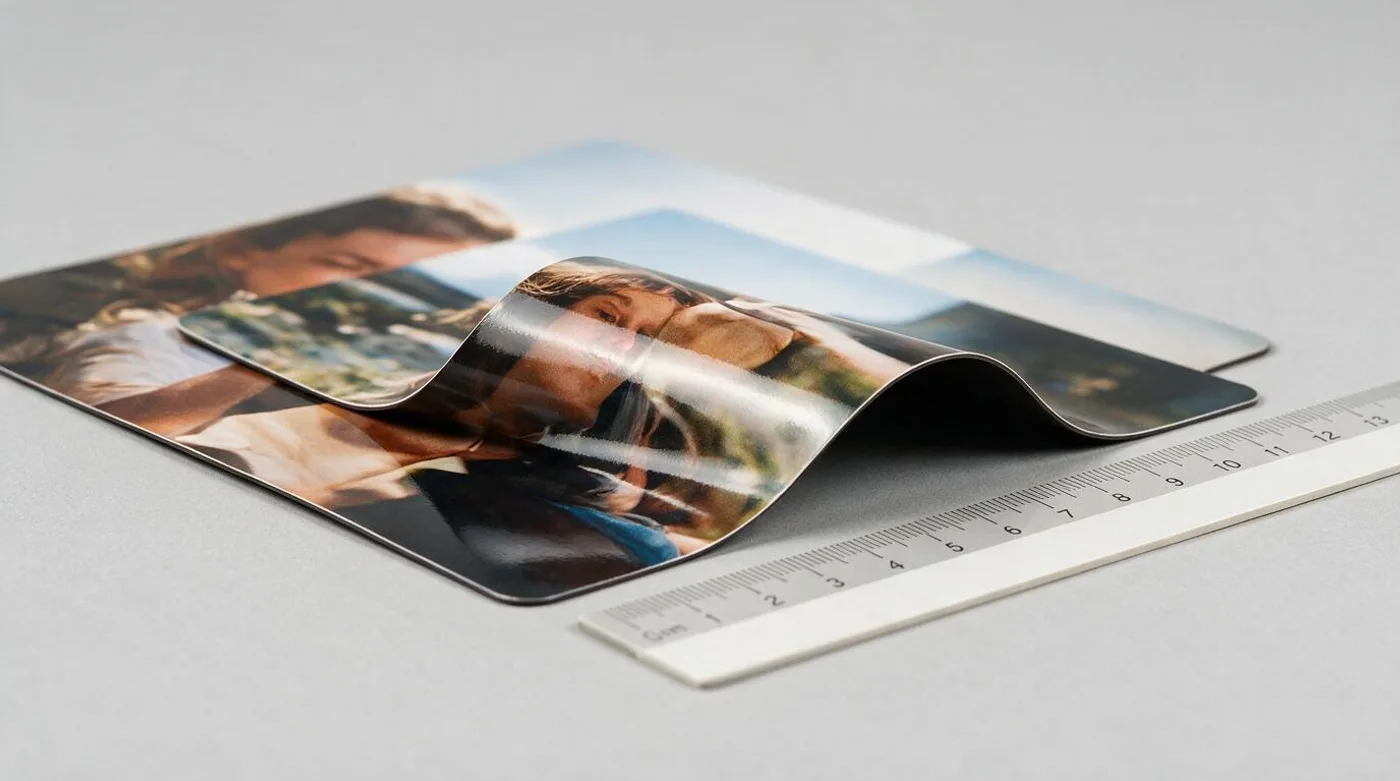
The minimum order is one
That is the most useful line on the whole listing, and it is easy to skim past. A minimum order of 1 means you can spend $2.50, put one magnet on your own door, and find out whether the print is what you hoped before committing to anything. Competing sheet magnet listings start at 25, which is $30 of magnets bought on faith.
$2.50 each is also the highest listed per-magnet price of the sheet options we cover, and the two facts are the same fact. Nobody sells one of anything cheaply. The economics of printing turn on run length, and a listing built around a run of one carries the setup cost in the unit price. Price per magnet covers how that curve behaves as quantity goes up.
What 0.75 mm of sheet actually holds
Flexible sheet is ferrite powder mixed into vinyl and rolled flat. Surface field is about 300 Gauss, which is weak enough that you can fold the sheet double without it fighting back. Thickness is the number that decides how much it grips.
| Build | Footprint | Holds on bare steel | On a painted door |
|---|---|---|---|
| Flexible sheet, 0.5 mm | 50 x 50 mm | 60 g | about 42 g |
| Flexible sheet, 0.75 mm | 50 x 50 mm | 110 g | about 77 g |
| Pressed photo magnet | 57 mm round | Not published | Not published |
Shutterfly is on the middle row. Choosing 0.75 mm over the thinner 0.5 mm sheet is the right call and it nearly doubles the grip, from 60 g to 110 g, for a third of a millimeter of extra material. It still leaves a gap to pressed construction that no amount of sheet thickness closes, because a pressed magnet has a solid ferrite disc behind a steel shell and pulls much harder than any sheet does. The bottom row is blank because no seller publishes a pull force for that build and nothing here has been measured.
The painted door column matters more than the plate column, since almost nobody has a bare steel fridge. A coated door keeps 60 to 80 percent of a plate figure, and paint adds 0.1 to 0.2 mm of gap before texture and door curvature take their share. Call it 77 g for a 2 x 3 inch Shutterfly magnet in normal use.
That figure is enough for what a photo magnet is nominally for. A photograph weighs nothing, and the magnet is holding itself. It runs out at the point where the magnet is asked to hold other things as well, which on a working kitchen fridge happens within about a week of it going up. Twenty sheets of office paper is roughly 100 g. A school newsletter and a takeaway menu underneath the photo is asking a 77 g magnet to do a 120 g job, and the whole assembly slides down the door overnight.
Where a laminate ages worse than a cover layer
Shutterfly laminates the print. A film goes over the ink and ends at the cut edge of the sheet, which is how every flexible photo magnet is finished, because there is no rim to fold over.
Two consequences follow, and both play out over years rather than weeks. The first is edge lift. A cut edge presents a corner of laminate that a fingernail, a sleeve, or a passing cereal box can catch, and once a millimeter of film has lifted, the curl only goes one direction. Pressed photo magnets avoid this by crimping a steel rim around the print, which is the structural difference the sheet against pressed comparison is mostly about.
The second is the print surface itself. A laminate sits close to the ink and takes the abrasion directly. A mylar cover over a pressed build puts a thicker, separate layer between the ink and the world. Neither of those claims comes from a sample we have handled, so treat both as arguments from construction. Corner lift after 30 days is one of the four rows on our table that is still empty, and it is the row that would settle this properly.
Heat is worth a sentence. Ferrite copes with high temperatures easily, up to about 250 C for a ceramic disc, so a magnet on a fridge door above a radiator is in no danger magnetically. Vinyl and laminate film are the parts that mind, and a magnet on a sunlit door will fade its print long before it loses any grip. Magnets in heat has the detail.
The 4 x 6 inch option
Shutterfly lists two sizes, 2 x 3 in (51 x 76 mm) and 4 x 6 in (102 x 152 mm). The larger one is a full photo print on a fridge door and it is a size that pressed construction does not offer at all, since pressing works from a fixed die and stops at around 64 mm.
We do not have a pull force figure for a 4 x 6 in sheet magnet, and we are not going to scale one up from the 50 x 50 mm number and present the result as data. More sheet on the door means more grip. How much more is a measurement nobody has taken here.
Size does bring one problem that is not about strength. A 4 x 6 in magnet is 152 mm across, and usable fridge door width runs 40 to 60 cm, so three of them fill a row. It is also a large area of unsupported vinyl, which is more edge to lift and more surface to catch. If the plan is one large print rather than a wall of small ones, this is the listing that sells it, with that caveat attached.
Shipping, and the door you are shipping it to
The listing publishes 5 to 8 days within the USA. That is a delivery window rather than a production time, and it is the figure to work backwards from when the magnet is a gift with a date attached to it. A photo magnet ordered for a birthday four days away is a photo magnet that arrives after the birthday.
The bigger risk before you order is the door itself, and it applies to every magnet on this site. Austenitic stainless steel, grade 304, is not magnetic. Its face-centered cubic structure is stabilized by nickel and holds no magnetic domain, and plenty of stainless fridge doors are made of it. Nothing sticks. Ferritic stainless, grade 430, is magnetic, and some doors use that instead, which is why one stainless fridge takes magnets and the identical-looking one next to it does not.
A weak magnet makes this worse rather than causing it. On a marginal surface a 77 g sheet print gives up where a pressed magnet or a ferrite disc still grips, so 0.75 mm sheet is the least forgiving thing you can buy for a door you have not tested. Put any magnet you already own on the door before ordering. If it slides, check the side panels, which are painted mild steel on most models and magnetic even when the door is not. Magnets on stainless steel has the rest.
Who should buy this, and who should not
Buy it for a single magnet. One photograph, one gift, one test print before a bigger order. The minimum of 1 is genuinely rare and it is worth paying $2.50 for.
Buy it for anything deliberately temporary. Save-the-dates come off the door after the wedding. A seasonal photo gets swapped in January. Corner lift over a decade is not a risk when the magnet has a six month job. Wedding save-the-dates covers sizing and quantity for that case.
Buy it when you want a 4 x 6 in print and are not prepared to crop the photograph down to a 64 mm square.
Look elsewhere when the magnet has to work. A fridge that carries paper wants a pressed photo magnet, or a plain ferrite disc at 500 g, or a neodymium disc if the load is serious. Look elsewhere when the photograph is meant to be on someone's door in ten years, because that is the case where the rim and the cover layer of a pressed build earn their cost. And look elsewhere for a bulk promotional run, where $2.50 a magnet against a thinner sheet at half the price makes the arithmetic obvious well before you reach 250 units.
The photo magnets category covers both builds side by side, and the best photo magnets comparison has the full spec table for every brand we cover.
Frequently asked
How much does a Shutterfly photo magnet cost?
$2.50 each is the listed price, with a minimum order of 1. That is the highest listed per-magnet price among the sheet magnet options we cover, and the only one that lets you buy a single magnet.
How thick is a Shutterfly magnet?
0.75 mm listed, which is the thicker of the two gauges used for print work. The thinner 0.5 mm sheet holds 60 g at a 50 x 50 mm footprint against 110 g for 0.75 mm.
How strong is a 0.75 mm sheet magnet?
110 g on bare steel at a 50 x 50 mm footprint, so roughly 77 g on a painted door. A pressed photo magnet of similar face size holds a good deal more, though no seller publishes the figure.
How long does Shutterfly take to deliver?
5 to 8 days within the USA on the published listing. Order well ahead of any date the magnet is meant to arrive for.
Will a Shutterfly magnet hold a stack of paper?
Not much of one. Twenty sheets of office paper comes to about 100 g, which is above what one 0.75 mm sheet print holds on a painted door. Use two magnets or a ferrite disc.