Do fridge magnets wipe credit cards?
A normal fridge magnet does not. A pressed photo magnet or a flexible sheet is nowhere near strong enough to rewrite a magnetic stripe through a wallet. A bare neodymium disc laid directly on the stripe is a different case. Chips and contactless antennas are not magnetic media and are unaffected.
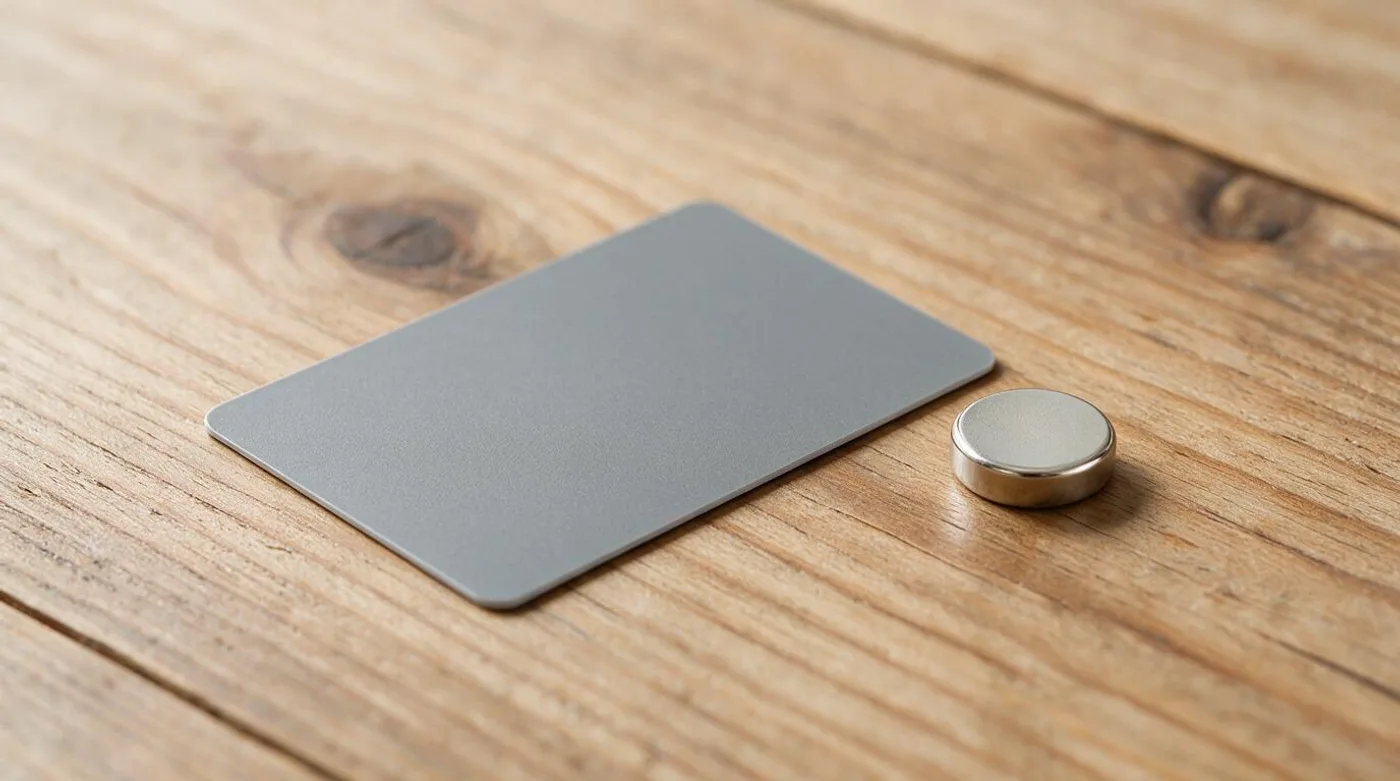
The warning about keeping bank cards away from fridge magnets has outlived the magnets it was written about and most of the cards too. It was reasonable advice once, when stripes were the whole card and the loudspeaker in a handbag was the usual culprit. Today it survives as folklore, and the folklore is aimed at the wrong object.
Two things are true at once. An ordinary fridge magnet will not rewrite a magnetic stripe, and a bare neodymium disc laid face down on one can. Those are different objects with different numbers behind them, and lumping them together as magnets is what makes the question confusing.
What is actually on a card
A magnetic stripe is a band of fine magnetic particles in a binder, and data is written by flipping the direction of tiny regions along the band. Flipping them again requires a field strong enough to overcome the coercivity of that particular stripe material, which is why cards are made in low-coercivity and high-coercivity versions. Bank cards use the high-coercivity kind. Nobody publishes a coercivity figure alongside a fridge magnet's specification, and we are not going to invent the comparison, so take the practical version instead: the field a stripe needs is well beyond what a magnet held against a wallet delivers.
The chip is a different technology entirely. It is a silicon integrated circuit with flash storage and a processor, and it stores charge rather than magnetic orientation. A contactless card carries a coil of wire round the edge of the plastic as an antenna. Neither responds to a static magnetic field. On a chip-and-contactless card the stripe is a legacy fallback that many people never use, so even a genuinely wiped stripe often goes unnoticed.
Where the fridge magnet numbers land
Field strength is the wrong number to buy a magnet on but the right one for this question, because what a card sees is field rather than pull.
| Magnet | Surface field | Field at a wallet's distance |
|---|---|---|
| Flexible sheet, 0.5 mm | about 300 Gauss | Effectively nothing |
| Pressed photo magnet, 57 mm | Not published | Effectively nothing |
| N42 disc, 12 x 3 mm | about 4,000 Gauss | Falls away over a few millimeters |
Three things follow from that table. A flexible sheet magnet reads about 300 Gauss at its own face, which is the surface of the print, and by the time you add the card's plastic and the leather of a wallet there is nothing left to talk about. A 12 mm neodymium disc reads about 4,000 Gauss, more than thirteen times as much, but at its face and nowhere else. And field falls off extremely steeply with distance, which is the reason a magnet that will not let go of a door is harmless to a phone in your other hand.
Distance is the whole safety margin. Contact is the only condition where a fridge magnet is in the conversation at all. How fridge magnets work has the underlying reason the field collapses so fast.
When a neodymium disc is a real risk
A bare N42 disc, plating intact, laid flat on the stripe of a card and left there is a plausible way to corrupt it. Not certain, and the outcome depends on the stripe's coercivity, but plausible enough that nobody should be doing it deliberately.
The scenario that produces this is not a fridge door. It is a drawer, a coat pocket, or a workbench where a handful of loose neodymium discs live alongside a wallet, a hotel keycard, an access fob, and a transit card. Discs migrate. They snap onto steel drawer runners, they cling to keys, and they end up flat against whatever plastic is in the same space. That is an argument for how the magnets are stored rather than for avoiding them, which how to store magnets deals with properly.
Hotel keycards deserve their own mention because they fail most often. Hotels buy in volume and much of that stock is low-coercivity, which is easier to disturb than a bank card by a wide margin. The usual culprit is not even a fridge magnet: it is the magnetic clasp on a handbag or the magnet in a phone case, which spends hours in contact with the card rather than seconds. Reception has heard this complaint before.
Access fobs and transit cards mostly do not care. Both are RFID coils and chips rather than magnetic media, so they behave like the contactless side of a bank card.
Drives, phones and laptops
Hard drives are the classic worry and mostly a misplaced one. A spinning drive contains a voice coil actuator built around neodymium magnets considerably stronger than anything on a fridge, sitting a few millimeters from the platters, and it works fine. The steel case shields it from outside fields as well. A fridge magnet on the outside of a laptop does nothing.
Solid state drives, memory cards and USB sticks store charge in flash cells and have no magnetic component to disturb at all. The magnetic worry simply does not apply to them.
Phones are more interesting than they used to be, because many now contain their own ring of magnets for accessory attachment, along with a magnetometer used for the compass. A strong external magnet can confuse the compass while it is nearby and can trigger a cover-closed sensor, and both effects stop when you take the magnet away. Screens are not affected in the way old CRT televisions were, since nothing in a phone display steers an electron beam.
The one genuinely fragile item on a fridge door is a mechanical watch left lying next to a strong magnet, which can pick up enough magnetism in its balance spring to run fast until a watchmaker demagnetises it.
Pacemakers and implanted devices
Implanted pacemakers and defibrillators respond to magnets by design. A magnet held over the device puts it into a fixed test mode, which is a deliberate feature and not a fault, but it is not a state anybody wants triggered by accident.
Every device maker publishes a minimum distance for magnets in the patient's documentation, and the figure varies by device. We do not print a number here, because a distance copied from the wrong manufacturer is worse than no number at all. Ask the clinic or read the card that came with the implant, and treat a magnet seller's reassurance as marketing rather than medical advice.
The practical version is easy. Do not carry loose neodymium magnets in a breast pocket, and do not lean a chest against a fridge covered in strong discs. Ordinary photo and souvenir magnets are not part of this conversation at the distances involved.
The warning that actually matters
The CPSC's guidance on small high-powered magnets has nothing to do with data and everything to do with children. Two swallowed magnets can find each other through separate loops of intestine and clamp the tissue between them, which kills the bowel wall and perforates it. The advice is to keep small high-powered magnets away from all children and teenagers.
That is the risk worth carrying out of this page. A wiped card costs a phone call and a week's wait. A pair of swallowed neodymium discs is surgery. Neodymium magnets carries the same guidance next to the pull figures, and it is the reason most kitchens are better served by a 57 mm pressed photo magnet than by anything that can fit inside a wallet.
Frequently asked
Can I keep my wallet on top of the fridge next to magnets?
Yes. Field strength falls away very steeply with distance, and a few centimeters of air plus a leather wallet puts a card far outside anything a fridge magnet can do. Contact is the only case worth thinking about.
Which is more likely to have wiped my card, a magnet or the terminal?
Neither, usually. Stripes wear out mechanically. A card swiped daily for two years has an abraded stripe, and that reads as a dead card long before any magnet gets the blame.
Is the chip on a bank card affected by magnets?
No. The chip is a silicon integrated circuit with flash memory and the contactless antenna is a coil of wire. Neither stores data magnetically, so a static magnetic field has nothing to erase.
What about hotel keycards?
Hotel keycards with a magnetic stripe are the weak link, because many are low-coercivity stock that is easier to disturb than a bank card. Keep one away from a bag clasp magnet as well as from a neodymium disc.
Will a fridge magnet damage a hard drive or a phone?
Not from a normal distance. A modern hard drive contains magnets far stronger than anything on a fridge door and is shielded by its own steel case. A bare neodymium disc placed directly on a running drive is worth avoiding anyway.