Photo magnets vs souvenir magnets
A photo magnet is a print you ordered, flat against the door, about 4 mm thick, with ferrite spanning its whole back. A souvenir magnet is a cast piece someone else designed, often heavier, and usually backed by one 20 mm ferrite disc listing 500 g. That mismatch is why souvenirs slide.
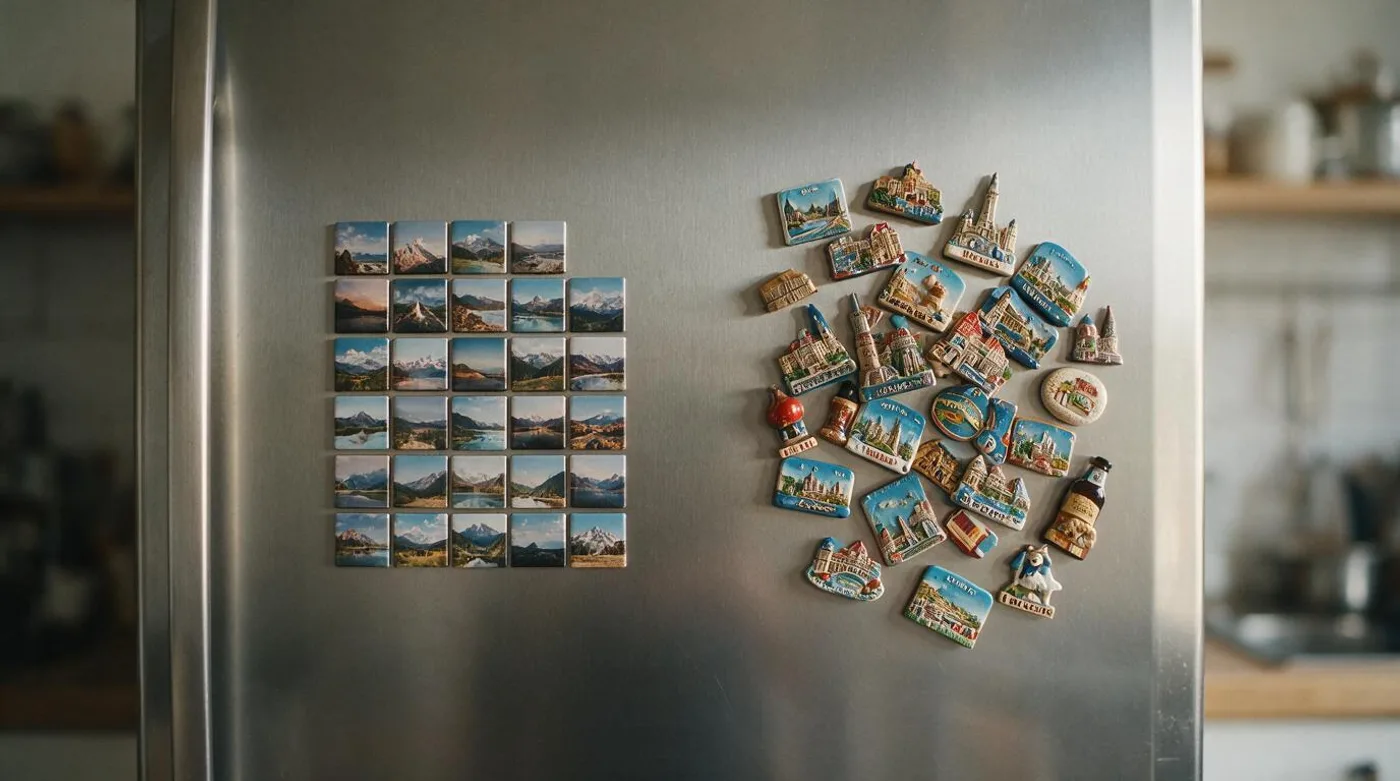
One of these you paid to have made from a file on your phone. The other cost about as much as a coffee at an airport, and you bought it because the trip was ending. They end up on the same steel door, forty to sixty centimeters of usable width, competing for the same space, and they behave nothing alike once they are up there.
The short version is that a photo magnet is a magnet with a picture on it, and a souvenir magnet is an ornament with a magnet stuck to the back. Everything below comes out of that.
What is behind each one
A pressed photo magnet is a print laid face up on a shallow steel shell, covered with clear mylar, crimped at the rim, with a flat ferrite slab glued across the back. About 4 mm thick overall. The magnet spans most of the footprint, so a 64 mm square magnet is holding on across most of 64 mm. The sheet version of the same product is thinner still, a laminated print on 0.5 to 0.75 mm of ferrite-filled vinyl, and it also touches the door across its whole area.
A souvenir magnet is usually a casting in polyresin, sometimes wood, sometimes a stamped tin plate, occasionally a lump of glazed ceramic. The magnetic part is a separate component, and it is almost always a small ferrite disc, 20 mm across being the common size, glued into a recess on the back. On a flat plate that disc lists 500 g. The rest of the object is dead weight the disc has to carry.
Weight against hold
| Photo magnet | Souvenir magnet | |
|---|---|---|
| Who designed it | you, from your own file | a factory, sold at the destination |
| Build | print under mylar in a crimped steel shell, ferrite back | cast resin, wood, tin, or ceramic with a ferrite disc glued on |
| Footprint on the door | 51 x 76 mm, 57 mm round, or 64 mm square | whatever the casting is |
| Contact with the door | the whole footprint | usually one 20 mm disc |
| Listed hold | nobody publishes one for the pressed build | 500 g for a 20 x 3 mm ferrite disc |
| Weight | light, and flat against the door | heavier, and standing off it |
| Ages by | print fading, rust at the rim if it gets damp | paint chipping, glue letting go of the disc |
| Cost | $1.20 to $2.50 each on published sheet prices | souvenir shop pricing, not published anywhere |
| What it is for | keeping a picture where you see it daily | remembering where you went |
The hold row has one cell filled and one empty, and even if both were filled they would not settle the question. The two magnets are carrying different loads. A photo magnet carries itself, a few grams of paper under mylar whose mass sits about 4 mm off the steel, held by ferrite that spans the whole back. The souvenir disc carries a casting that can weigh many times the magnet, positioned a couple of centimeters out from the door and touching it through 20 mm of contact. Same units, different jobs.
Why the souvenir slides
Two things are working against a heavy souvenir, and neither shows up in a pull force number.
The first is direction. A published pull force is the straight-out force needed to break the magnet off the door, measured perpendicular to the steel. A magnet on a vertical fridge door is not being pulled that way. It is being dragged downwards, and what resists that is friction between the magnet face and the paint, which is a fraction of the perpendicular figure. We have not measured that fraction, so we are not going to put a number on it, but it is small enough that a magnet listing 500 g of pull will start creeping under a load well under 500 g. How fridge magnets work covers the perpendicular case in more detail.
The second is the lever. A resin model of a cathedral has its center of mass two or three centimeters out from the door. Gravity acting on that mass tries to rotate the whole souvenir about the bottom edge of the backing disc, which pulls the top of the disc away from the steel. Once any part of the disc lifts, the gap opens, and a small ferrite disc loses pull to a gap fast. Paint alone costs a tenth of a millimeter or two. A lever that opens half a millimeter at the top of the disc has taken most of what the magnet had.
A photo magnet dodges both problems by accident of construction. Its mass sits inside its own footprint, so there is no lever, and the ferrite spans the whole back rather than a fifth of it, so friction acts across the entire face. This is also why the flat sheet version, at 110 g listed for 0.75 mm stock, still does not slide. It weighs almost nothing.
If you want a souvenir to stay put, the fix is at the back, not the front. Prise the old disc off, clean the recess, and glue on a 25 x 5 mm ferrite disc, listed at 1,100 g, or two 20 mm discs spaced apart so the pair resists rotation. The sizes and thickness page has the rest of the disc sizes.
What each costs, and what each is for
Photo magnets have published prices because they are printed to order by companies that quote online. Shutterfly lists $2.50 each for 0.75 mm sheet magnets, minimum order 1, USA shipping in 5 to 8 days. Vistaprint lists $1.20 each for 0.5 mm sheet, minimum order 25, USA shipping in 5 to 7 days. Pressed photo magnets are sold by the piece with prices quoted on request rather than posted, so we leave that number blank.
Souvenir magnets have no published price at all. They are sold in gift shops at whatever the local market bears, and the same casting can cost twice as much at an airport as it does two streets away. Nobody publishes their weight or the size of the disc inside them either, which is why this page compares construction rather than specifications.
The purposes barely overlap. A photo magnet is on the door so that somebody looks at the picture every day, and it doubles as a clamp for a permission slip. A souvenir magnet is a record of a trip, and a good one, since it takes no shelf space and costs less to post home than anything else in the shop. Travel collections is about arranging a lot of them without the door turning into a jumble.
How each one ages
Neither ages the way people expect, because in both cases the ferrite is the part that lasts. Ceramic ferrite at room temperature is effectively stable, so the magnet inside a souvenir bought decades ago pulls the same as the day it was cast.
What fails on a souvenir is everything glued or painted onto it. The disc comes off first, usually because it was held by a dot of hot melt adhesive in a shallow recess, and a warm kitchen plus repeated door slams is enough to work it loose. After that it is the paint on the high points, worn by hands, and the printed banner across the front of a resin casting, which is often a paper label under varnish rather than a print on the surface.
What fails on a photo magnet is the print or the shell. Sealed under mylar in a crimped steel rim, color should hold about a decade indoors, an estimate from the build rather than a tested number. Left somewhere damp, the crimped rim is where rust starts, since that is the one place the steel is exposed. A sheet photo magnet fails earlier and more visibly, with corners that curl and an inkjet print we would expect to start fading in two to three years near a window.
Both on the same door
A door with twenty souvenirs and four photo magnets tends to look like two collections that happened to share a fridge, because the souvenirs vary wildly in color, height, and outline while the photo magnets are all rectangles at the same 4 mm thickness.
The arrangement that works is to give each one its own zone rather than mixing them. Souvenirs cluster well in a block, where their varied outlines read as one texture, and they are better placed high, since a sliding souvenir has less distance to travel before it stops against another one. Photo magnets want a clean run at eye level where the pictures can be seen without being crowded by a resin lighthouse.
Keep both off the handle side of the door, where the seal flexes every time the door opens and the constant small shocks work a heavy souvenir loose. And if a magnet has been in one spot for years, expect a mark under it when it moves. Removing magnet marks covers the ring left by a ferrite disc and the wider shadow left by a pressed magnet.
Frequently asked
Why do my souvenir magnets slide down the fridge door?
The backing disc is sized for cost, not for the weight of the casting on top of it. A 20 mm ferrite disc lists 500 g of straight pull on bare steel, closer to 350 g on painted paint, and the force that resists sliding is only a fraction of that.
Can I fix a souvenir magnet that keeps sliding?
Prise off the old disc and glue on a larger one, or two. A 25 x 5 mm ferrite disc lists 1,100 g against the 500 g of a 20 x 3 mm, and two discs spread across the back also stop the souvenir rotating off the door.
Do photo magnets ever slide?
Rarely, because the ratio is the other way round. A pressed photo magnet weighs a few grams and holds far more than it weighs, with its whole mass sitting about 4 mm from the door instead of hanging out on a lever.
Are souvenir magnets worth collecting on a fridge?
They hold up well as objects. The ferrite inside them does not weaken, so a souvenir from thirty years ago sticks as it did new. The parts that fail are the paint, the glue on the backing disc, and the door space.
Which is better for holding up a shopping list?
The photo magnet, easily. It presents a flat sealed face to the door with the print inside a steel shell, so paper clamps evenly across the footprint. Most souvenirs touch the door only through a small disc, and paper under the casting is held by nothing.