Best souvenir fridge magnets, builds compared
A souvenir magnet stays up when a ferrite disc, rather than a strip of flexible sheet, sits flat against the door. A 20 by 3 mm disc holds 500 g on steel and about 350 g on a painted door, which carries any resin dome you are likely to buy home.
Where these figures come from
This comparison uses published product specifications. We have not handled or measured these products. Prices and availability can change; check the seller's listing before ordering. Method, equipment, and limits are on the how we test page.
Spec comparison
| Spec | Resin dome, ferrite disc back | Cast polyresin, ferrite disc back | Enamel on steel, ferrite disc back | Laser-cut wood, flexible sheet back | Printed tin, flexible sheet back |
|---|---|---|---|---|---|
| Material | Printed card under a domed epoxy lens, ferrite disc back | Cast polyresin body, ferrite disc set into the back | Vitreous enamel on a steel blank, ferrite disc back | Plywood face, flexible ferrite-in-vinyl sheet | Litho-printed tinplate, flexible ferrite-in-vinyl sheet |
| Listed thickness | 3 mm | 3 mm | 3 mm | 0.75 mm | 0.5 mm |
| Sizes | 20 mm disc back, 50 to 76 mm face | 20 mm disc back | 20 mm disc back | 50 x 50 mm sheet | 50 x 50 mm sheet |
| Price per magnet | Not listed | Not listed | Not listed | Not listed | Not listed |
| Minimum order | Not listed | Not listed | Not listed | Not listed | Not listed |
| Shipping | Not listed | Not listed | Not listed | Not listed | Not listed |
| Pull force | Not yet measured | Not yet measured | Not yet measured | Not yet measured | Not yet measured |
| Measured thickness | Not yet measured | Not yet measured | Not yet measured | Not yet measured | Not yet measured |
| Print sharpness | Not yet measured | Not yet measured | Not yet measured | Not yet measured | Not yet measured |
| Corner lift after 30 days | Not yet measured | Not yet measured | Not yet measured | Not yet measured | Not yet measured |
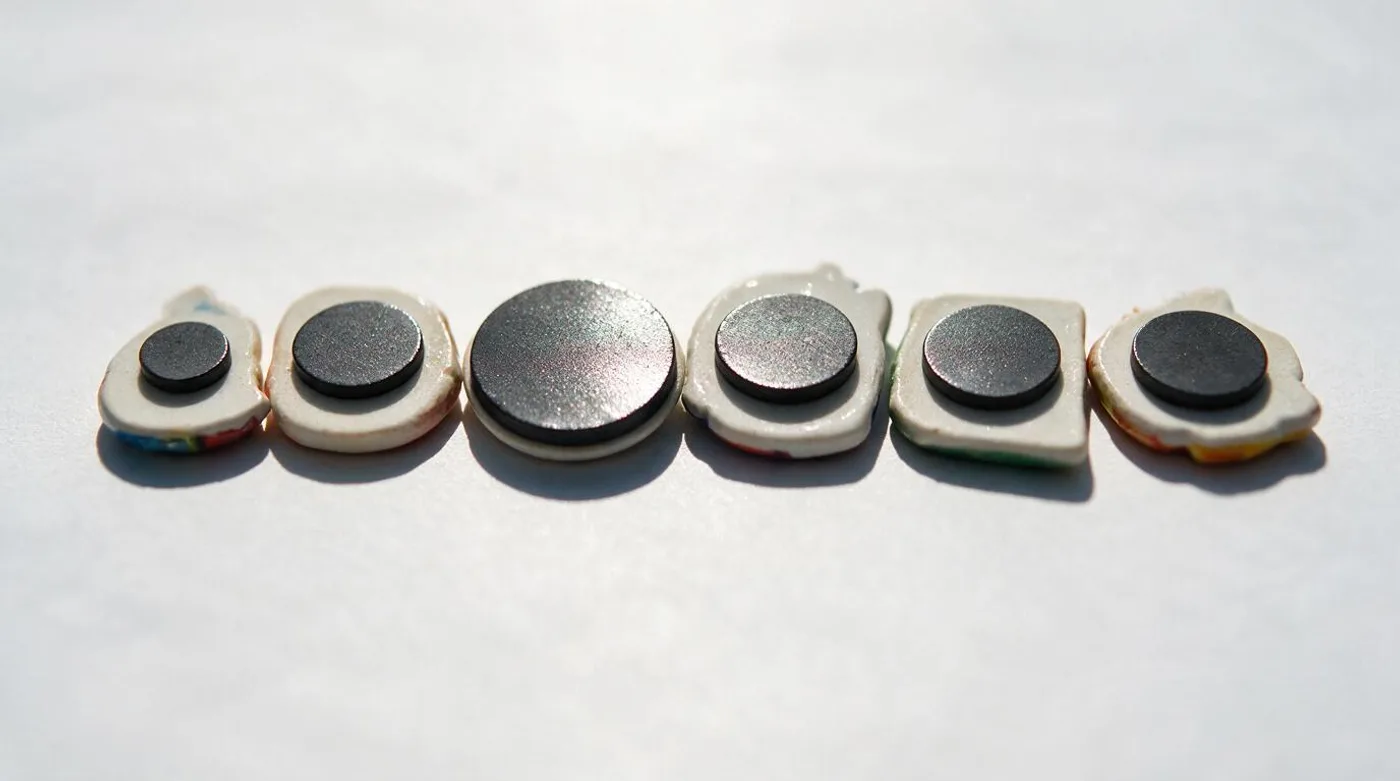
You buy the magnet in a gift shop for the picture on the front. You find out what you actually bought about a week later, when the little cast lighthouse has crept two centimeters down the door and parked itself on top of the pizza voucher. Nothing on the front of a souvenir magnet decides whether that happens. The back does.
This page compares magnet builds rather than retail brands, because published specifications from sellers in this category are not available. Souvenir stock is bought by the case from unnamed suppliers and resold with no listing at all, so there is nothing to compare brand against brand. What can be compared is construction: what the face is made of, what the magnet on the back is, and how much of it touches the door. The pull force figures below are manufacturer listings and the generic values in our facts sheet, not our own readings.
The disc on the back is the product
| Build | Backing | On bare steel | On a painted door | Usual failure |
|---|---|---|---|---|
| Resin dome | 20 x 3 mm ferrite disc | 500 g | about 350 g | Dome yellows in sunlight |
| Cast polyresin | 20 x 3 mm ferrite disc | 500 g | about 350 g | Weight levers the top edge off |
| Enamel on steel | 20 x 3 mm ferrite disc | 500 g | about 350 g | Disc glue lets go |
| Laser-cut wood | 0.75 mm flexible sheet | 110 g at 50 x 50 mm | about 77 g | Ply cups, sheet lifts |
| Printed tin | 0.5 mm flexible sheet | 60 g at 50 x 50 mm | about 42 g | Strip too small for the face |
The gap between the top three rows and the bottom two is the whole story. A 20 x 3 mm ferrite disc holds 500 g on a bare steel plate and about 350 g once paint gets in the way, since a painted door keeps only 60 to 80 percent of the plate figure. A flexible sheet is ferrite powder mixed into vinyl, with a surface field around 300 Gauss, and it needs a full 50 x 50 mm of contact to reach 110 g at 0.75 mm. Souvenirs almost never get a piece that big. They get a strip, or two small squares in the corners, and the figure drops with the area.
Weight, and the lever that comes with it
Souvenir magnets do not usually fall off. They rotate off, which looks like sliding. The mass of a cast lighthouse sits 20 or 30 mm out from the door, so gravity pulls down on a point well away from the steel and tries to turn the piece around its bottom edge. That turning force peels the top of the magnet away from the door a fraction of a millimeter. Since each tenth of a millimeter of gap costs a small disc roughly 10 percent of its pull, a magnet that is peeling has already lost most of its grip before anything visibly moves. Then it walks down in small steps, usually overnight when the compressor is doing the shaking.
Flat pieces do not have this problem, which is why a resin dome with the same 350 g disc behind it stays put when a cast figure of the same weight does not. Two discs set apart, top and bottom, fix it for wide pieces. One disc in the middle of a heavy 3D casting is the arrangement to avoid.
Published weights for souvenir magnets are effectively nonexistent, so the practical check is your hand. Hold the piece and ask whether it feels heavier than a small apple. If it does, a single 20 mm ferrite disc is doing more work than it should.
Why the resin dome build wins
A printed card under a domed epoxy lens on a 20 x 3 mm ferrite disc has the best ratio of grip to weight of anything sold in a gift shop. The face is card and a thin lens, so there is very little mass. The back is flat, so the disc lies square against the door with no gap. The dome itself is the only thing that dates: epoxy yellows under direct sunlight over years, so a magnet on a door that catches afternoon sun ages faster than the same magnet three meters away.
It also survives the kitchen. The lens seals the print, so grease wipes off with a cloth and the picture underneath is never touched. Compare that with an unsealed paper print on a sheet magnet, which absorbs cooking film and goes gray at the edges.
Cast polyresin, and the check before buying
Cast pieces are the reason this category has a reputation. They are the heaviest build, the mass is furthest from the door, and the disc is frequently set into a recess in the back with a dab of glue, sitting a millimeter proud or a millimeter deep. A recessed disc is worse than a proud one, because the recess adds gap, and gap is expensive.
Two checks take five seconds in the shop. Put the piece back down on the display fridge and give it a light push downwards, and see whether it slips or holds. Then run a thumb over the disc to feel whether it stands proud of the resin around it. If it sits below the surface, the piece will need the same disc to work through an extra half millimeter of air, and it will not.
Enamel, tin and wood over a few years
Vitreous enamel on a steel blank is the most durable face in the category. It does not fade, it does not yellow, and it cleans with anything. The steel blank carries weight for its size, so it wants a disc rather than sheet, and most of them have one.
Printed tin is the lightest face, and gets away with the least backing. It is also the build most likely to arrive with a token strip of 0.5 mm sheet in the middle of a 76 mm face, holding 42 g on a door with the rest of the back doing nothing. The tin itself is fine for decades if it stays dry, and rusts at the folded edge if it does not.
Laser-cut wood is the one that changes shape. Thin ply in a kitchen takes up moisture from steam and cups slightly, and a cupped back lifts the middle or the corners of a flexible sheet off the door. The magnet has not weakened. The contact has gone.
When the door is the problem
Sometimes the backing is fine and the door is not. Many stainless fridge doors are austenitic 304, whose face-centered cubic structure is stabilized by nickel and holds no magnetic domain at all, so a souvenir that gripped the old fridge slides straight down the new one. Ferritic 430 stainless is magnetic and looks identical from a meter away. The quick test is a 20 mm ferrite disc against the door, and the fuller explanation is in why magnets do not stick to stainless.
Even on a magnetic door, the finish matters. Paint contributes 0.1 to 0.2 mm, a textured or hammered finish contributes more, and a door that curves across its width means a flat 76 mm tin only touches along a line rather than over its whole back. On a curved door the disc-backed builds win by a wider margin than the table suggests, because a small disc sits flat against a curve while a large flexible sheet cannot. The souvenir magnet types page has the rest of the construction detail.
What to do with the ones you already own
A souvenir magnet with a failing sheet back is worth ten minutes of rescue. Peel off the old sheet, clean the residue, and glue a 20 x 3 mm ferrite disc to the back, or two discs for anything wider than about 60 mm. That takes the piece from roughly 42 g of hold to about 350 g, and the change is obvious the moment you put it back on the door.
For a collection large enough to cover a door, the limit stops being magnetism and becomes space. Usable door width on most models is 40 to 60 cm, which is fewer souvenirs than most people expect, and the overflow ends up on the side panel. Our travel collections page has more on arranging them, and photo against souvenir covers the choice between bringing back a magnet and printing your own photograph when you get home. The mechanics behind all of it are in how fridge magnets work.
Frequently asked
Why do my souvenir magnets slide down the fridge door?
Almost always the backing. A flexible sheet strip holds 60 g at 0.5 mm and 110 g at 0.75 mm over a full 50 by 50 mm, and souvenirs rarely get a piece that big. A 20 by 3 mm ferrite disc holds 500 g on steel.
How heavy can a souvenir magnet be?
A single 20 by 3 mm ferrite disc keeps about 350 g on a painted door. A cast piece that comes close to that will creep, because its weight sits away from the door and levers the top edge off.
Do souvenir magnets work on a stainless fridge?
Only if the door is ferritic 430 stainless. Austenitic 304 is not magnetic and nothing will stick to it. The painted mild steel side panel is usually magnetic even when the door is not.
Are two small discs better than one big one?
For a wide or heavy piece, yes. Two discs set apart resist the piece rotating off the door, which is the failure that makes cast souvenirs walk downwards overnight.