Best business card magnets for promotion
A 0.75 mm flexible sheet is the pick for promotional magnets. It holds 110 g at 50 by 50 mm against 60 g for 0.5 mm sheet, and the two published prices for printed sheet magnets are $1.20 and $2.50 each. Pressed builds grip far harder and cost more.
Where these figures come from
This comparison uses published product specifications. We have not handled or measured these products. Prices and availability can change; check the seller's listing before ordering. Method, equipment, and limits are on the how we test page.
Spec comparison
| Spec | Flexible sheet, 0.75 mm | Flexible sheet, 0.5 mm | Pressed magnet, steel shell |
|---|---|---|---|
| Material | Ferrite powder in vinyl, laminated print | Ferrite powder in vinyl, laminated print | Ferrite disc in a crimped steel shell, mylar cover |
| Listed thickness | 0.75 mm | 0.5 mm | 4 mm |
| Sizes | 2 x 3 in (51 x 76 mm), 3 x 3 in (76 x 76 mm), 4 x 6 in (102 x 152 mm) | 2 x 3 in (51 x 76 mm), 4 x 6 in (102 x 152 mm) | 2.25 in round (57 mm), 2.5 x 2.5 in square (64 mm) |
| Price per magnet | Not listed | Not listed | Not listed |
| Minimum order | Not listed | Not listed | Not listed |
| Shipping | Not listed | Not listed | Not listed |
| Pull force | Not yet measured | Not yet measured | Not yet measured |
| Measured thickness | Not yet measured | Not yet measured | Not yet measured |
| Print sharpness | Not yet measured | Not yet measured | Not yet measured |
| Corner lift after 30 days | Not yet measured | Not yet measured | Not yet measured |
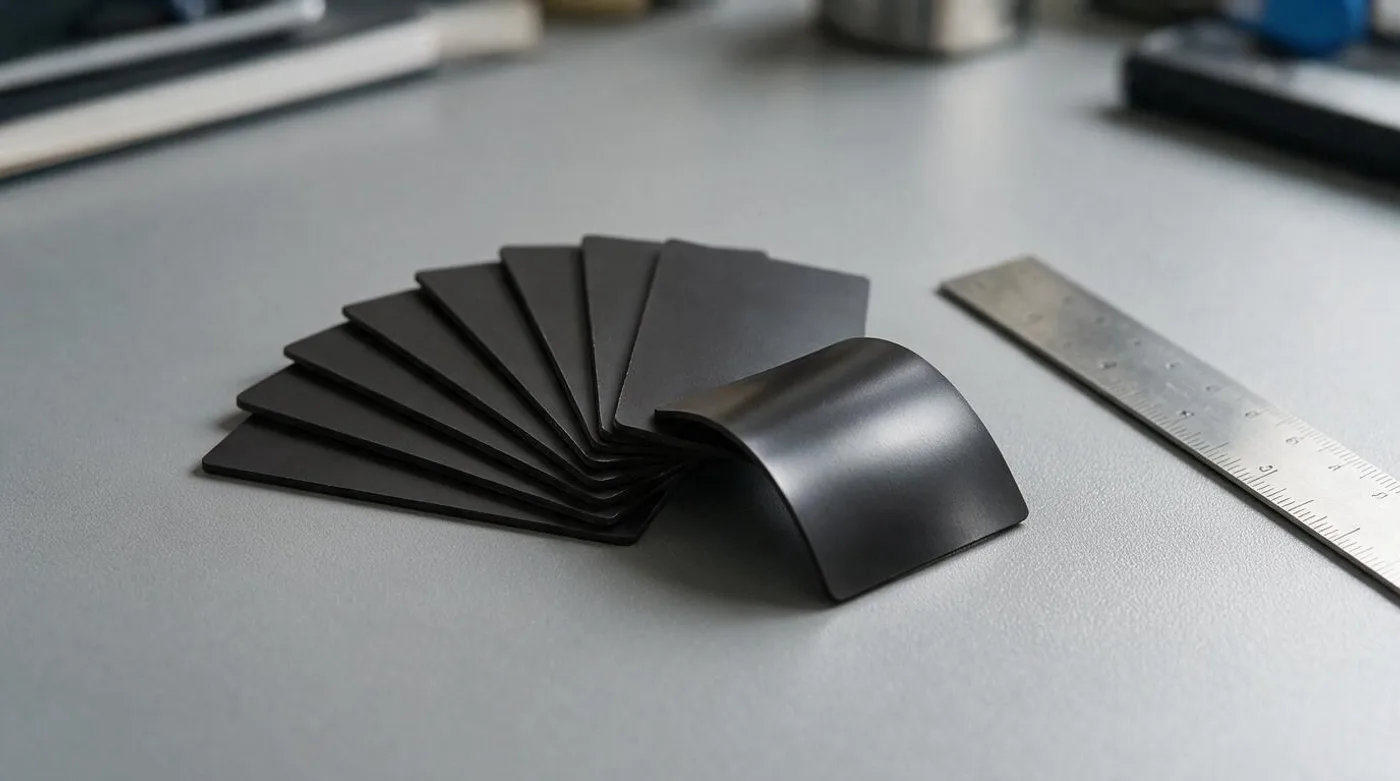
Work out the cost of a promotional magnet the way a plumber does, and the arithmetic gets short quickly. At $1.20 each, five hundred magnets is $600. At $2.50 each, the same five hundred is $1,250. The extra $650 buys 0.25 mm of thickness and nearly double the hold, and whether that is worth it comes down to one question nobody has published an answer to, which is how many of each end up still on a door a year later.
This page compares magnet builds rather than retail brands, because published specifications from sellers in this category are not available. Promotional printers list a price and a size and stop, and thickness, magnetic grade and print process are usually absent. Those two prices above are the only published per-unit figures we are willing to quote, and everything else here is a build specification or a generic pull force value from our facts sheet. We have measured none of it.
What each build holds
| Build | Face size | On bare steel | On a painted door | Thickness |
|---|---|---|---|---|
| Flexible sheet, 0.5 mm | 50 x 50 mm | 60 g | about 42 g | 0.5 mm |
| Flexible sheet, 0.75 mm | 50 x 50 mm | 110 g | about 77 g | 0.75 mm |
| Pressed magnet | 57 mm round or 64 mm square | not published | not published | about 4 mm |
Flexible sheet is ferrite powder mixed into vinyl, with a surface field of about 300 Gauss. It holds by area, so the numbers above scale with the face: a 2 x 3 inch card at 51 x 76 mm covers more than the 50 x 50 mm square in the table and holds proportionally more, while a slim bookmark shape holds less. Going from 0.5 mm to 0.75 mm adds 50 g at the same footprint, an increase of over 80 percent for half a sheet of paper's worth of extra thickness. That is a bigger jump than the same step gives on a rigid disc, where doubling thickness adds 40 to 70 percent.
The pressed build is a different animal, a flat ferrite magnet in a crimped steel shell with the print under a clear mylar cover, about 4 mm thick overall. Its two empty cells are empty because no seller publishes a pull force for a pressed magnet and nothing has been on a gauge here. It has a great deal more grip than a 0.75 mm sheet of similar face size, which follows from the ferrite disc behind the shell against a third of a millimeter of powder in vinyl, and it is the only build here that survives being knocked off a door onto a tile floor without a mark. The full construction comparison sits in magnetic sheet against pressed.
Cost per unit and the minimum order
The published prices we can quote are $1.20 each for a 0.5 mm printed sheet with a minimum order of 25, and $2.50 each for a 0.75 mm printed sheet with a minimum of 1. Neither is a bulk price. What a run of 1,000 costs is not published anywhere we can cite, and printers quote it individually, so treat those two figures as the ceiling rather than the rate.
The minimum order matters more than it looks for a small business. A minimum of 1 lets you order a single magnet, put it on your own fridge for a fortnight and see how the print survives a kitchen before committing to the run. A minimum of 25 is still cheap enough to use as a sample batch. Ordering 1,000 of anything without holding one first is how a business ends up with a box of magnets that curl at the corner. We work through the volume question in how many to order.
Print quality on each surface
A print on flexible sheet is laminated, which puts a thin clear film over the ink. Laminate is what stands between the ink and a kitchen, so it decides how the magnet looks after a year of steam, splashes and being wiped with whatever cloth is nearest. Solid dark blocks show wear first, because a scratch in a laminate over a dark field catches the light. Fine reversed-out type under 7 point is the other thing that suffers, since the laminate diffuses the edge slightly.
The pressed build puts the print under mylar in a steel shell, and the crimped rim protects the edge where laminate normally fails. Nothing touches the print at all. For a magnet carrying a phone number that has to stay readable for the decade we estimate that build gives it, that construction is the one that does it, at a thickness and a cost that make sense only for a smaller, more deliberate handout. The printing options themselves are covered in printing methods.
How long a customer keeps one
There is no published retention data for promotional magnets, and any figure quoted at you in a sales email is a guess dressed up in a percentage sign. What can be said is mechanical. A magnet leaves a door for three reasons: it slides, it curls, or it looks tired.
Sliding is a hold problem. A 0.5 mm sheet holding about 42 g on a painted door is fine on a flat, cool, freshly cleaned surface, and marginal on a curved door with a textured finish. The magnet does not fall off dramatically. It creeps, someone gets tired of straightening it, and it goes in a drawer. A 0.75 mm sheet at about 77 g has enough margin that the same door holds it still.
Curling is a laminate and vinyl problem, and it starts at a corner. Once a corner lifts, the gap under it grows, and gap is what kills a sheet magnet, since each tenth of a millimeter costs a small magnet roughly 10 percent of its pull. Looking tired is the print, and a laminated sheet in a working kitchen picks up a film of cooking grease that dulls the whole face. All three failures are slower on the thicker sheet, which is why it wins here despite costing more per unit.
Size, and how much door you are asking for
Usable door width on most fridges is 40 to 60 cm, and most of that is already spoken for by a school calendar and a child's drawing. A 2 by 3 inch magnet at 51 by 76 mm is legible at arm's length and takes a modest share. A 4 by 6 inch magnet at 102 by 152 mm is a poster, and it competes with things the household actually cares about, which is a fight the plumber loses.
The exception is a magnet that earns its space by being useful. A calendar strip, a bin collection schedule, a conversion chart or a list of emergency numbers gets kept for what it does rather than who printed it, and the phone number rides along at the bottom. On 0.75 mm sheet at that size the backing covers six times the area of the 50 x 50 mm square in the table, and it is being asked to hold nothing heavier than itself.
Posting them, and the doors that refuse them
A 0.75 mm sheet magnet goes in a standard envelope with a letter and adds almost nothing to the postage. A 4 mm pressed magnet does not, so it travels as a small packet, and on a mailing of five hundred that difference can exceed the difference in the magnets themselves. If the campaign is a mailshot rather than a counter handout, the thickness decides the budget before the print does.
The other thing worth knowing before a large run is where the magnet will land. Many stainless fridge doors are austenitic 304 stainless, which is not magnetic, so the magnet ends up on the painted mild steel side panel instead, turned side-on and read by nobody. Ferritic 430 stainless doors are magnetic. Neither the printer nor you can control which fridge a magnet meets, and it is one more argument for a build with margin to spare: a 0.75 mm sheet on a cool painted side panel still holds about 77 g, while the thinner sheet on the same panel is already close to its limit. The metallurgy behind it is in why magnets do not stick to stainless.
What to specify when you order
Four lines on a purchase order remove most of the risk. Ask for the sheet thickness in millimeters rather than a description, because "thick" and "premium" mean nothing. Ask whether the print is laminated and with what. Ask for the finished size in millimeters including any bleed trim. And ask for one sample before the run, on the same stock as the run.
The number to compare quotes on is cost per magnet delivered, not the price of the sheet, since postage on 4 mm pressed magnets and on 0.75 mm sheet are not in the same class. Our price per magnet page keeps the arithmetic, and promotional and business magnets covers the formats in more detail.
Frequently asked
How much does a promotional fridge magnet cost?
The two published prices we can point to are $1.20 each for a 0.5 mm printed sheet at a minimum order of 25, and $2.50 each for a 0.75 mm printed sheet at a minimum of 1. Bulk pricing at higher volumes is not published.
Is 0.75 mm sheet worth the extra over 0.5 mm?
It nearly doubles the hold, 110 g against 60 g at 50 by 50 mm, for 0.25 mm more thickness. On a curved or textured door that difference decides whether the magnet stays where the customer put it.
How big should a promotional magnet be?
A 2 by 3 inch face (51 by 76 mm) reads at arm's length and leaves room for other things. Usable door width on most models is only 40 to 60 cm, so a 4 by 6 inch magnet is asking for a large share of it.
Do pressed magnets make sense for a giveaway?
Only where the magnet has to survive years of handling. A pressed build puts the print under mylar and outpulls 0.75 mm sheet by a wide margin at the same face size, and that sheet holds 110 g. It is also about 4 mm thick and costs more to post.