Meal planning on the fridge door
A fridge door gives you 40 to 60 cm of usable width, which is two A4 sheets side by side with a 20 mm gap. Hold each sheet at four corners with 500 g ferrite disc magnets rather than 60 g sheet magnets, and clip receipts instead of laying a magnet over them.
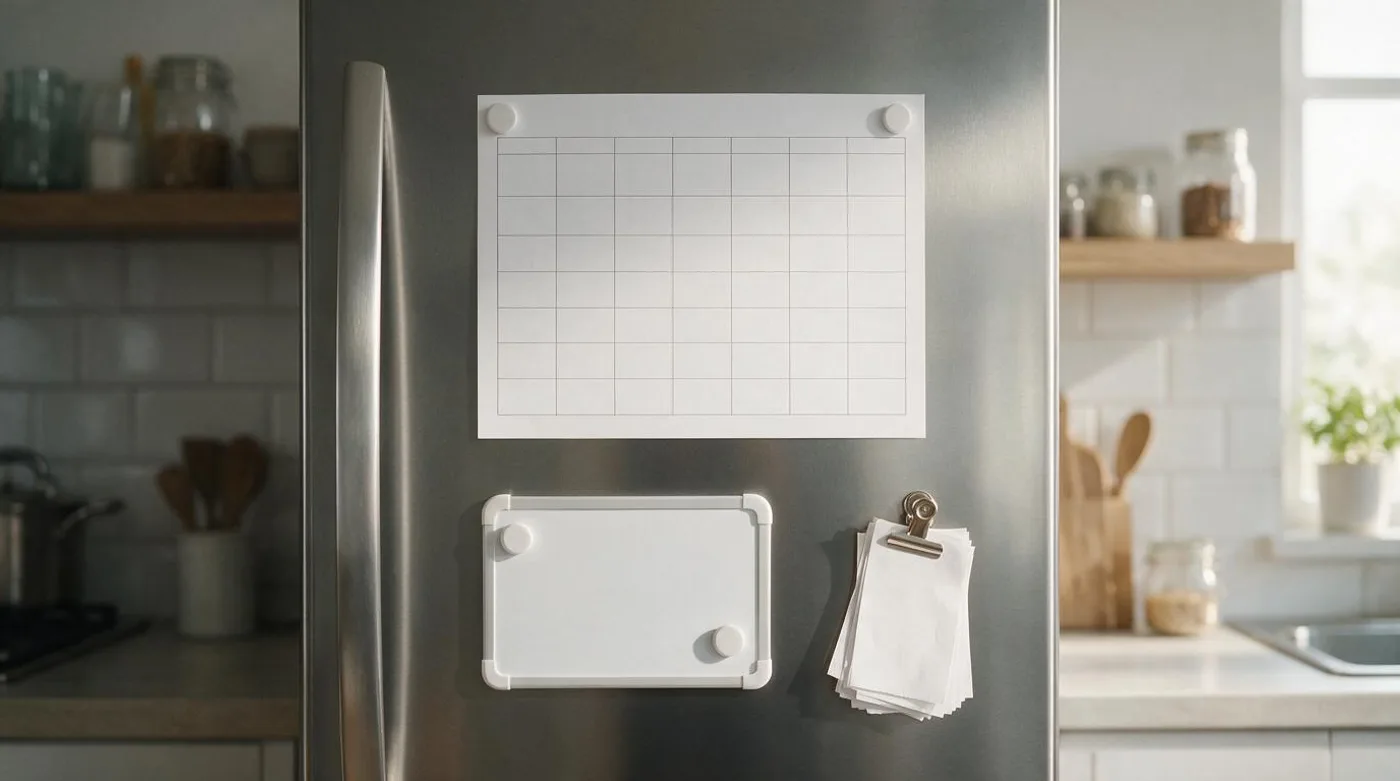
A meal plan works or fails on whether anybody reads it, and the fridge is the only surface in the house that gets opened by every member of the household several times a day. A plan on a phone requires somebody to decide to look at it. A plan on the door is read by accident, at the exact moment a person is standing in front of the ingredients, which is the only moment when reading it changes anything.
So the door is the right surface. The trouble is that a door is small, curved, and mostly occupied by whatever was already on it, and a full sheet of paper is larger than people remember.
Two sheets across, and no more
A4 is 210 by 297 mm. US letter is 216 by 279 mm. Either way, two sheets side by side in portrait with a 20 mm gap between them need 440 to 452 mm of width.
Usable door width on most models is 40 to 60 cm. A narrow door at 400 mm therefore takes one sheet with space beside it, and not two. A wide door at 600 mm takes two comfortably and has 150 mm left over, which is one column for a shopping list or a strip of clips. Three sheets across needs 670 mm at minimum and does not fit on any domestic fridge.
That constraint decides the whole layout before you choose a single magnet. If you want a week visible as seven days, it goes on one sheet in landscape or on two sheets, and each of the two carries three or four days. Splitting it across five small cards looks tidy on a desk and turns into confetti on a door.
Height is less constrained and more wasted. Three A4 sheets stacked in landscape come to 630 mm plus gaps, which is most of a door, but the bottom of that stack sits below waist height where nobody reads it while standing. Keep the planning material between shoulder and hip and use the low ground for things that only need to be findable.
What holds a full sheet without curling
Weight is not the constraint. Copy paper at 80 gsm gives an A4 sheet of about 5 g, and the weakest magnet in this whole category holds 60 g on a bare plate. Anything at all will carry the sheet.
The constraint is curl. A sheet held by two magnets at the top corners hangs fine for a day, then the bottom corners lift, because kitchens are humid and paper responds to humidity by not staying flat. A lifted corner catches every sleeve going past the fridge, and by the end of a fortnight the sheet has a permanent kink across it.
Four magnets, one per corner. That is the whole technique.
| Holding a single A4 or letter sheet | Hold on bare steel | On a painted door | Verdict |
|---|---|---|---|
| 0.5 mm flexible sheet magnet, 50 x 50 mm | 60 g | about 42 g | works flat, fails the moment anything goes under it |
| 0.75 mm flexible sheet magnet, 50 x 50 mm | 110 g | about 77 g | the same, with a margin |
| 20 x 3 mm ferrite disc | 500 g | about 350 g | the sensible default at each corner |
| 25 x 5 mm ferrite disc | 1,100 g | about 770 g | more than needed, and it protrudes |
| Pressed photo magnet, 64 mm square | not published | not published | works, and covers 64 mm of the sheet |
| 10 x 2 mm neodymium disc | 1,400 g | about 980 g | small footprint, holds the corner of anything |
The right-hand columns come from multiplying the bare plate figure by 0.7, which is the working correction for a painted door. The pressed row has no figures because nobody publishes a pull force for that build, though its ferrite magnet puts it well above either sheet row. The full list is in the magnet strength chart.
Two rows there deserve a note. The pressed photo magnet at 64 mm square has grip to spare and is also 64 mm of paper you can no longer read, which matters at the corner of a grid that has writing near the edge. The 10 x 2 mm neodymium disc is the opposite trade: it covers almost nothing, holds 980 g on paint, and is small enough to be swallowed, so it does not belong on a door at toddler height.
Magnetic dry-erase sheets, and why they hold
A flexible dry-erase sheet is a sheet magnet with a wipeable coating on the printed face, usually 0.5 to 0.75 mm thick, and it holds by the same mechanism as any other sheet magnet.
The reason a large one holds so much better than a small one is contact area. A 0.5 mm sheet holds 60 g per 50 x 50 mm square. An A4 sheet is 210 by 297 mm, which is about 25 of those squares, so the arithmetic gives roughly 1,500 g on a bare plate, and something like a kilogram once paint is in the way. That is why a big flexible planner sits on a door happily while a business card magnet made of exactly the same material slides off under a menu.
Which also tells you the failure mode. Only the part that touches counts. A trapped air bubble, a crease from shipping, or a door with enough curvature to lift the middle takes that area out of the sum, and a sheet that should hold a kilogram starts creeping. Roll a large sheet on from one edge rather than slapping it on flat, and store spares rolled with the magnetic face out, which is covered in how to store magnets.
The rigid alternative is a steel-backed board, which is a different object entirely. That board does not stick to anything; magnets stick to it. It wants a wall, and it gives you a surface that behaves like bare steel rather than like a painted door, so every pull figure on this site applies to it at full value. Whiteboard and office magnets covers the hardware that goes with one.
Clips for the things that are not sheets
Receipts, coupons, a torn-out recipe, the delivery note with the code on it. All of these are small, thick, curled, and impossible to hold flat, and the instinct is to put a magnet on top of the pile.
Do not put a magnet on top of the pile. Paper under a magnet is gap, and gap is expensive. Paint alone adds 0.1 to 0.2 mm and costs a magnet 20 to 40 percent of its pull. A wad of receipts adds a couple of millimeters, and a small magnet has nothing like that in reserve.
A clip magnet holds the paper in a jaw and keeps its own base flat on the steel with nothing between them, so a 20 x 3 mm ferrite base in a clip housing keeps its full 500 g on a plate, about 350 g on a painted door, whether the jaw is holding one receipt or thirty. One clip near the handle for things being used this week, one somewhere colder for things being kept, and the pile stops being a pile.
Coupons with expiry printed on them work better in a clip than under a magnet for a second reason. You have to open the clip to add anything, and opening it is when you notice what is in there.
When the door will not take a magnet
Austenitic stainless steel, grade 304, is not magnetic. Nickel stabilises a face-centered cubic structure that holds no magnetic domain, and no magnet on this site or anywhere else will stick to it. Ferritic stainless, grade 430, is magnetic and looks the same on a showroom floor. There is no way to tell by eye, only by trying, and why magnets do not stick to stainless explains the metallurgy behind that.
Three things usually work when the front does not.
The side panels on most models are painted mild steel even when the door is not magnetic, which is the cheapest fix and often the best one, since a side panel is a tall narrow strip that suits a weekly list better than a square door does. Check both sides, including the one against the cupboard.
A steel strip or a steel-backed board fixed to the wall beside the fridge gives you a proper bare steel surface, and bare steel is where the catalogue pull figures are true. A strip 500 mm long carries a week of sheets and takes up wall that was doing nothing.
Adhesive-backed steel sheet, sold in rolls, sticks to the fridge door or to a cupboard end and turns it magnetic. It is thin enough to look like part of the door and it will pull paint off if you ever remove it, so put it somewhere you have decided about. Whatever the surface, the pull figures behave as though it were bare steel plus the thickness of whatever coating is on top, which is the same arithmetic as sizes and thickness applies to everything else.
Frequently asked
What holds an A4 planner sheet flat on a fridge door?
Four magnets, one at each corner. Two at the top will hold the weight easily, but the bottom corners curl forward within a week in a kitchen. A 20 x 3 mm ferrite disc holds 500 g on a bare plate and about 350 g on paint, which is far more than a 5 g sheet needs.
Do magnetic dry-erase sheets stick well enough to use?
Yes, because pull scales with contact area. A flexible sheet magnet holds 60 g per 50 x 50 mm square at 0.5 mm thickness, and an A4 sheet is about 25 of those squares. What ruins it is an air bubble or a curved door, since only the touching part counts.
How many magnets do I need for a week's planning?
Four per sheet, plus one clip for receipts and one for coupons. A two sheet layout on a 40 to 60 cm door comes to eight corner magnets and two clips, which is a smaller number than most people buy.
My fridge door is not magnetic. What now?
Check the side panel, which on most models is painted mild steel even when the front is austenitic stainless. Failing that, a steel strip or a steel-backed board screwed to the wall next to the fridge gives you the surface the door refuses to be.