Check the fit before wrapping a set
Before giving photo magnets, check that the recipient has a surface where they stick and enough clear space for the set. Measure the finished outlines, include gaps, and protect each printed face during packing. The right quantity depends on the display area and the person, rather than a fixed gift size.
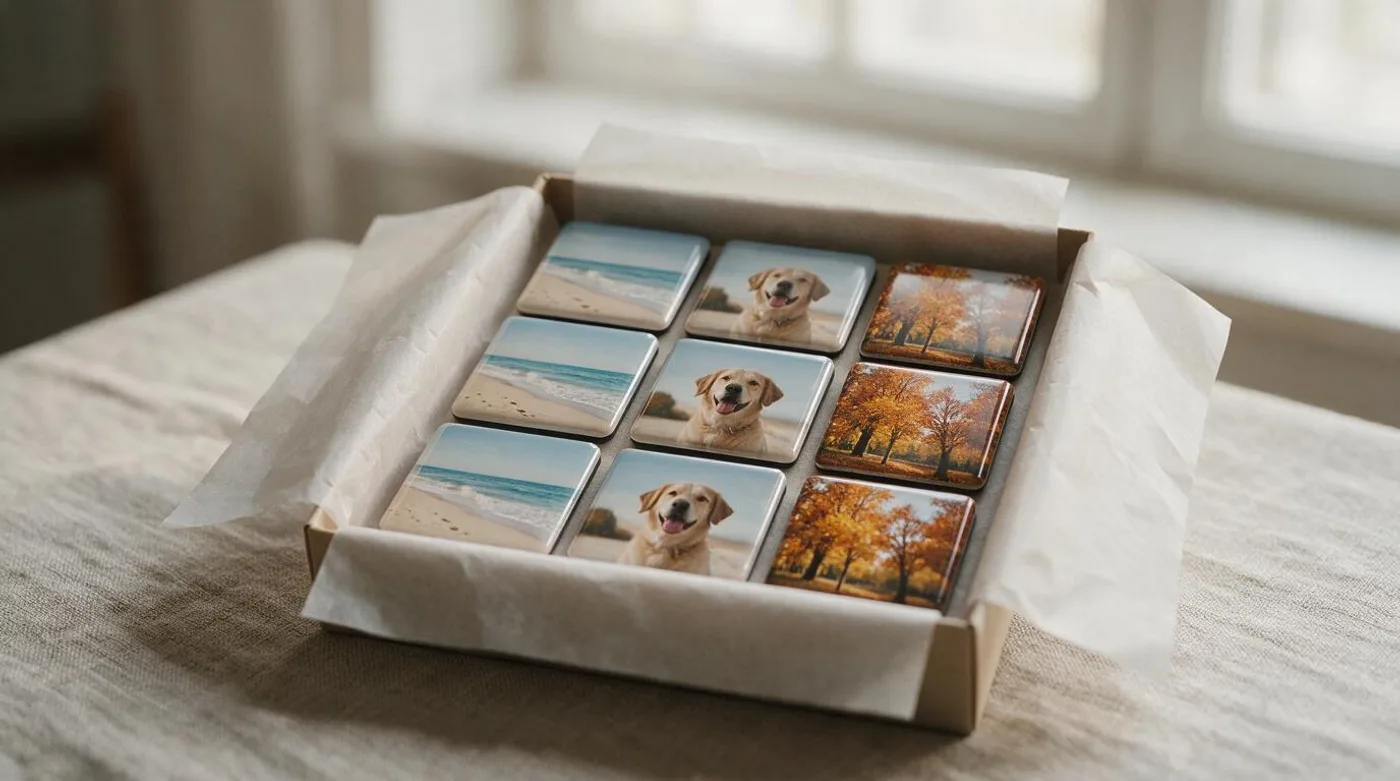
A set can fit neatly in a gift box and still be awkward on the recipient's fridge. Six pictures of the grandchildren need a place to go. If the door already carries school notices and a shopping list, a smaller set may get more use than a boxful. Check the surface and the space before deciding how many pieces to give.
Start with the display area
Ask whether the door holds a magnet, or whether the recipient uses a magnetic board. A photo of the kitchen can show clear space, but it cannot establish whether a particular panel attracts a magnet. If the gift is a surprise, someone in the household may be able to test it with an existing magnet. Ask about the front and the side separately. Leave room for handles, dispensers, notes, and the magnets already there.
Measure the clear rectangle that the recipient can spare, rather than the whole door. A 12 inch wide panel (304.8 mm) with a handle running through it does not offer 12 inches of display space. If the set will go above a dispenser, leave enough clearance to remove a magnet without catching its rim on the trim. Paper outlines let you try that movement before spending money.
Use the layout planner for the area you have measured. In this worked example, each square is 2.5 inches wide (63.5 mm) and the gaps are 0.4 inch (10.16 mm). Nine squares in three rows occupy an 8.3 x 8.3 inch block (210.82 x 210.82 mm). Six squares, placed three across and two down, occupy 8.3 x 5.4 inches (210.82 x 137.16 mm). The calculation uses the finished outline, including any rim. It does not include extra clearance around the outside of the group.
| Example arrangement | Overall width | Overall height |
|---|---|---|
| Three 2.5 inch squares in one row, 0.4 inch gaps | 8.3 inches | 2.5 inches |
| Six squares in three columns, 0.4 inch gaps | 8.3 inches | 5.4 inches |
| Nine squares in three columns, 0.4 inch gaps | 8.3 inches | 8.3 inches |
These are geometry examples, not recommended gift quantities. A mixed set needs a separate sketch because the planner uses one size at a time. Cut paper outlines when the arrangement includes both rectangles and circles. Label each outline with its photo so you can judge the group without confusing a pleasing layout with a useful selection.
Choose a set the recipient can use
Start with the pictures the recipient would want to see. For a grandparent, that might mean one current picture of each child, including children who live farther away. For someone who has moved, it could be the kitchen table at the old house and a familiar view from its window. A pet owner might want the dog asleep in its usual chair. The connection comes from those particular pictures; adding more copies of the same scene does not necessarily improve the gift.
Keep a list of the chosen files and the intended recipient. This helps when you are making several related sets. Two grandparents may want the same family photograph, while siblings may want different pictures from a shared trip. Check for accidental duplicates before uploading. If one picture belongs in every set, count those copies separately from the individual selections.
Open each crop at the proposed printed size. A full group photograph can look fine on a laptop while leaving every face tiny on a two-inch square. Try another frame or a tighter crop if the person receiving the gift would need to lean close to recognize it. Leave room around a face or handwritten date when the seller's template shows an edge that wraps or gets trimmed. The photo magnet construction guide explains why the finished outline and visible print area can differ.
Fresh Magnets' photo magnet collection provides a product reference for this planning. Its prepared catalogue lists 2 x 2 inch and 2.5 x 2.5 inch squares, a 2 x 3 inch rectangle, and 2.25 inch and 3 inch rounds. Those are fixed options, so make your paper outlines from the selected dimensions rather than assuming any custom size is available. The public store currently shows a coming-soon message; confirm ordering availability before attaching a date to the gift.
Count the magnets you intend to give before choosing a pack. If you need eight, a nine-pack leaves one extra; decide whether to keep it or give a ninth photograph. If you need two different sets of six, confirm that the order accepts the separate designs you want. The quantity guide covers the difference between a count of gifts, a count of magnets, and the packs purchased. Keep unwanted extras out of the wrapping rather than making the recipient find room for them.
Keep the faces apart in the parcel
Inspect the delivered set before wrapping it. Compare the pictures with your file list, check that every intended copy is there, and look at the faces and edges under ordinary room light. If a crop cuts off a name or someone else's magnet appears in the box, you want time to resolve that before the occasion. Keep the order details with your own records, especially when several sets have similar pictures.
Place a clean, soft separator between magnets. Stop the stack from shifting so a hard rim cannot rub against a printed face. A loose stack inside a large box still has room to move, even if the box itself is sturdy. Arrange the magnets in separate sleeves or compartments where possible, then cushion the group inside the outer packaging. Keep tape on the wrapping rather than on the printed faces.
A retail presentation box may need an outer parcel for posting. Choose that parcel for the packed weight and the shape of its contents. USPS's package preparation guidance recommends room for cushioning around the contents and a closed-box shake check. If you hear movement, add cushioning or improve the arrangement. The same guidance recommends an extra delivery and return address inside the package in case the outside label is damaged.
Wrap the gift after deciding how it will travel. For a hand-delivered set, a box that opens to show the pictures may be enough. For a posted gift, use the outer parcel to take handling knocks, with the presentation wrapping inside it. We have not tested a particular gift box or mailer for transit protection. Ask the carrier about the complete package if its contents are unusually rigid or dense.
Check dates against delivery
Work backward from the date you will hand over or mail the gift. An order sent to your home needs time for delivery, inspection, wrapping, and possibly a second postal journey. Record those stages separately. A seller's dispatch estimate describes when an order leaves the seller; it does not tell you when the recipient will open it.
Fresh Magnets states that US orders usually dispatch in 1 to 3 business days. Treat that as the seller's estimate and check the current terms when ordering. Add the delivery estimate for the actual destination and service, then allow your own time to inspect the set. A batch for relatives at several addresses also needs envelopes or boxes, labels, and postage for each onward shipment.
If the seller ships directly to the recipient, ask whether you can include a note and whether the package includes an invoice. If it ships to you first, label each finished gift with the recipient's name before sealing the outer parcel. Put your file list beside the boxes and tick off the pictures in each one. That final check catches a swapped set while you can still open the wrapping.
Frequently asked
Is one photo magnet enough for a gift?
It can be. A single picture may be all someone wants. There is no minimum count that makes a gift worthwhile.
Will a set fit on a stainless fridge?
Test the actual door or ask the recipient. Some fronts hold magnets and some do not. The side panel can behave differently.
How should I pack a set?
Separate the faces with clean protective material, keep the pieces from moving against each other, and use packaging suitable for their weight and rigidity.