Magnets at a desk and on office surfaces
Office surfaces vary far more than fridge doors do. Painted steel lockers and cabinets hold a 20 x 3 mm ferrite disc at 500 g. Aluminum, laminate and melamine whiteboards hold nothing at all. Test with a magnet before buying anything, and fix a steel strip where there is no steel.
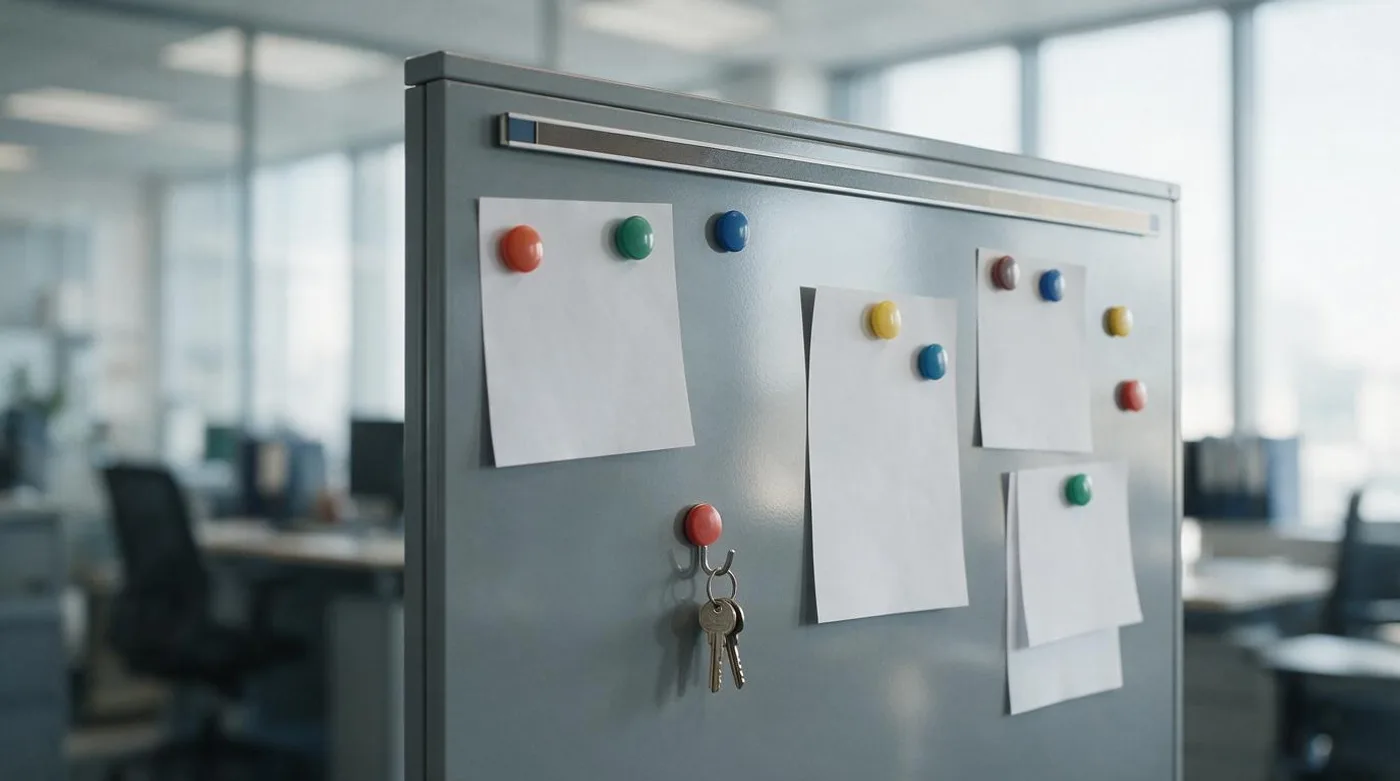
An office contains steel lockers, aluminum partitions, laminate desks, plasterboard, glass, two kinds of whiteboard that look identical from a meter away, and a fire door with a steel core under the veneer that turns out to be the best magnetic surface in the building. A domestic fridge is a known quantity by comparison. Its door is painted steel, ferritic stainless, or austenitic stainless, and that is the entire list.
Which is why the first job here is a survey rather than an order. Two filing cabinets can stand against the same wall, one holding a magnet firmly enough to carry a folder and the other refusing completely, with nothing on either of them to say why. That is painted mild steel against aluminum, and it stays invisible until you walk round the room with a magnet in your pocket.
What is actually steel
| Surface | Magnetic | What holds on it |
|---|---|---|
| Steel-backed whiteboard | yes, and the coating is thin | close to the bare plate figures: 500 g for a 20 x 3 mm ferrite disc |
| Melamine whiteboard on hardboard | no | nothing |
| Painted steel locker | yes | 500 g ferrite disc, about 350 g after paint |
| Painted mild steel filing cabinet | yes | the same |
| Aluminum cabinet or partition | no | nothing |
| Austenitic stainless, grade 304 | no | nothing |
| Ferritic stainless, grade 430 | yes | the full range, minus whatever the finish adds |
| Laminate or veneer desk | no | nothing, unless there is a steel frame under it |
| Steel-cored fire door | usually, under the veneer | depends entirely on how thick the veneer is |
The whiteboard row is the one that surprises people, because the two kinds are sold at similar prices and hang on the same wall brackets. A steel-backed board has a sheet of mild steel behind the writing surface, with a porcelain enamel or painted coating over it that is thinner than the paint on a fridge door. A melamine board is coated hardboard, and no magnet will ever touch metal through it.
That thin coating is worth something. Every pull figure published for a magnet is measured against a flat, bare steel plate, and a fridge door gives 60 to 80 percent of it back because of paint, texture and curvature. A good steel whiteboard is flat, uncurved, and thinly coated, so it keeps far more of the plate figure than any fridge does. It is the closest thing to laboratory conditions most people will ever stick a magnet to.
Stainless is the other trap, and it goes the same way it goes on a fridge. Grade 304 austenitic stainless is not magnetic, because nickel stabilises a face-centered cubic structure that holds no magnetic domain. Grade 430 ferritic stainless is magnetic and looks the same. Kitchen fittings, splashbacks and appliance panels in an office kitchen are a coin toss, and why magnets do not stick to stainless is the long version.
Aluminum fails for a different reason, which is worth knowing because it produces a party trick. Aluminum is not ferromagnetic, so nothing sticks. Drop a strong neodymium magnet down an aluminum tube, though, and it falls slowly, because the moving field induces eddy currents in the metal that push back. The magnet still will not stay put on the surface.
Holding a stack of documents
Paper is light and thick, which is the wrong combination for a magnet. Office copy paper at 80 gsm gives an A4 sheet of about 5 g, so fifty sheets weigh roughly 250 g, well inside what a 20 x 3 mm ferrite disc can carry at 500 g on a plate.
The trouble is that a ream of 500 sheets is about 50 mm thick, so those fifty sheets stand 5 mm proud of the board. A magnet laid on top of them is 5 mm away from the steel, and pull collapses over that distance: paint alone at 0.1 to 0.2 mm costs a small magnet 20 to 40 percent, and each further tenth of a millimeter takes roughly another 10 percent off the top. Five millimeters is not a penalty. It is the end of the conversation.
So the rule for anything thicker than a few sheets is that the paper must not go under the magnet. Either clip it, or hang it. A clip magnet keeps its base flat against the steel with nothing in between, which means a 20 x 3 mm ferrite base holds its 500 g whether the jaw contains one page or a hundred, and on a thinly coated whiteboard it holds close to the whole of it.
For a single sheet, four small magnets at the corners beat one large one in the middle. A sheet held in the middle bows out at every edge and catches on sleeves and on the board eraser.
Clips, hooks and pot magnets
| Job | Magnet | Hold on bare steel |
|---|---|---|
| Single sheets, notes, printed schedules | 20 x 3 mm ferrite disc in a plastic cap | 500 g |
| Thick documents, sample swatches, a set of drawings | clip magnet on a ferrite base | 500 g |
| Keys, lanyards, a light bag on a locker | 12 x 3 mm N42 disc, or a small hook magnet | 2,500 g |
| A coat, a tool roll, a heavy bag on a steel cabinet | 16 mm neodymium pot with hook | 6,000 g |
| Cable runs along a desk frame | 10 x 2 mm N42 disc in a cable clip | 1,400 g |
The pot magnet in the fourth row is the one people underuse. A neodymium disc set into a steel cup holds roughly twice what the bare disc would, because the cup catches the flux that would otherwise loop out of the back of the magnet and drives all of it through the open face. At 16 mm it takes 6,000 g on a bare plate and about 4,200 g through paint, which will hang a coat and a bag off the end of a steel cabinet with room to spare. Load it hanging straight down and give yourself margin, because a hook that creeps takes the coat with it. Neodymium fridge magnets covers the pot construction in detail.
Neodymium at a desk needs two cautions attached. It is brittle under its nickel plating and chips when two discs are allowed to snap together across a gap, so slide them apart sideways rather than pulling them straight off each other. And a bank card, a hotel key card or an old access badge with a magnetic stripe will be wiped by contact with a strong disc, which is a real hazard in a drawer where badges and magnets both live.
There is a third caution that applies specifically to offices with children visiting or with anyone who fiddles. Small high-powered magnets are a swallowing hazard, and two of them swallowed together can pinch the bowel wall between them. Loose neodymium discs belong in a labeled box, not in a pen pot.
Color coding that people will actually follow
Colored magnets solve a real problem on a shared board, which is that a board covered in identical black clips carries no information until you read every card on it.
Keep the scheme to four colors or fewer. Five is where people stop remembering which is which and start reading the cards again, at which point the colors have cost you money and gained you nothing. Two colors used consistently beat six used approximately.
Code by state rather than by owner. States are stable and there are few of them: waiting, in progress, blocked, done. Owners change, and a board coded by person needs recolouring every time somebody joins or leaves. If the board is a rota rather than a workflow, code by day instead, which has the same property of never needing to change.
Colored caps also do a mechanical job. A 20 mm ferrite disc in a plastic cap is easier to lift off a flat board than a bare disc, which has no edge to get a fingernail under and gets prised off with a pen instead. Bare discs on a whiteboard also mark it over time, because ferrite is dark gray, brittle, and slightly abrasive.
Where there is no steel
A magnetic strip screwed or glued to the wall is the simplest fix, and the useful ones are steel strips that magnets stick to rather than magnetic strips that stick to something else. Half a meter above a desk carries a week of paper, and it puts the magnetic surface exactly where the aluminum partition refused to be.
Steel-backed boards do the same job with more area, and they behave like bare steel, so the catalogue figures apply at full value. Buy on the presence of steel rather than on the writing surface, since a board that takes magnets and a board that takes markers are two independent properties and plenty of boards have only one of them. Whiteboard and office magnets covers the hardware that pairs with either.
Adhesive-backed steel sheet in a roll turns a laminate desk end, a cupboard side, or the flat of a partition into a magnetic surface. It is thin enough to disappear under a coat of paint and aggressive enough to take laminate with it when removed, so put it somewhere permanent.
The last option is to stop fighting the surface. If everything within reach is aluminum and glass, a magnet is the wrong tool, and the honest answer is a pinboard or a rail. We would rather say that than sell you a stronger magnet for a wall that has no iron in it, because no magnet on the strength chart sticks to aluminum and none ever will.
Frequently asked
Why do magnets stick to one whiteboard and slide off another?
A steel-backed whiteboard has a sheet of mild steel behind the writing surface. A melamine board is a coated hardboard with no steel in it at all. They look identical from a meter away and cost roughly the same, so the only reliable test is a magnet.
Are filing cabinets magnetic?
Painted mild steel ones are. Aluminum ones are not, because aluminum is not ferromagnetic, and neither is austenitic stainless. Two cabinets standing side by side in the same office can differ, so try the door before you plan anything on it.
What holds a thick document on a whiteboard?
A clip magnet, because the paper sits in the jaw rather than under the magnet. A 20 x 3 mm ferrite base holds 500 g against bare steel, and a whiteboard's coating is thin, so it keeps far more of that figure than a painted fridge door would.
What is the strongest thing I can hang off a steel cabinet?
A pot magnet. A 16 mm neodymium pot with a hook holds 6,000 g on bare steel, roughly 4,200 g through paint. The steel cup around the magnet catches flux that would otherwise loop out the back, which roughly doubles the pull of the disc inside it.